
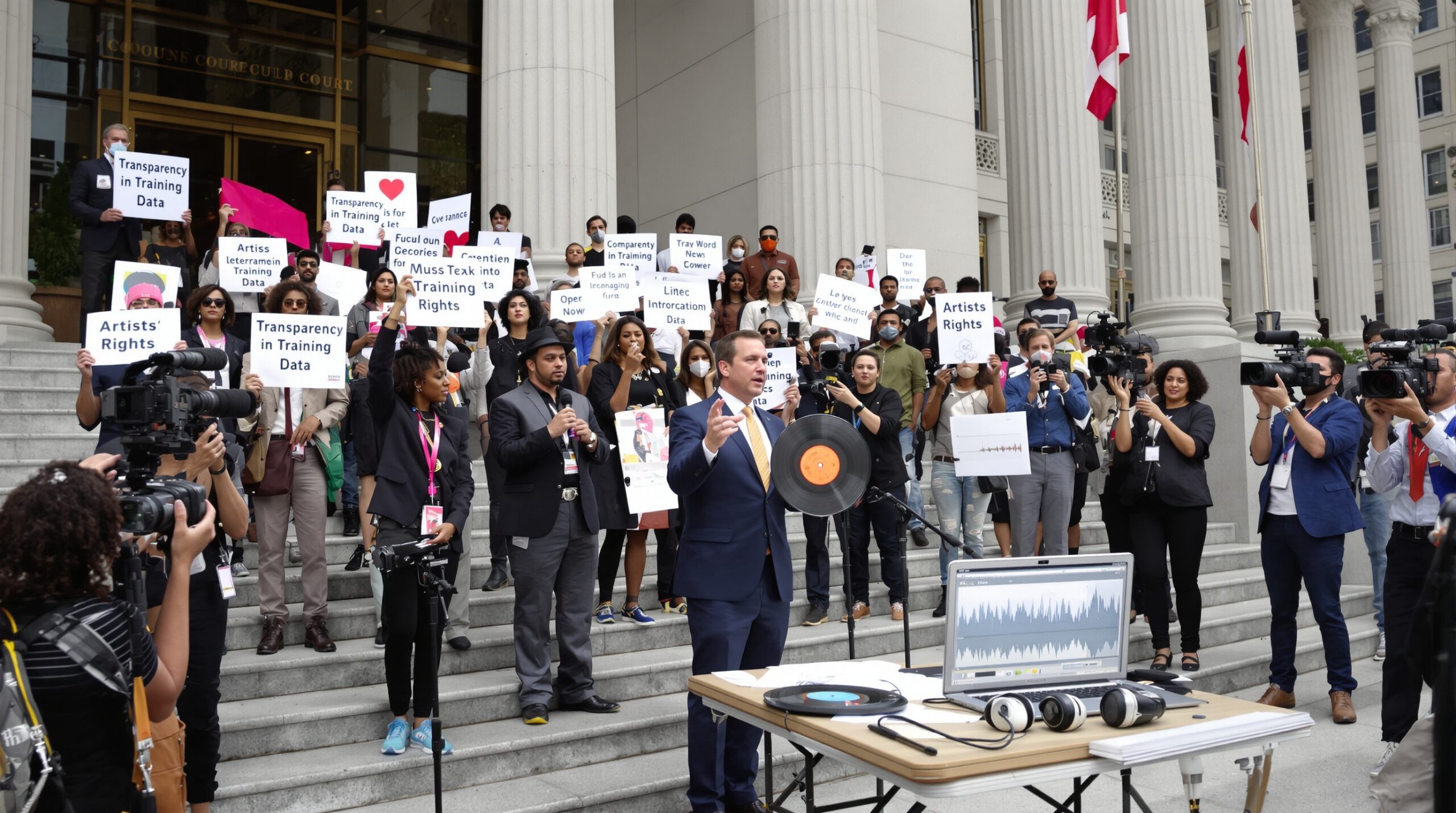
Artificial intelligence has entered the studio, and the law is catching up fast. Major record labels have sued leading music generators, alleging wholesale copying during training and infringing outputs. Artists are also demanding to know what recordings and compositions trained these systems. The dispute now tests copyright limits and sets the stage for industry rules.
The lawsuits challenge how models ingest massive libraries and how they respond to user prompts. They also press for detailed disclosure of training sources. As the cases progress, the outcomes could reshape music production, licensing, and innovation. The stakes for creators, startups, and platforms are enormous.
The Stakes for the Music Industry
Music companies see training without permission as uncompensated exploitation of years of investment. They argue models absorbed protected recordings and compositions without licenses. Artists worry about lost revenue, diluted brands, and voice impersonation harms. Labels also fear a flood of soundalike tracks crowding streaming services.
AI developers counter that training is transformative analysis, not market substitution. They stress user creativity and new opportunities for collaboration. They add that guardrails can reduce copying risks. Those competing narratives frame the legal battle now underway.
What the Lawsuits Argue
In June 2024, major labels sued Suno and Udio in U.S. federal courts. The complaints allege unauthorized copying of sound recordings during training and infringing outputs on demand. They also cite examples of tracks that closely resemble recognizable songs or styles. The labels seek damages and injunctions against continued infringement.
The Reproduction Right and Derivative Works
The claims focus on the reproduction right in training corpora. Copying recordings into datasets creates fixed duplicates, plaintiffs argue. They also raise derivative work theories for outputs that capture protected expression. Courts will assess whether outputs cross the line into substantial similarity.
Lyrics and Melodies as Separate Rights
Lyrics implicate literary rights, distinct from sound recording rights. Labels and publishers can coordinate, but their rights differ legally. Some AI cases also involve lyrics reproduction during prompting. That issue raises additional liability under composition copyrights.
Output Liability and Substantial Similarity
Not all AI outputs are infringing. Courts examine protectable elements, access, and substantial similarity. If a generated track reproduces melody or lyrics, risk increases. If it only evokes a general style, infringement becomes harder to prove. That boundary remains contested in music cases.
Transparency Demands and Training Data
Artists and labels want to see the training set’s sources. They also want disclosure of any licensed catalogs. Developers often cite confidentiality and security when resisting detailed lists. They add that web-scale datasets defy complete enumeration.
Still, pressure for transparency has grown beyond litigation. Policymakers now consider standardized disclosures for foundation models. These measures aim to clarify whether copyrighted material was included. They also help creators decide about opt-outs and licensing options.
EU AI Act and Text-and-Data Mining Opt-Outs
The EU AI Act requires a “sufficiently detailed” summary of copyrighted training data. Providers must respect text-and-data mining opt-outs under EU law. Rightsholders can reserve rights through machine-readable notices. Those rules now influence global compliance plans for music models.
United States Landscape and DMCA Limits
U.S. law lacks a general training transparency mandate. The DMCA targets platform takedowns, not model training disclosures. Fair use analysis remains case specific and fact intensive. Congress has floated proposals on AI transparency and voice cloning. None have passed as comprehensive federal statutes yet.
Dataset Audits and Model Cards
Some researchers propose independent dataset audits under confidentiality. They also recommend model cards documenting sources, licenses, and risks. These tools can show compliance with opt-outs and agreements. They further support provenance tracking across training, fine-tuning, and outputs.
Voice Cloning and Publicity Rights
AI vocals that mimic recognizable singers raise separate concerns. Right of publicity laws can protect names, images, and voices. States vary on scope, defenses, and post-mortem duration. Tennessee updated its law in 2024 to address voice cloning. New York expanded post-mortem rights in 2021.
Proposed federal bills would target deceptive AI impersonations. Drafts have considered consent requirements and narrow exceptions. Enforcement details and safe harbors remain under debate. These rules would complement, not replace, copyright protections. The combined frameworks could deter unauthorized vocal replicas.
Potential Regulatory Responses
Regulators are studying collective solutions for training access. Collective licensing could cover recordings and compositions at scale. Governance would need accurate reporting and equitable distribution. Transparency becomes critical for any blanket arrangement to work. That is where registries and audits could help.
Collective Licensing and Registries
Music already uses collective systems for public performance and mechanicals. Training might follow similar centralized models, with adaptations. Registries could track catalog participation and opt-outs. Rate setting could consider usage, outputs, and market impact. Oversight would need to balance access with fair payment.
Watermarking and Provenance Standards
Technical standards can help verify origins and uses. Content provenance frameworks like C2PA attach signed metadata. Audio fingerprinting can flag matches to existing recordings. Watermarking research aims to identify AI-generated audio reliably. None offer perfect protection, but layered tools improve accountability.
Technical Realities of Training
Music models learn statistical patterns from vast corpora. They capture timbre, rhythm, harmony, and production cues. Memorization risk rises with duplicated or overrepresented tracks. Fine-tuning on narrow datasets increases regurgitation chances. Developers can mitigate risks with deduplication and regularization techniques.
Embeddings, Memorization, and Regurgitation
Embeddings compress audio features into learned vectors. Those vectors enable style synthesis and conditional generation. However, they can memorize rare sequences, including melodies. Stress tests can detect verbatim or near-verbatim reproduction. Red-teaming and filters can reduce problematic outputs.
Synthetic Data and Contamination
Models can train on synthetic mixes to diversify features. Yet synthetic data can carry traces of originals. That contamination complicates provenance and licensing analysis. It also challenges claims of clean-room development. Careful dataset governance remains essential for compliance.
Precedents and Possible Outcomes
Courts will weigh fair use defences for training copies. They will also scrutinize output similarity on the facts. Prior cases offer partial guidance, not firm answers. Courts have allowed some large-scale copying for indexing and search. Yet they have curbed uses that replicate protected expression.
Fair Use Analysis After Recent Supreme Court Guidance
Transformative purpose remains important but not decisive. Courts consider the use’s purpose, nature, amount, and market harm. Commercial uses face higher scrutiny when markets overlap. Music outputs that displace licensed alternatives raise concerns. Evidence on actual and potential markets will matter greatly.
Remedies, Damages, and Injunctions
If liability is found, remedies could be significant. Plaintiffs may seek statutory or actual damages for copying. Injunctions could restrict training data, features, or prompts. Courts might also require enhanced filtering and disclosures. Settlements could bundle licenses and transparency commitments.
Business Models and Market Impacts
Startups face legal uncertainty that complicates fundraising and partnerships. Labels may negotiate portfolio licenses with usage reporting. Artists could receive new revenue streams for training participation. Platforms might add verified AI music lanes and disclosures. Consumers could gain clearer labeling of AI-assisted tracks.
Global divergence will shape strategic choices for developers. The EU’s transparency rules may drive earlier compliance investments. The U.S. focus on litigation raises settlement pressure. Companies may localize models or features by jurisdiction. Harmonization efforts could reduce fragmentation over time.
What to Watch Next
Key hearings and motions will clarify core legal questions. Discovery fights over datasets and logs will test transparency claims. Courts may evaluate model behavior through expert demonstrations. Early rulings could spur settlements or new claims. Parallel policy debates will continue shaping expectations and norms.
Artists and labels want enforceable visibility into training sources. Developers seek workable disclosure frameworks with trade secret protection. Standards bodies and collectives can bridge those goals. The emerging balance will influence music’s creative future. The landmark case now underway will guide that balance decisively.