

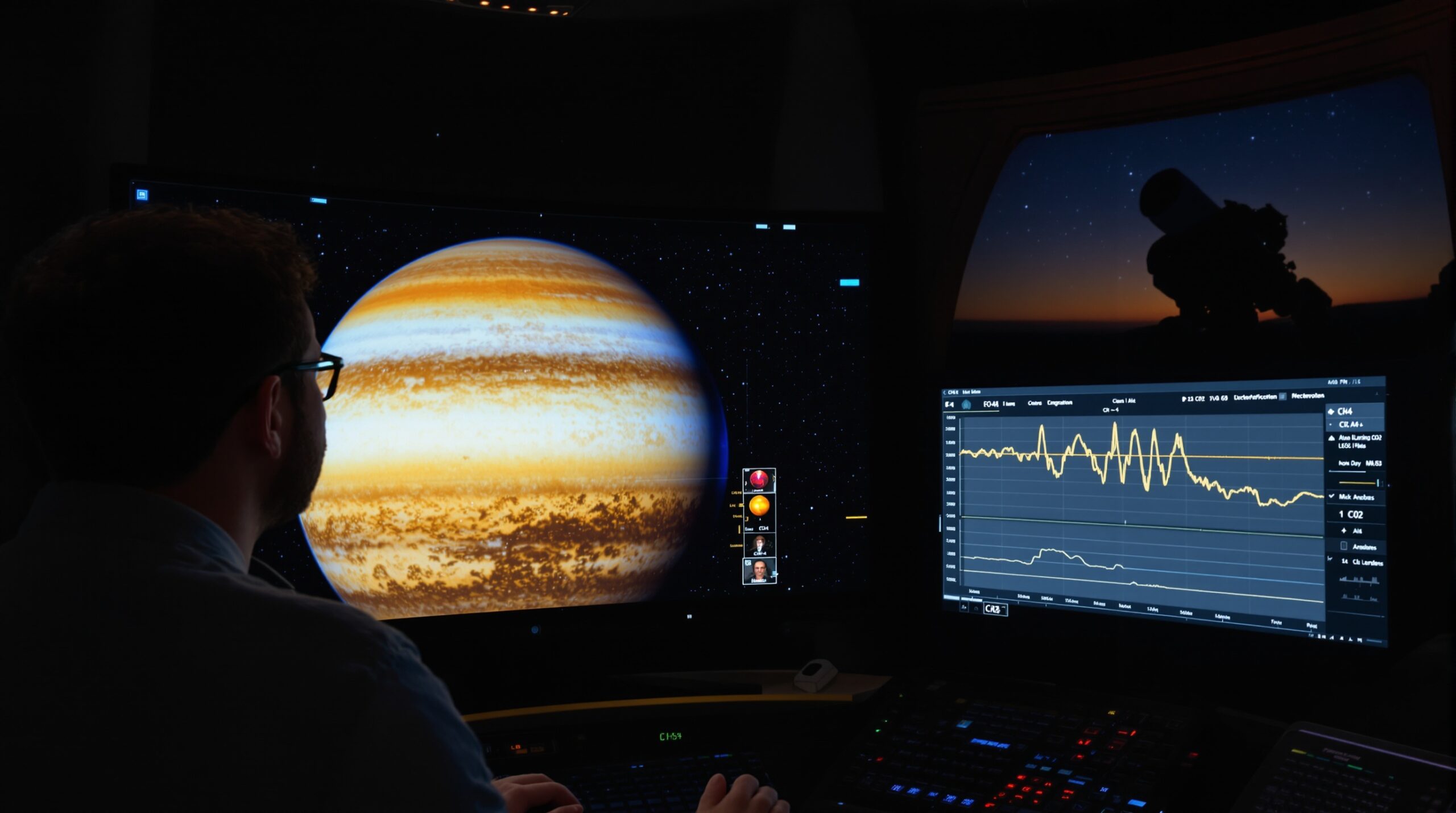
Methane and Carbon Dioxide Detected on a Nearby Exoplanet Hint at Complex Chemistry
Astronomers using the James Webb Space Telescope have detected methane and carbon dioxide on a nearby exoplanet. The world, known as K2-18 b, orbits a cool dwarf star about 120 light-years away. Its atmosphere shows clear fingerprints of carbon-bearing molecules, revealing rich chemical processes. These findings suggest complex atmospheric chemistry and possible conditions friendly to life. They also raise careful questions about biosignatures and planetary evolution. The discovery marks a significant step for comparative planetology.
How Astronomers Spotted Atmospheric Molecules
Scientists observed the planet as it crossed its star, a technique called transit spectroscopy. During transits, starlight filters through the atmosphere and picks up molecular signatures. Methane imprints features near 3.3 microns, while carbon dioxide marks a strong band near 4.3 microns. Webb’s instruments captured these wavelengths with unprecedented sensitivity and stability. Researchers applied retrieval models to match the spectra with expected molecular patterns. The best fits required methane and carbon dioxide to explain the observed features.
The World Under Investigation
K2-18 b is a sub-Neptune, between Earth and Neptune in size and mass. It likely possesses a deep, hydrogen-rich atmosphere above a volatile-rich interior. The planet orbits within its star’s temperate zone, receiving moderate stellar energy. That placement makes temperate chemistry more likely than on many hot Jupiters. However, temperate does not guarantee Earth-like surfaces or oceans. The planet could host high-pressure ices or a global ocean beneath dense gas layers.
Why Methane and Carbon Dioxide Matter
Methane and carbon dioxide sit at opposite ends of a redox spectrum. Together, they can indicate active cycles linking carbon, hydrogen, and oxygen. Some mixtures can arise from life, but abiotic chemistry can also produce them. Their relative abundances and context therefore matter greatly for interpretation. Disequilibrium can hint at sources and sinks operating simultaneously. This detection opens the door to such nuanced assessments on temperate exoplanets.
Abiotic Sources and False Positives
Abiotic processes can generate methane and carbon dioxide without life. Volcanic outgassing can supply methane on worlds with reducing interiors. Water-rock reactions, including serpentinization, can also release methane into hydrogen-rich atmospheres. Photochemistry can oxidize carbon and build carbon dioxide over time. Impacts and delivery by comets may further alter atmospheric inventories. Therefore, methane and carbon dioxide alone do not confirm biology.
Reading Clues from Ratios and Context
Scientists focus on ratios, not single detections, to read atmospheric chemistry. The methane to carbon dioxide ratio tracks redox balance and possible disequilibrium. The carbon-to-oxygen ratio constrains formation history and likely condensates. Metallicity reveals enrichment relative to the host star and points to accretion pathways. Retrieved temperatures and pressure levels help determine where these molecules reside. Contextual information narrows possibilities for chemistry, climate, and any biological influence.
Clouds, Hazes, and Pressure Levels
Clouds and hazes complicate spectral interpretation by muting molecular features. Aerosols can flatten parts of the spectrum and hide deeper layers. Retrievals account for scattering, particle sizes, and cloud-top pressures. Correct cloud modeling avoids overestimating or underestimating molecule abundances. K2-18 b likely hosts hazes or clouds that shape the transmission signal. Constraining aerosols will sharpen abundance estimates and chemistry inferences.
Instrumental Confidence and Robust Detections
Webb provides high precision, but scientists still test for systematics carefully. Teams cross-check results across instruments and independent pipelines. They examine stellar activity, including starspots and faculae, that can contaminate spectra. Statistical retrievals compare models and quantify detection significance using rigorous metrics. Methane and carbon dioxide achieve strong confidence against alternative explanations. Continued observations will strengthen constraints and refine chemical abundances.
Could Life Be Responsible?
Life remains one possible contributor to methane under certain conditions. On Earth, microbes produce methane in varied environments, from wetlands to sediments. However, K2-18 b presents a very different planetary environment. It likely lacks a rocky surface exposed to a thin atmosphere. High pressures and deep oceans could separate any biosphere from the upper atmosphere. Hence, biosignature claims require multiple lines of evidence and careful modeling.
What Additional Evidence Would Help
Scientists aim to measure complementary gases and their variability over time. Water vapor would clarify hydrogen content and vertical mixing. Carbon monoxide would trace photochemical pathways and help balance the carbon budget. Ammonia or sulfur gases could further illuminate redox conditions and interior outgassing. Thermal phase curves could reveal heat transport and dayside chemistry. Secondary eclipses could directly probe emission from deeper, warmer layers.
Upcoming Observations and Missions
Webb will continue observing K2-18 b with additional modes and epochs. Mid-infrared spectra can test for carbon monoxide and refine carbon dioxide constraints. Ground-based high-resolution spectroscopy can cross-correlate methane features against telluric lines. Instruments like CRIRES+ and IGRINS can provide velocity-resolved detections. The European ARIEL mission will survey exoplanet atmospheres statistically. Next-generation telescopes will target smaller, cooler worlds with greater sensitivity.
Modeling the Chemistry Behind the Signals
Researchers run photochemical and climate models to match the observed spectra. Ultraviolet radiation drives methane destruction and carbon buildup in upper layers. Vertical mixing can replenish methane from deeper, warmer regions. The balance sets observable methane and carbon dioxide abundances. Model grids explore metallicity, carbon-to-oxygen ratio, and eddy diffusion coefficients. Best-fit models currently favor hydrogen-rich, metal-enriched atmospheres featuring active photochemistry.
Implications for Sub-Neptune Worlds
Sub-Neptunes are the most common planets in our galaxy, yet remain poorly understood. Many likely carry thick volatile envelopes that shape surface conditions. Detecting methane and carbon dioxide clarifies chemistry in these atmospheres. Such detections also reveal how planetary formation and migration sculpt compositions. Understanding these worlds will inform targets in future habitable planet searches. K2-18 b now serves as a crucial benchmark for this class.
Setting Expectations for Biosignature Searches
Biosignature assessments demand multiple gases in sustained disequilibrium. They also require environmental context that supports plausible biology. Observers must exclude abiotic production pathways using comprehensive modeling. Only then can scientists weigh biological interpretations responsibly. Methane and carbon dioxide help start that conversation without finishing it. The path forward emphasizes consistency, redundancy, and caution over sensational claims.
The Bottom Line
The detection of methane and carbon dioxide on K2-18 b is a milestone. It demonstrates Webb’s ability to probe temperate exoplanet atmospheres deeply. The chemistry appears complex, active, and potentially compatible with life-friendly processes. Yet abiotic explanations remain viable and must be tested rigorously. Future measurements will sharpen abundances, reveal additional species, and map atmospheric layers. Step by step, astronomers are turning intriguing hints into a coherent planetary story.
