

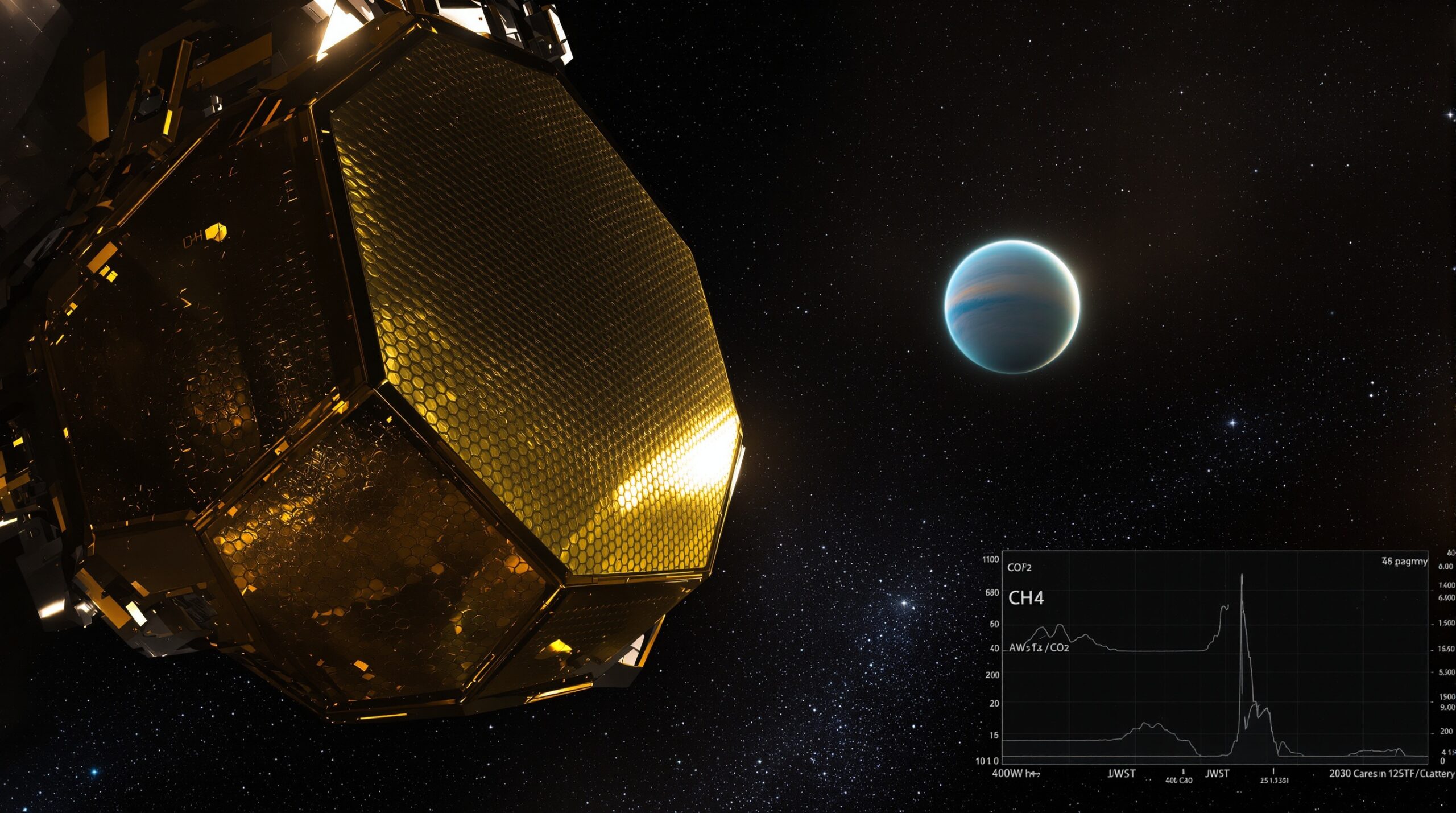
Astronomers using the James Webb Space Telescope have detected methane and carbon dioxide on K2-18 b. This intriguing world orbits within the habitable zone of a nearby red dwarf star. The measurements come from transit spectroscopy across infrared wavelengths. They reveal a carbon-bearing atmosphere with features shaped by hydrogen and possible water vapor. The results strengthen the case for a temperate, ocean-bearing “Hycean” world. Yet they also demand cautious interpretation and sustained follow-up observations.
What Webb observed in the planet’s atmosphere
Webb watched K2-18 b pass in front of its star multiple times. During each transit, starlight filtered through the planet’s atmospheric limb. Gases imprint spectral fingerprints that reveal their presence and abundance. Webb’s instruments sampled light from roughly 0.8 to 5 microns. The spectra show robust features of methane and carbon dioxide. Models also indicate a suppression of ammonia relative to expectations. Together, these patterns suggest a hydrogen-rich atmosphere with complex carbon chemistry.
Meet K2-18 b and its red dwarf star
K2-18 b orbits a cool red dwarf star in the constellation Leo. The system lies about 120 light-years from Earth. The planet is about 2.6 Earth radii and 8.6 Earth masses. It completes an orbit every 33 days within the star’s habitable zone. Earlier Hubble observations indicated water vapor in its atmosphere. Webb’s finer sensitivity now expands the atmospheric inventory. These measurements make K2-18 b a leading subject for habitability studies.
Why methane and carbon dioxide matter
Methane and carbon dioxide are key tracers of carbon chemistry in planetary atmospheres. Their relative amounts reflect temperature, metallicity, and photochemical processes. These gases also influence climate through greenhouse warming and radiative balance. On K2-18 b, their detection supports a hydrogen-dominated envelope. That envelope could overlay a deep water layer or ocean. Such a configuration is consistent with proposed Hycean world scenarios.
How astronomers extracted faint atmospheric signals
Transit spectroscopy compares a star’s light during and outside planetary transits. The difference isolates absorption from the planet’s thin atmospheric annulus. On K2-18 b, the signal is only a few parts per million. Webb’s stability enables precise measurements at that scale. Researchers then fit atmospheric models to the observed spectra. Retrievals explore temperature profiles, cloud properties, and chemical abundances. The broad wavelength coverage reduces degeneracies and strengthens gas identifications.
Habitability claims require careful, evidence-based caution
Methane and carbon dioxide do not by themselves indicate biology. Geological and photochemical processes can produce both gases abiotically. A hydrogen-rich atmosphere also alters expected biosignature chemistry. Scientists therefore look for atmospheric disequilibrium across multiple gases. Earlier hints of dimethyl sulfide remain unconfirmed and highly tentative. Future observations must test such claims with independent, higher signal detections.
What Hycean worlds could mean for life’s potential
Hycean worlds are proposed ocean-bearing planets with hydrogen envelopes. Their surfaces may host liquid water under moderate temperatures and pressures. Thick atmospheres could shield oceans from stellar radiation. Such worlds might be more common than Earth analogs around small stars. K2-18 b currently represents the most promising Hycean candidate. Confirming this scenario would expand the search space for habitable environments.
Follow-up observations are already underway
Webb will continue observing K2-18 b in future cycles. Additional transits will improve signal-to-noise and constrain clouds and hazes. Mid-infrared spectra from MIRI can refine carbon dioxide and methane abundances. Observations may also strengthen water vapor detections and temperature estimates. Ground-based facilities will monitor stellar activity and refine ephemerides. Coordinated efforts will reduce uncertainties and test alternative atmospheric models.
A closer look at the host star’s influence
Red dwarfs can exhibit flares and star spots that affect transit spectra. Stellar contamination can mimic or dilute atmospheric signals. Teams therefore model stellar variability alongside planetary spectra. Multi-epoch observations help separate stellar and planetary effects. Photometric monitoring tracks spot evolution and flare rates. Together, these steps build confidence in atmospheric inferences.
What these detections imply for exoplanet demographics
Sub-Neptunes like K2-18 b are common in our galaxy. Yet their atmospheres have remained hard to characterize. Webb’s detections show that temperate sub-Neptunes can host detectable carbon chemistry. This expands atmospheric studies beyond hot Jupiters and warm Neptunes. Comparative surveys will chart how chemistry varies with temperature and metallicity. That knowledge will guide future target selection and mission design.
Limits, uncertainties, and the path to stronger conclusions
Atmospheric retrievals depend on model assumptions and priors. Cloud structure and particle size can shift inferred abundances. Photochemical pathways under hydrogen atmospheres introduce additional uncertainty. Instrument systematics also require careful calibration and validation. Independent teams reanalyzing the same data help verify results. More transits and longer wavelength coverage will narrow current error bars.
Why Webb is uniquely suited for this breakthrough
Webb delivers unparalleled stability and infrared sensitivity. Its instruments capture multiple molecular bands in a single visit. That coverage constrains temperatures, clouds, and abundances simultaneously. Space-based observations also avoid telluric interference from Earth’s atmosphere. The result is cleaner spectra with fewer confounding factors. These strengths enabled methane and carbon dioxide detections on a small, temperate world.
Key measurements and context
K2-18 b’s radius is about 2.6 times Earth’s radius. Its mass is approximately 8.6 Earth masses. The orbital period is roughly 33 days in the star’s temperate zone. The system sits around 120 light-years away in Leo. Webb saw methane and carbon dioxide absorption across near-infrared wavelengths. Ammonia appears depleted relative to expectations for a pure hydrogen-helium atmosphere.
What might confirm ocean conditions on K2-18 b
Scientists seek temperature-pressure profiles consistent with liquid water at depth. Strong water vapor features across multiple bands would support that picture. A muted spectrum could indicate high-altitude clouds or hazes. Mid-infrared continuum measurements can help break such degeneracies. Thermal emission observations during secondary eclipses could constrain energy balance. Together, these tests would assess Hycean ocean plausibility.
Broader significance for the search for life
These detections mark a turning point for temperate exoplanet atmospheres. Webb has unlocked a category once beyond our reach. The approach now scales to other nearby sub-Neptunes in habitable zones. Each new atmospheric spectrum will refine chemistry and climate theories. Over time, patterns of disequilibrium might reveal promising biosignature targets. Careful, cumulative evidence will be essential for any future life claims.
Collaboration, transparency, and community verification
Webb data are available to the global scientific community. Independent analyses test robustness and identify systematics. Cross-checks between instruments further validate molecular identifications. Open methods help resolve debates over modeling choices. This collaborative process accelerates understanding and reduces bias. Public engagement also strengthens support for sustained exoplanet exploration.
Conclusion: A promising world under careful scrutiny
The detection of methane and carbon dioxide on K2-18 b is a major milestone. It highlights Webb’s power to probe temperate exoplanet atmospheres. The findings support a hydrogen-rich envelope with active carbon chemistry. A Hycean ocean remains plausible but unproven. Upcoming observations will refine abundances, clouds, and temperature structures. With patience and precision, astronomers will clarify this world’s true habitability potential.
