

Tantalizing Signs of an Exomoon Atmosphere Emerge from JWST Spectral Data
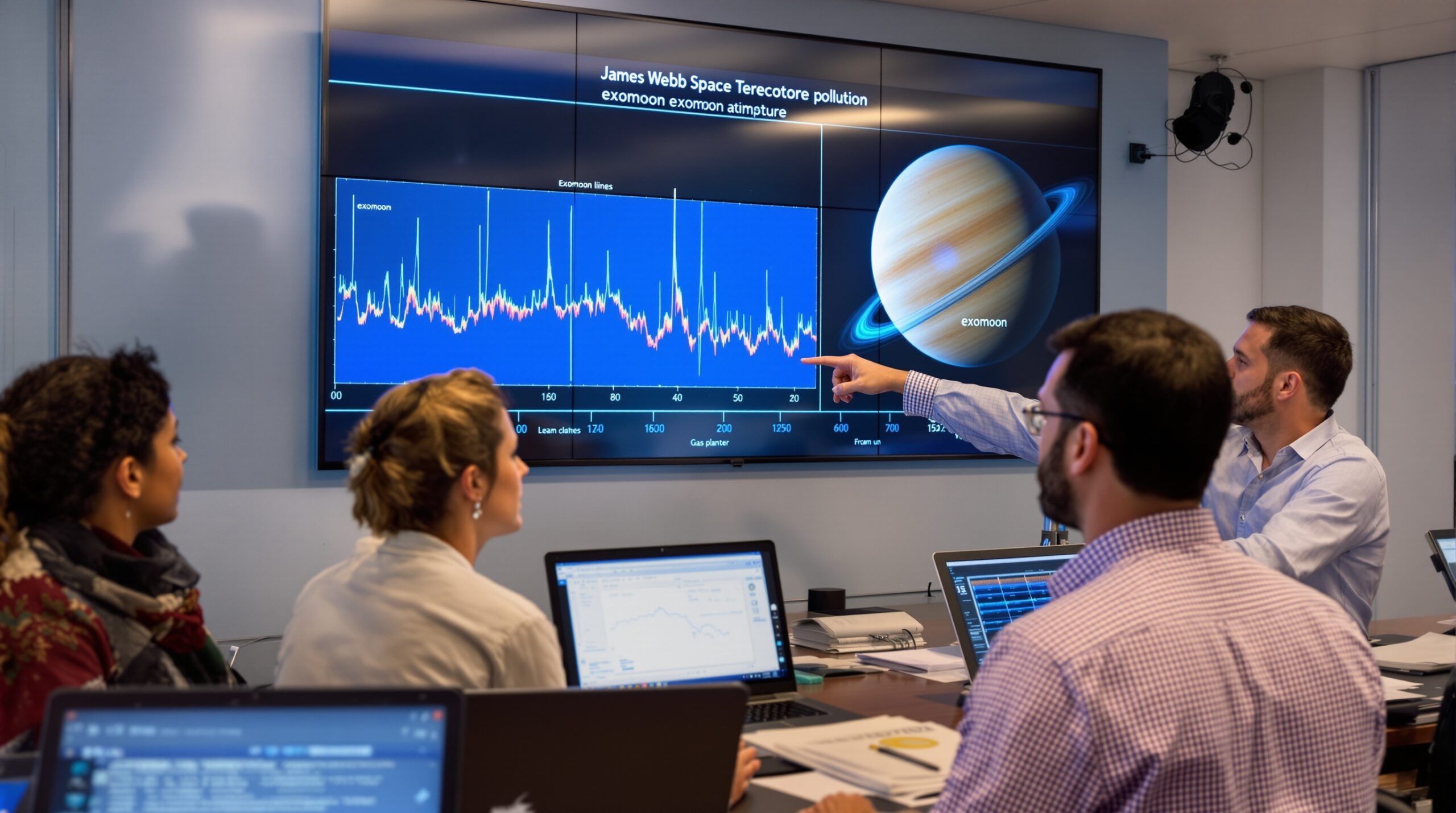
Astronomers report the first tantalizing evidence for an exomoon atmosphere, gleaned from James Webb Space Telescope spectra. The claim centers on subtle, time-offset absorption features during a giant exoplanet’s transit. These features appear consistent with a smaller companion enveloped by gas. The signal remains tentative, yet it showcases the precision JWST now brings to exomoon searches. Careful follow-up will determine whether this intriguing hint withstands deeper scrutiny.
The result emerges from multiple JWST observations using transit spectroscopy across near-infrared wavelengths. Researchers applied models that include both a transiting planet and a bound satellite. They found improved fits when including a moon with an atmospheric annulus. The atmospheric signal seems faint but coherent across instruments. This coherence encourages cautious optimism while emphasizing the need for repeated events.
Why an Exomoon Atmosphere Would Matter
Exomoons represent a largely unexplored frontier in planetary science. Thousands of exoplanets are known, yet no exomoon is securely confirmed. An exomoon atmosphere would offer a new window into satellite formation and evolution. It would also expand our understanding of where complex chemistry arises. These possibilities drive intense interest in even tentative atmospheric signals.
Moons can inherit gases from their natal disks or capture them later. They can also outgas from interiors during geologic activity. Magnetospheric interactions can modify or strip their atmospheres over time. These processes leave detectable spectral fingerprints. Detecting such fingerprints would provide rare constraints on moon histories beyond our Solar System.
Our Solar System offers instructive comparisons. Titan holds a thick nitrogen atmosphere with rich organic chemistry. Io vents sulfur compounds into Jupiter’s magnetosphere. These environments shape surface conditions and space weather. Analogous processes could occur around exoplanets as well. This context makes the reported signs especially compelling and worth thorough investigation.
How JWST Detected the Candidate Signal
JWST observes exoplanets by recording starlight filtering through planetary atmospheres during transits. Instruments such as NIRISS and NIRSpec disperse the light into spectra. Gases imprint characteristic absorption features at specific wavelengths. Researchers track these features as functions of time and wavelength. Small differences in timing can reveal additional bodies in the system.
The team analyzed time-resolved spectra across 0.6 to 5 microns. They aligned spectral channels and corrected for instrumental systematics. The light curve was modeled with a planet-only scenario first. A second model added a bound satellite with an atmosphere. The planet-plus-moon model produced a statistically better fit to the data.
Key parameters included the moon’s projected separation, size, and atmospheric scale height. The models also allowed for limb darkening and stellar variability. Researchers tested multiple detrending schemes to mitigate time-correlated noise. Importantly, the best-fit moon signal appeared before and after the main planetary transit. That pattern aligns with a trailing or leading companion.
Spectroscopic Fingerprints and Timing Clues
The reported signal clusters around known molecular bands. Features near 1.4 microns favor water vapor if real. An additional dip near 1.083 microns hints at metastable helium. Helium signals often trace atmospheric escape. The combined pattern suggests a low-mass atmosphere with potential outflow. Such a pattern would be plausible for a moon under strong irradiation.
Timing matters as much as spectral content. The absorption appears offset from the planet’s main transit. This offset matches the expected geometry of a bound satellite. A leading moon would imprint pre-transit features. A trailing moon would leave post-transit signatures instead. The data seem to prefer a trailing configuration, though uncertainties remain significant.
What the Data Show So Far
Statistical tests favor the planet-plus-moon model over a planet-only model. The improvement remains moderate rather than decisive. Bayesian evidence increases, and information criteria improve slightly. Residuals flatten across key wavelengths when including a moon. The fit gains coherence across instruments, which strengthens the case. Still, single-event detections warrant extra caution.
Atmospheric retrievals explore plausible compositions and temperatures. Water and helium provide the most consistent spectral matches. Methane appears disfavored at the retrieved temperature range. A hydrogen-rich envelope with water traces also fits. That scenario could explain a helium escape signature. The implied atmospheric scale height suggests relatively low gravity.
Physical interpretations remain diverse. The moon could resemble a mini-Titan with added hydrogen. It could also be a captured icy body losing volatiles. Magnetospheric interactions might shape an extended exosphere. Each scenario predicts different variability patterns across future transits. Those patterns create clear observational tests for follow-up.
Caveats and Alternative Explanations
Several non-moon mechanisms can mimic moonlike signals. Stellar spots can imprint chromatic, time-dependent features. Unocculted faculae can bias atmospheric slopes. Instrumental systematics can masquerade as shallow spectral dips. Time-correlated noise can create spurious pre- or post-transit absorption. Each possibility demands careful modeling and independent checks.
The team reports extensive systematics tests. They tried different detrending baselines and decorrelation methods. The signal persists across these choices, which is encouraging. However, independent re-analyses remain essential for robust claims. Different pipelines can reveal hidden sensitivities. Community verification will therefore play a decisive role.
Geometry also complicates interpretation. Ring systems can mimic a companion’s extended silhouette. Planetary exospheres can lead or trail a planet as well. Dusty outflows from volcanically active moons can confuse spectra. Each alternative leaves distinctive temporal and spectral signatures. Longer monitoring can separate these scenarios with higher confidence.
Implications for Formation and Habitability
If confirmed, the result would reshape moon formation theories. It would show that sizeable moons can retain atmospheres around giant planets. Disk-born moons could capture primordial hydrogen envelopes. Alternatively, captured bodies could outgas after tidal heating. Such processes would operate across a wide range of orbital distances. The discovery would broaden our view of atmospheric diversity.
Habitability considerations remain nuanced for exomoons. Thick hydrogen envelopes can produce strong greenhouse effects. Tidal heating can support subsurface oceans or drive volcanism. Magnetic shielding from a host planet can reduce atmospheric loss. Conversely, magnetospheric bombardment can also erode atmospheres. Determining the balance requires multi-epoch, multiwavelength observations. These factors set the stage for future searches.
Next Steps and Verification Plans
Confirming an exomoon atmosphere requires repetition. Multiple transits should show consistent, phase-dependent signals. Different instruments should recover the same spectral features. Observations at varied wavelengths will test composition claims. Phase curve monitoring could track trailing or leading absorption. Those tests would build a robust evidence chain.
JWST follow-up can target helium, water, and carbon dioxide bands. NIRISS SOSS can probe visible to near-infrared features. NIRSpec can refine the helium triplet at 1.083 microns. MIRI can examine thermal emission constraints at longer wavelengths. Coordinated ground-based spectroscopy can provide complementary resolution. Together, these tools can tighten parameter estimates significantly.
Independent teams should reprocess the same datasets. Cross-checks using different pipelines help guard against biases. Stellar monitoring can constrain spot coverage and variability. High-cadence photometry can map occulted and unocculted regions. Dynamical modeling can assess moon stability and plausible orbits. All these steps reduce ambiguity and strengthen conclusions.
The Bigger Picture for Exomoon Science
Exomoon science stands at an inflection point today. Hints have surfaced before in transit timing and shape variations. However, atmospheric detections were out of reach until JWST. Spectroscopy adds powerful, independent evidence to geometric methods. It pushes exomoon studies into the atmospheric era. This development opens practical pathways to confirmation.
Future observatories will accelerate progress. ESA’s Ariel mission will survey exoplanet atmospheres systematically. The Habitable Worlds Observatory concept promises even finer sensitivity. Extremely Large Telescopes will enable high-resolution ground spectroscopy. Combined approaches will target moons across multiple detection channels. The reported hint serves as a catalyst for these efforts.
Careful Optimism, Rigorous Testing
The new analysis presents a careful, testable claim rather than a firm detection. The data show a small, coherent excess consistent with a moon’s atmosphere. The statistical preference is noteworthy but not conclusive. Independent analyses and fresh observations will decide the outcome. Either result will advance our understanding substantially.
If the signal holds, astronomers will have captured the first exomoon atmosphere. That discovery would illuminate how moons retain gases under harsh irradiation. It would also guide target selection for life-friendly environments. If it fades, the process will still refine methods. Better pipelines and strategies will follow, improving future searches.
Either way, JWST has clearly transformed what is measurable. Subtle atmospheric signatures now sit within reach for complex systems. Moons, rings, and exospheres can be separated with careful modeling. Today’s tantalizing hint demonstrates what careful analysis can reveal. Tomorrow’s observations will tell the rest of the story.
