

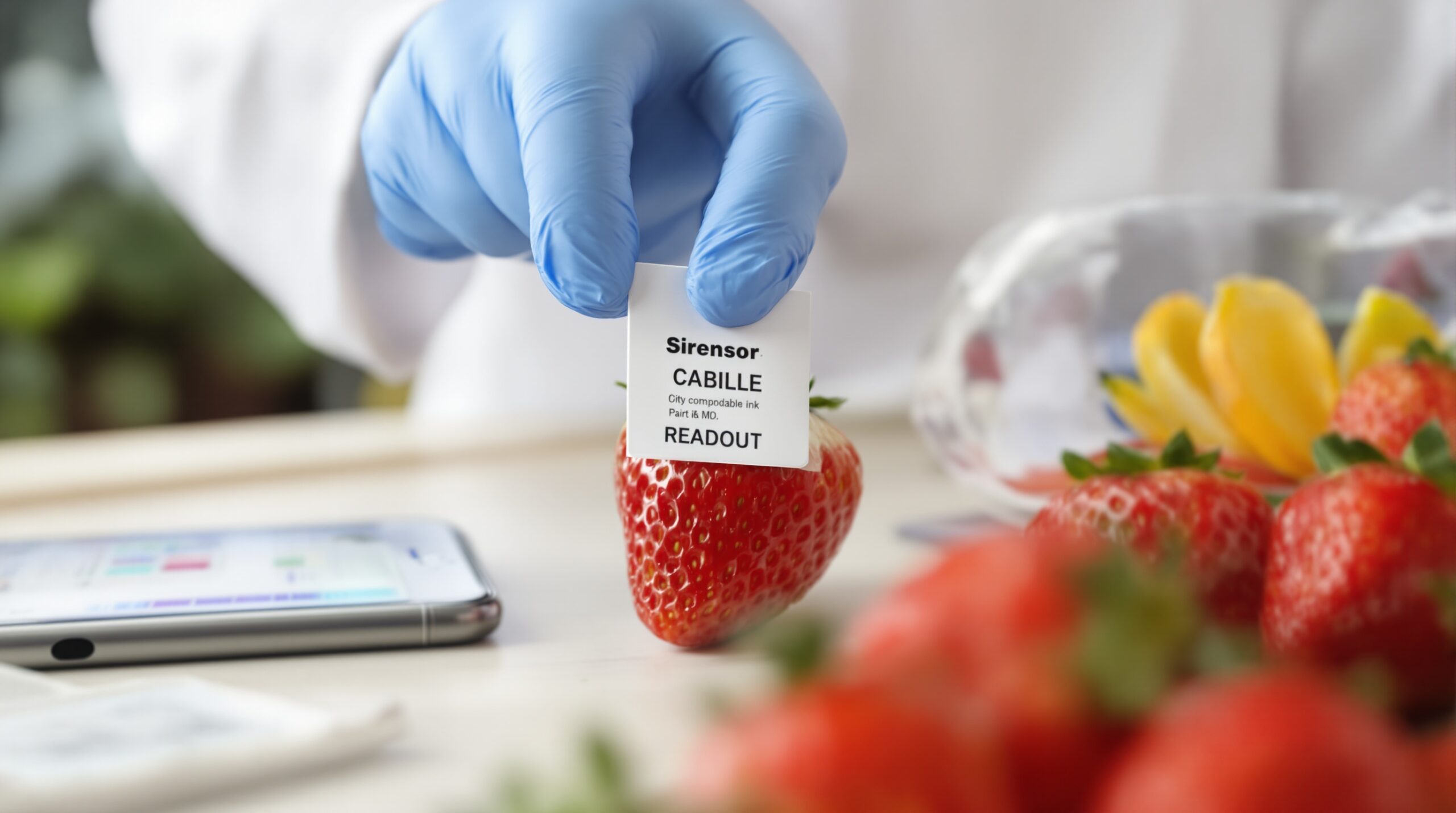
Food waste remains a costly climate and nutrition problem across supply chains. Grocers, distributors, and consumers often rely on static dates. Those dates rarely reflect actual product condition. Real-time indicators can bridge that gap and improve decisions. New biodegradable semiconductor inks now bring that possibility to compostable packaging. These inks let manufacturers print low-cost sensors directly onto paper and bioplastic films. As a result, packages can report freshness through their entire journey.
The idea blends two urgent goals into one solution. The first goal targets accurate freshness tracking. The second goal targets sustainable electronics that avoid persistent e-waste. By combining both, compostable sensors provide information without creating disposal headaches. The approach also supports circular packaging systems. Consequently, brands can measure quality while meeting environmental targets.
Why Real-Time Freshness Tracking Matters
Global estimates suggest roughly one third of food goes uneaten. Losses occur from farm to fork for many reasons. Temperature abuse, damaged packaging, and variable supply chains drive spoilage. Static date codes cannot capture those dynamic conditions. Sensors can monitor conditions that accelerate microbial growth and oxidation. That information can guide handling and reduce premature disposal.
Freshness tracking also protects safety and brand trust. Sensors can flag time-temperature excursions during transit. They can reveal packaging leaks and gas buildup in modified atmospheres. Retailers can triage inventory using objective measures. Consumers can receive reliable signals at home. Together, these steps reduce waste while safeguarding health.
What Are Biodegradable Semiconductor Inks?
Biodegradable semiconductor inks carry functional materials in a degradable matrix. They print onto substrates like paper or compostable films. After use, they can break down under composting conditions. Their design reduces persistent residues compared with conventional electronics. The inks typically include a semiconductor phase, a binder, and safe solvents. Formulations may also include surfactants, crosslinkers, and plasticizers.
The semiconductor phase provides sensing or switching behavior. Organic molecules can supply that function with compatible chemistry. Natural pigment families can also provide electronic activity. Some metal oxides serve as semiconductors in certain designs. Researchers pair those phases with biodegradable binders. Examples include cellulose derivatives, chitosan, shellac, and plant-based polyesters. Designers tune rheology to meet printing requirements.
Material Choices and Trade-Offs
Material selection balances performance, safety, and end-of-life goals. Paper or cellulose films often form the substrate. These materials are renewable and widely compostable. Semiconducting phases can include organic small molecules or polymers. Some come from bio-derived feedstocks or nature-inspired chemistries. Melanin-like materials show mixed ionic and electronic conduction. That behavior can support humidity and pH sensing.
Designers also use carbon-based systems for electrodes and antennas. Biochar, graphite, or carbon black can deliver adequate conductivity. They disperse in water with biobased binders. For gas sensing, chemiresistive systems remain attractive. Functionalized carbons can interact with amine vapors from spoiled food. Metal oxides like zinc oxide can also respond to amines. However, metal choices require careful toxicology evaluation. Engineers must also confirm composting behavior of each component.
Finally, encapsulation layers protect sensors during use. Biodegradable coatings can resist moisture and grease. Materials include cellulose coatings, beeswax, and shellac. These layers must allow target gases to reach the sensor. Engineers therefore tune permeability using blends and thickness. The final stack remains thin and flexible. That feature simplifies integration with packaging lines.
Printing Methods Compatible with Packaging
Printing translates laboratory materials into manufacturable devices. Common methods include inkjet, screen, gravure, and flexographic printing. Each method demands specific viscosity and surface tension windows. Particle size and dispersion stability also matter. Drying and curing must match packaging throughput. Low-temperature processing protects compostable films from distortion.
Roll-to-roll setups can deliver high volume at low cost. Registration between sensor layers remains important for device yield. Corona or plasma treatment can improve ink adhesion on films. Primer layers can also help with wetting and line definition. Quality control uses inline optical and electrical checks. That approach confirms print continuity and resistance targets. This discipline improves reliability in real deployments.
How the Sensors Detect Freshness
Spoilage changes the package environment in measurable ways. Microbial metabolism releases amines, ammonia, carbon dioxide, and sulfur compounds. Protein breakdown raises total volatile basic nitrogen values. Surface pH often increases as spoilage advances. Temperature abuse accelerates these processes dramatically. Sensors track these signals and infer freshness in real time.
Chemiresistive sensors measure resistance changes from gas interactions. Functional coatings selectively absorb amines and modulate conduction. Organic field-effect transistors can amplify those changes. Potentiometric sensors measure pH shifts through ionic conduction. Colorimetric layers can also provide visible outputs. Designers select the modality based on product and packaging. Each modality offers distinct trade-offs in cost and complexity.
Printed antennas and simple circuits connect the sensors. Passive NFC tags can power brief readouts using smartphones. That approach avoids onboard batteries and simplifies composting. Alternatively, printed zinc paper batteries can supply energy. Those cells can be designed for responsible end-of-life. Data can feed inventory systems for analytics. Users receive clear freshness indications without opening the package.
From Lab Signal to Actionable Information
Raw sensor signals require interpretation to be useful. Calibration links resistance or voltage changes to amine concentrations. Temperature compensation reduces false positives during cooling cycles. Algorithms translate sensor outputs into freshness indices. Simple thresholds can trigger “consume soon” alerts. More advanced models can estimate remaining shelf life. Those outputs support dynamic pricing and waste reduction.
Compostability, Safety, and Compliance
Compostable sensors must meet end-of-life standards. Industrial compostability standards include EN 13432 and ASTM D6400. These standards assess biodegradation, disintegration, and eco-toxicity. Components should not leave visible fragments or toxic residues. Paper substrates and many bio-based binders can meet these criteria. Designers must assess each ink component individually.
Food-contact safety remains equally important. Materials need migration testing under relevant conditions. Regulations include FDA and EU frameworks for food contact. Barrier layers can separate electronics from food when needed. Adhesives and coatings must also pass compliance checks. Manufacturers document materials through declarations of compliance. Clear labeling helps end users follow disposal instructions correctly.
Performance Metrics That Matter
Key metrics include sensitivity, selectivity, and response time. Meat and fish spoilage produce amines at low parts-per-million levels. Sensors should detect relevant thresholds reliably. Response times of minutes support distribution decisions. Stability must extend through refrigerated shelf life. Baseline drift should remain minimal under humidity swings. Cross-sensitivity to alcohols or acids needs mitigation.
Engineers use reference channels and coatings for robustness. They also employ encapsulation strategies against condensation events. Calibration routines can correct lot variations during production. Package geometry also affects gas transport to sensors. Vent patterns and headspace composition matter. Therefore, co-design with packaging engineers improves outcomes. Pilot testing in real supply chains validates final performance.
Manufacturing Economics and Integration
Cost per sensor must fit packaging budgets. Roll-to-roll printing can deliver sensors for cents per unit. Material choices strongly influence ink costs and yields. High solids content reduces passes and speeds production. Simple readouts can lower electronics complexity. Passive NFC removes battery costs and handling steps. Integration with digital twins adds enterprise value.
Implementation requires tight coordination with converters and brands. Sensors must survive die-cutting, lamination, and sealing. Heat-seal windows and sensor layouts require careful planning. Line trials confirm adhesion and registration at speed. Converters can add inline testing to ensure function. These steps reduce returns and product spoilage risks. A stable process unlocks scale and consistency.
Current Challenges and Research Needs
Several challenges still limit widespread deployment today. Material biodegradation and device stability can conflict. Designers must balance shelf life against compostability. Moisture protection complicates gas access to sensing layers. Cross-sensitivity can generate false alarms in complex headspaces. Therefore, selectivity engineering remains a priority.
Ink formulations also need broader safety data. Toxicology and environmental fate of some nanomaterials require caution. Researchers are exploring safer particle-free systems. Standardized test methods would speed benchmarking and certification. Life cycle assessments can quantify real environmental benefits. Composting infrastructure access varies widely by region. Clear consumer guidance remains necessary for proper disposal.
Connectivity raises further questions beyond materials. Data interoperability supports retailer platforms and cold chain tools. Cybersecurity and privacy require appropriate safeguards for tags. Battery-free designs can reduce attack surfaces significantly. Nevertheless, secure pairing and authentication remain valuable. Open standards can prevent vendor lock-in and fragmentation. Collaboration across supply chains will accelerate trust and adoption.
Outlook for Compostable Freshness Sensors
Biodegradable semiconductor inks are unlocking a promising class of sensors. Printed, flexible devices now fit onto everyday packages. They can measure gases, pH, temperature, and humidity. Combined signals produce robust freshness indicators. Passive wireless interfaces make data access simple and safe. Compostable stacks reduce downstream waste and contamination concerns.
Near-term deployments will likely focus on high-value perishables. Seafood, poultry, and ready meals offer strong use cases. Early systems may provide threshold alerts instead of continuous curves. As materials mature, functionality will expand. Broader compostability certifications will follow robust testing. Integration with digital inventory tools will create further savings. These savings can finance wider adoption across categories.
Ultimately, freshness becomes visible and actionable throughout the chain. Consumers gain confidence from clear indicators at home. Retailers reduce shrink through better rotation and discounts. Producers learn from temperature and handling analytics. Meanwhile, compostable electronics avoid persistent waste. This alignment turns information into environmental progress. The technology therefore holds meaningful promise for food systems.
Continued collaboration will decide the pace of success. Material scientists, converters, and brands must iterate together. Regulators can clarify paths for safe commercialization. Municipalities can expand composting access and education. Pilot projects can prove value and refine designs. With thoughtful development, compostable sensors can scale responsibly. The result can be fresher food with lighter environmental footprints.
