

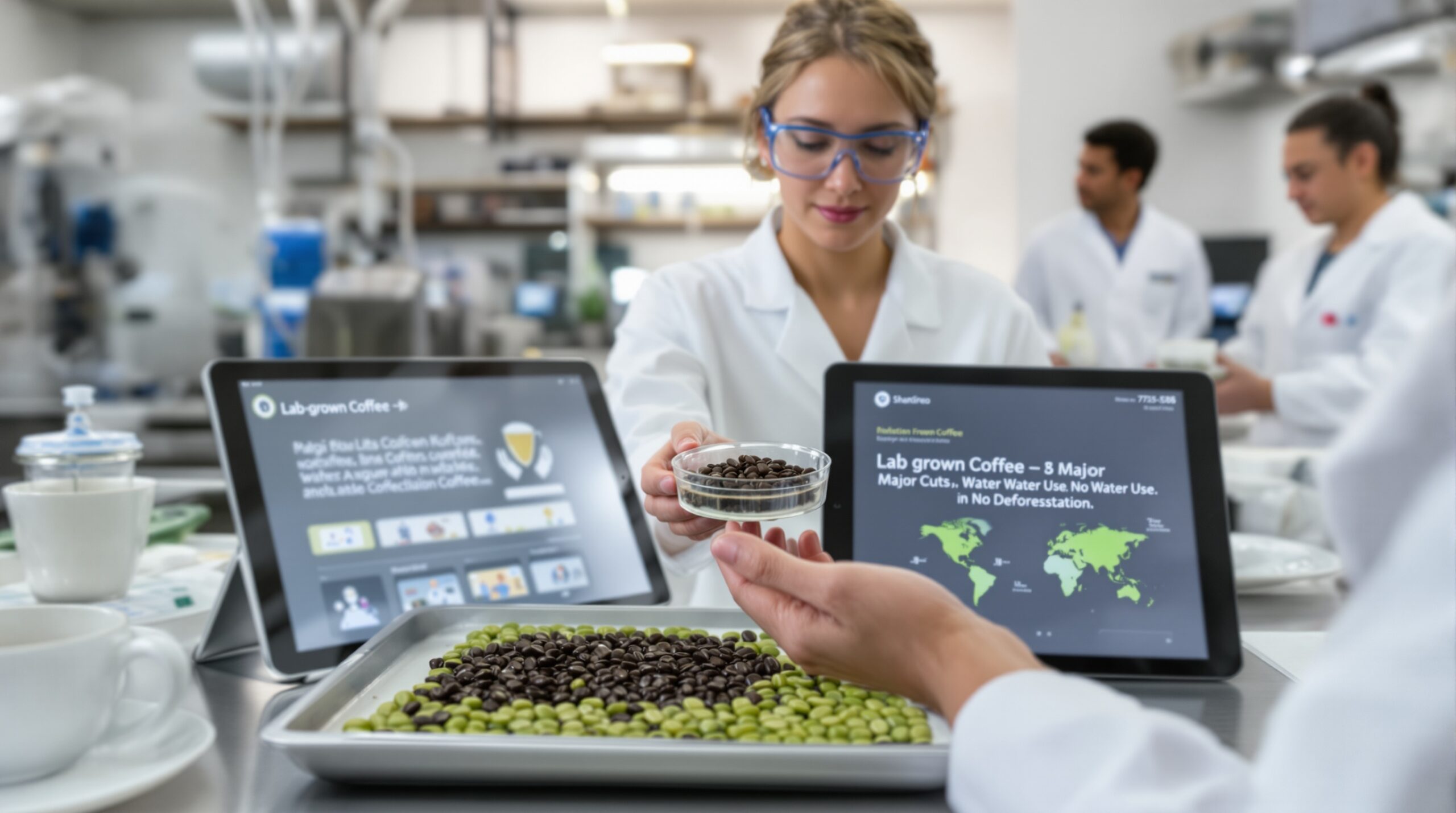
A biotech startup unveiled lab-grown coffee produced from cultured coffee plant cells, not traditional farmed beans. Company leaders claim the approach can dramatically reduce water use and deforestation pressures. The announcement signals growing momentum for cellular agriculture beyond meat and dairy. It also raises practical questions about scale, taste, cost, and regulation. Those questions will determine whether the promise translates into real environmental gains.
How Lab-Grown Coffee Works
Lab-grown coffee uses plant cell culture techniques to produce coffee biomass in controlled bioreactors. Scientists take tissue from coffee plants and induce cell proliferation in sterile conditions. The cells grow in nutrient media, forming biomass that contains coffee precursors and aromatic compounds. Technologists then harvest, dry, and roast the biomass to develop familiar flavors. The process does not necessarily create whole beans, as in farmed coffee. Instead, it produces a roastable material that can mimic ground coffee behavior. This distinction matters for clarity and expectations about product form.
Researchers have demonstrated coffee cell culture at lab scale in prior public projects. These prototypes showed that roasting can unlock recognizable coffee aromas. However, flavor and mouthfeel depend on cell lines, media composition, and roasting profiles. Developers can tune these parameters to achieve targeted taste profiles. Such tuning resembles precision used in specialty coffee roasting. That flexibility could become a competitive advantage over field-grown variability.
Environmental Footprint and Resource Use
Conventional coffee production consumes significant water and land resources. Global demand drives cultivation into sensitive tropical regions, increasing ecological pressures. Well-known analyses estimate around 140 liters of water per cup of coffee. Much of that footprint occurs on farms through irrigation and processing. Sun-grown plantations can require additional inputs and deliver lower canopy cover. These factors can amplify biodiversity loss and run-off pollution.
Lab-grown coffee shifts resource use from fields to factories. Bioreactors operate in closed environments with precise inputs and controls. Water recirculation and reduced evaporation can lower net freshwater consumption. Land requirements drop because production occurs vertically and indoors. Farmers do not clear forests for new plantations when supply grows this way. That substitution could ease pressure on high-conservation-value landscapes.
However, energy demand can complicate the footprint comparison. Bioprocessing needs electricity for agitation, sterilization, and climate control. If electricity comes from fossil fuels, emissions can offset water and land savings. Robust comparisons therefore require peer-reviewed life cycle assessments. Those studies should include location-specific energy mixes and process yields. Transparent data will help validate sustainability claims and build trust.
Deforestation Dynamics in Coffee Supply Chains
Coffee expansion has contributed to deforestation across parts of Latin America, Africa, and Southeast Asia. Demand growth encourages planting on hillsides and forest frontiers. Shade-grown systems can protect biodiversity but often yield less. Sun-grown systems deliver higher yields but reduce canopy habitat. Enforcement varies, and smallholder livelihoods rely on crop revenues. Alternatives that reduce expansion pressure could complement conservation strategies.
Lab-grown supply can decouple production from forested land. It can deliver incremental volume without clearing high-carbon ecosystems. That pathway supports corporate deforestation pledges and emerging import regulations. Still, production must avoid indirect impacts, such as shifting energy emissions elsewhere. Coordination with conservation groups can guide responsible deployment. Transparent sourcing of inputs and energy will strengthen environmental credibility.
Mechanics Behind Water Savings
Bioreactors allow closed-loop water management with filtration and reuse. Engineers can recycle process water, reducing overall withdrawals. Precision feeding minimizes excess media and wastewater volumes. The system avoids field evaporation and seepage losses. Processing can integrate membrane systems to capture and reuse condensate. Together, these measures can sharply reduce water intensity per kilogram produced.
Conventional coffee requires washing, pulping, fermentation, and drying steps. Those stages often discharge effluents into local waterways. Factory designs can treat and reclaim process water more consistently. Monitoring sensors provide early detection of leaks or contamination. That control improves environmental performance and regulatory compliance. It also supports credible reporting to sustainability auditors and investors.
Flavor, Quality, and Consumer Acceptance
Flavor defines whether consumers adopt lab-grown coffee at scale. Cell selection and roasting chemistry shape volatile compounds and body. Developers can target arabica-like profiles or novel flavor signatures. Sensory panels must evaluate consistency, aroma complexity, and aftertaste. Third-party testing can validate claims beyond internal preferences. Transparent labeling will help manage expectations during early releases.
Prior research projects produced coffee aromas recognizable to experienced tasters. Those findings suggest cell-based coffee can approach familiar flavor benchmarks. Still, baristas and roasters will expect stable performance under various brewing methods. Developers must demonstrate behavior across espresso, filter, and cold brew formats. Training and recipe guides can accelerate adoption in cafes and offices. Early partnerships may focus on blends rather than full replacement.
Economics and Scale-Up Challenges
Scaling from lab to industrial volumes presents technical and economic hurdles. Growth media costs dominate early production economics. Teams must reduce media costs and improve cell densities. Continuous processing and larger bioreactors can increase throughput. Sterilization strategies must protect cultures without excessive energy use. Process optimization will determine cost parity with commodity coffee.
Supply chains must also mature beyond pilot runs. Reliable suppliers must provide media components and single-use assemblies. Equipment vendors need to support food-grade certification and uptime guarantees. Downstream drying and roasting require standardization for consistent results. Packaging and distribution channels can leverage existing coffee networks. Economies of scale will improve with predictable demand and multi-year contracts.
Regulatory Pathways and Safety
Regulatory agencies evaluate novel foods for safety and labeling. Companies may pursue self-affirmed GRAS or FDA review in the United States. The European Union requires novel food authorization before market entry. Other markets have their own pre-market pathways and documentation. Safety dossiers typically include composition, toxicology, and allergen assessments. Clear labeling will inform consumers about production methods and ingredients.
Quality systems must meet food-grade standards across the facility. Hazard analysis and critical control points guide risk management. Traceability systems track inputs, batches, and distribution. Independent audits can verify compliance and process controls. Strong quality culture reduces recalls and builds retailer confidence. Aligning with global standards simplifies multinational expansion plans.
Market Implications for Coffee Farmers
New supply models can affect farming communities and rural economies. Lab-grown volumes may first target commodity segments where margins are thin. That shift could pressure prices for lower-grade beans. Policymakers and buyers should consider just transition strategies and support. Diversification programs can help farmers adapt and reduce income volatility. Certification schemes can reward regenerative practices and quality improvements.
Conversely, specialty coffee may remain differentiated by terroir and craftsmanship. Lab-grown options could reduce pressure on marginal lands. Farmers can then focus on quality and agroforestry approaches. Those systems enhance biodiversity and climate resilience. Collaboration between startups and producer groups can create shared value. Joint projects might support seedling distribution, shade tree planting, and agronomy training.
What to Watch Next
Key milestones will test the startup’s sustainability and market claims. Independent life cycle assessments should quantify water, land, and emissions impacts. Third-party sensory evaluations will benchmark flavor against leading coffees. Pilot facility performance will reveal true yields and costs. Regulatory progress will dictate launch timing and labeling language. Early customer pilots can validate brewing performance in real-world settings.
Energy sourcing will significantly shape environmental results. Commitments to renewable power can improve emissions profiles. Heat recovery and efficiency upgrades will also matter at scale. Partnerships with roasters can accelerate flavor iteration and acceptance. Transparent reporting will help stakeholders evaluate progress and challenges. Those disclosures will separate hype from durable innovation.
Conclusion: Potential, Proof, and Practical Paths Forward
The debut of lab-grown coffee underscores rapid innovation in sustainable beverages. The approach can reduce water use and deforestation risks. It also faces meaningful hurdles in cost, energy, and taste. Independent validation will determine whether promises become outcomes. Constructive collaboration can align startups, farmers, and conservation goals. With careful execution, coffee’s future can be both flavorful and forest friendly.
