

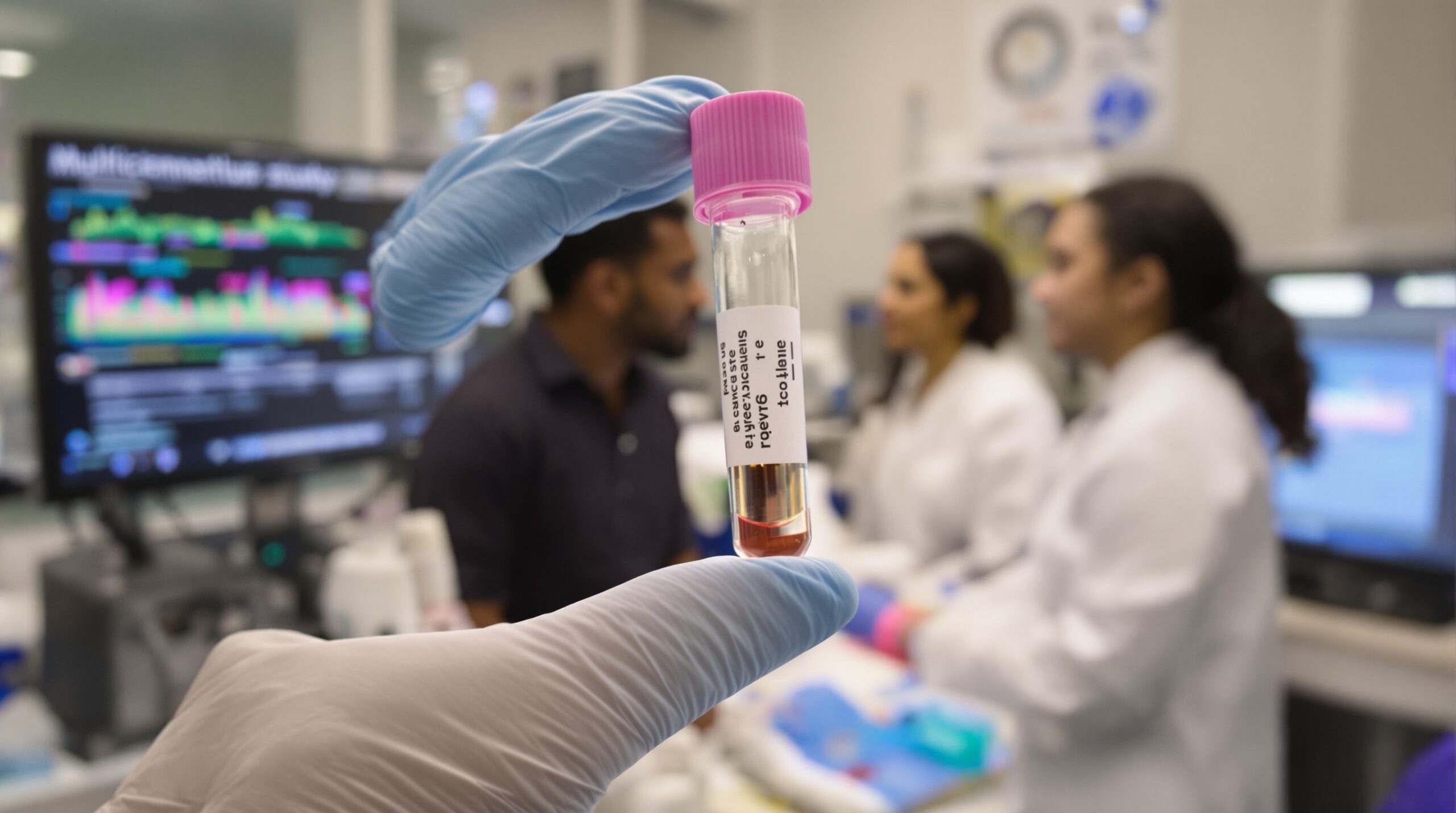
Pancreatic cancer often evades detection until advanced stages, limiting treatment options and survival. A new multicenter study reports a blood test that detects early-stage disease with high accuracy. Researchers from academic and community hospitals collaborated to validate the assay across diverse clinical settings. The findings highlight a potential shift toward earlier detection and improved outcomes.
Why early detection matters
Early-stage pancreatic cancer is more amenable to surgery and curative therapies. Detection before spread can double or triple survival in some cohorts. Yet most patients present after the disease has silently progressed. Therefore, a reliable blood test could fill a critical gap in clinical practice.
Study overview and design
The study enrolled several hundred participants across multiple centers. Investigators included patients with confirmed pancreatic cancer, individuals with benign pancreatic disease, and healthy controls. Sites followed harmonized protocols for blood collection, processing, and storage. This design strengthened data consistency and reduced pre-analytical variability.
Participants represented a range of ages, racial backgrounds, and risk profiles. The cohort included people with new symptoms and those under surveillance for high risk. An independent central lab processed samples to maintain analytic uniformity. Importantly, statisticians remained blinded to diagnosis during model training and validation.
What the test measures
The blood test integrates multiple biomarker classes in a single assay. It analyzes cell-free DNA methylation patterns associated with malignant transformation. It also measures established protein markers, including CA19-9, and additional inflammation and stromal signals. A machine learning classifier combines features into a single risk score.
These features capture tumor biology and host responses that surface before imaging changes become obvious. The model emphasizes reproducible signals that generalize across sites. It also applies quality controls to reduce noise in low-input samples. Consequently, the algorithm can evaluate small volumes with consistent performance.
Accuracy and key performance metrics
The test achieved high accuracy in detecting pancreatic cancer across stages. The area under the receiver operating characteristic curve approached 0.94 in the validation cohort. Sensitivity for stage I and II disease reached around 80 percent at 95 percent specificity. Importantly, performance remained strong in patients with small tumors.
Specificity exceeded 95 percent among healthy controls and those with non-malignant conditions. False positives remained uncommon in individuals with chronic pancreatitis. Furthermore, the test outperformed CA19-9 alone, which detects many early cases poorly. The combined panel improved both sensitivity and overall discrimination.
External validation across sites
Investigators trained the model on a subset and tested it on a blinded cohort. The analysis included patients from additional centers not used during training. Results reproduced within tight confidence intervals, suggesting robust generalizability. Site-to-site differences did not meaningfully erode test performance.
Subgroup analyses evaluated age, sex, race, and comorbid conditions. The classifier maintained comparable accuracy across demographic groups. It also performed reliably in both symptomatic and surveillance populations. These findings support use in varied clinical pathways with appropriate guardrails.
How the test compares with current practice
Clinicians often order CA19-9, but this marker misses many early cancers. Imaging can detect tumors, yet sensitivity declines for very small lesions. Endoscopic ultrasound offers improved resolution but is invasive and resource intensive. Therefore, a simple blood test could streamline triage and accelerate diagnostic workup.
The study showed that combining methylation signals with proteins clearly improved accuracy. The approach reduced dependence on a single marker that fluctuates with inflammation. It also provided a probabilistic score that informs next steps. Consequently, clinicians can pair results with targeted imaging strategies.
Implications for high-risk surveillance
High-risk individuals face frequent imaging and procedures. The blood test could help prioritize who needs immediate evaluation. A high score could prompt rapid MRI or endoscopic ultrasound. Conversely, a low score might support routine surveillance intervals.
Surveillance programs could integrate the assay alongside genetic counseling and lifestyle interventions. The test might also help manage equivocal imaging findings. It could guide decisions when cystic lesions raise uncertain risk levels. However, programs must define thresholds that balance sensitivity and false positives.
Clinical workflow and decision support
Clear pathways ensure consistent, safe use in clinics. The study proposed a simple reporting format with tiered risk categories. Reports suggested recommended follow-up actions for each tier. This framework can reduce variability and support shared decision-making.
Electronic records can incorporate the score to trigger alerts and reminders. Teams can track outcomes and adjust thresholds as new data emerge. Meanwhile, multidisciplinary review can adjudicate complex cases. Structured implementation will help convert accuracy into real-world benefit.
Strengths of the multicenter approach
Multicenter design improves confidence in generalizable results. Diverse patient populations mirror real practice better than single-site studies. Standardized protocols minimized technical variability across laboratories. Additionally, blinding reduced bias during model development and validation.
The dataset included benign disease controls that can mimic cancer clinically. This inclusion tests the assay against common confounders. The design therefore addresses spectrum effects that inflate accuracy artificially. As a result, the reported metrics carry stronger clinical relevance.
Limitations and unanswered questions
The study did not evaluate population-wide screening. Pancreatic cancer remains relatively rare in average-risk adults. Even high specificity yields lower positive predictive value in general populations. Therefore, targeted use in higher-risk groups appears most appropriate initially.
Pre-analytical variables require vigilant control in everyday practice. Hemolysis, delayed processing, and storage conditions can influence results. Real-world performance may vary outside research settings. Ongoing registry data will help characterize effectiveness across systems.
The analysis also cannot prove improved survival on its own. Demonstrating benefit requires trials showing earlier stage at diagnosis and better outcomes. Health systems must evaluate downstream imaging, procedures, and costs. Careful stewardship will maximize benefit and minimize harm.
Regulatory and access considerations
Before clinical adoption, the assay needs regulatory review and quality certification. Laboratories must validate analytical performance under strict standards. Payers will assess clinical utility and cost-effectiveness for coverage decisions. Equitable access should remain a core goal during rollout.
Training and education will guide appropriate test ordering. Clinicians need clarity on interpretation and follow-up pathways. Patients should receive transparent information about benefits and limitations. With thoughtful implementation, access can expand without widening disparities.
Future research directions
Prospective trials should measure stage shift and patient-centered outcomes. Pragmatic studies can test workflows in community settings. Investigators can evaluate repeated testing intervals and longitudinal changes in risk scores. Integration with imaging could further refine diagnostic algorithms.
Biomarker discovery will likely continue improving accuracy. Additional molecular signals may capture earlier biological changes. Algorithm updates can incorporate new features through transparent versioning. Meanwhile, open data collaborations can accelerate progress across institutions.
What this means for patients and clinicians
The study offers credible evidence for a powerful new detection tool. Patients at increased risk may benefit from earlier answers. Clinicians gain an objective measure to complement symptoms and imaging. Together, teams can move from suspicion to action faster.
Clear communication remains essential during adoption. Patients should understand that no test is perfect. Teams must discuss next steps after positive or negative results. Shared decisions can align testing with individual values and goals.
Balancing optimism with caution
The results justify optimism and careful next steps. High accuracy across centers suggests meaningful clinical potential. Yet broader validation and outcomes data remain necessary. Responsible stewardship will protect patients while unlocking benefits.
Bottom line
This multicenter study introduces a blood test that detects early pancreatic cancer with impressive accuracy. The assay integrates methylation patterns and protein biomarkers into a single risk score. It outperforms traditional markers and retains performance across diverse sites. With rigorous validation and thoughtful implementation, it could transform pancreatic cancer detection.
Healthcare systems can prepare by establishing protocols, training teams, and participating in registries. Researchers should prioritize trials that measure outcomes beyond accuracy. Payers and regulators can evaluate evidence transparently and equitably. Together, stakeholders can bring earlier detection to patients who need it most.
