

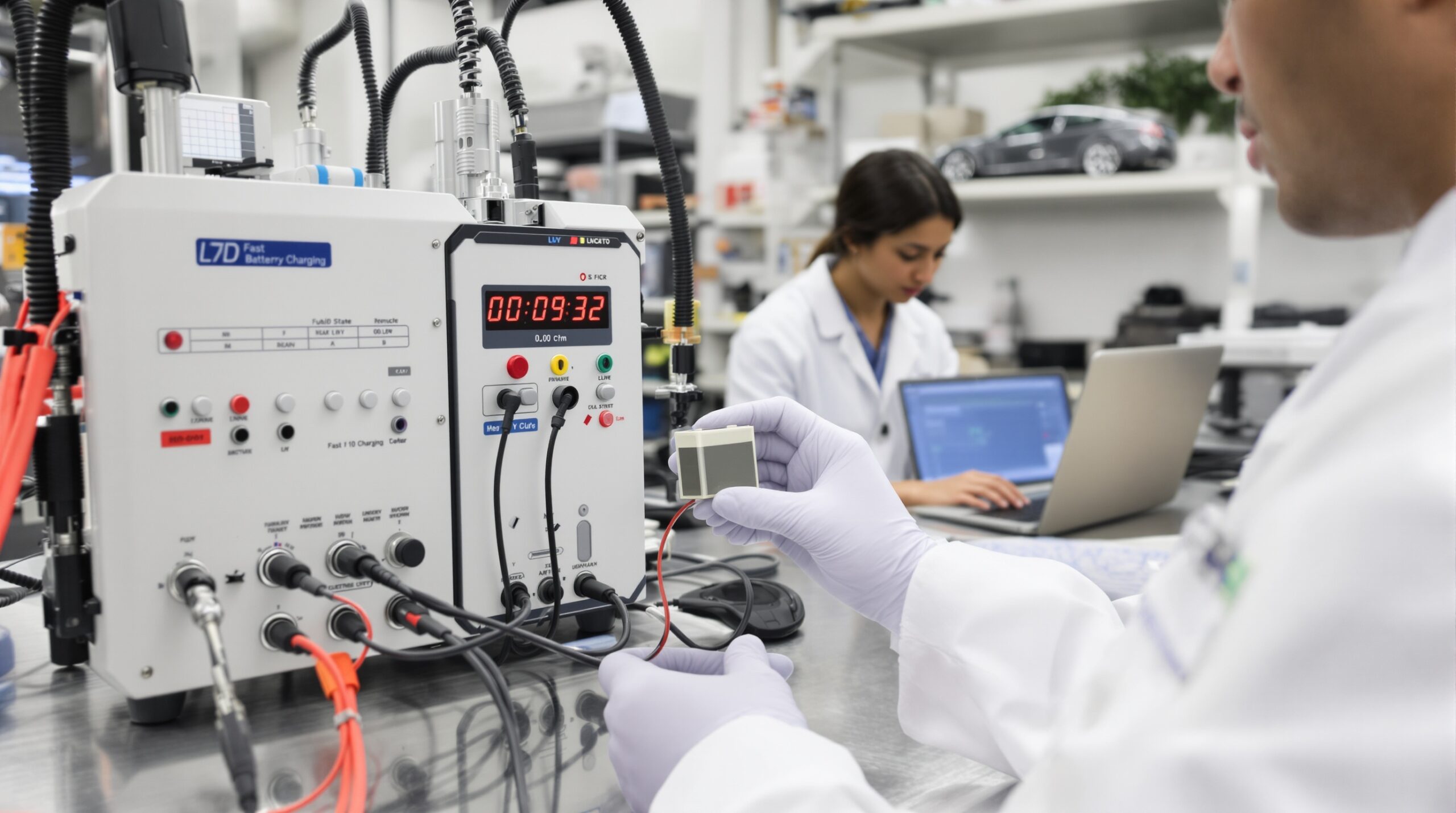
A research team reports a solid-state lithium-metal cell charging from 10% to 80% in under ten minutes. The demonstration uses a solid electrolyte and a high-energy cathode in a compact lab prototype. Engineers designed the cell for low resistance and stable interfaces under fast-charging currents. The result signals meaningful progress toward faster, safer electric vehicles. The findings also spotlight key hurdles between lab success and mass production.
Today’s lithium-ion packs rarely sustain repeated sub-ten-minute fast charges without heavy trade-offs. Drivers often accept longer charging times to protect battery health. Automakers also limit charge rates to manage heat and degradation. This new solid-state result challenges that compromise in a controlled environment. It suggests a path to quicker charging without catastrophic side effects.
What the Lab Achieved
Researchers constructed multi-layer cells using a solid electrolyte and a lithium-metal anode architecture. They charged the cells at high C-rates while monitoring temperature, voltage, and pressure. The protocol targeted rapid 10-80% charging with minimal impedance growth. The cells maintained capacity and avoided short circuits during the test window. The team repeated cycles to confirm performance consistency across samples.
Importantly, engineers controlled several variables to achieve stable operation. They optimized stack pressure to ensure intimate contact at critical interfaces. They managed heat using fixtures that extract thermal energy during high-current pulses. They also adjusted cathode loading to balance energy and power. These measures supported fast-ion transport and uniform lithium plating.
The demonstration used small-format lab cells rather than full automotive packs. Such a setup enables precise control and rapid iteration. It also limits confounding factors that appear at pack scale. Even so, the data help quantify the technical ceiling for charging rates. That ceiling informs realistic targets for future vehicle platforms.
How Solid-State Batteries Differ
Solid-state batteries replace flammable liquid electrolytes with solid ion conductors. These materials can conduct lithium ions while resisting thermal runaway. Lithium-metal anodes deliver higher theoretical energy than graphite anodes. Together, these features promise greater energy density and improved safety margins. They also open pathways for faster charging under controlled conditions.
Electrolyte and Anode Choices Matter
Several solid electrolytes compete for viability, including sulfide, oxide, and polymer systems. Sulfides offer high conductivity at room temperature with favorable processing. Oxides provide chemical stability but often demand higher fabrication pressures. Polymers excel in manufacturability yet typically require moderate heating for high conductivity. Each path shapes trade-offs in charging performance and durability.
Interfaces and Dendrite Management
Fast charging stresses the lithium-metal interface. Uneven current distribution can nucleate lithium protrusions, sometimes called dendrites. Researchers mitigate these effects using engineered interlayers and controlled pressure. They also tailor electrolyte chemistry to suppress interfacial degradation. These tactics stabilize plating and stripping during aggressive charge pulses.
Testing Conditions and Caveats
Lab cells often operate under idealized conditions that differ from vehicles. Fixtures maintain constant pressure across the stack during cycling. Thermal management hardware extracts heat more effectively than most pack systems. Electrolyte thickness and electrode loadings may be optimized for testing. These choices can inflate apparent performance versus real-world environments.
Measurement protocols also influence results. Some tests report charging time to 80% rather than full capacity. Others exclude rest periods or conditioning steps between cycles. Temperature setpoints can enhance ionic mobility and shorten charge times. Careful reading of methods helps contextualize these impressive numbers.
Scaling introduces additional challenges beyond materials performance. Larger cells suffer higher internal resistance and uneven thermal gradients. Manufacturing tolerances also tighten as layer counts increase. Pack-level controls must balance performance across thousands of cells. These realities temper expectations while guiding development priorities.
Implications for Next-Generation Electric Vehicles
Sub-ten-minute charging would reduce range anxiety and improve trip flexibility. Drivers could refuel rapidly during short stops on long routes. Fleet operators could increase vehicle utilization without oversized packs. Automakers could right-size batteries and reduce vehicle weight. These advantages compound economic and environmental benefits.
Faster charging also affects infrastructure design. Stations may require higher peak power with advanced load management. Grid operators could deploy smart buffering using onsite storage. Utilities may incentivize off-peak preconditioning to flatten demand spikes. Policy frameworks will need to consider these dynamics. Coordinated planning can minimize costs while maximizing user benefits.
Technical Levers Enabling Rapid Charging
Lower Impedance Solid Electrolytes
High ionic conductivity reduces voltage drop under load. Researchers pursue compositions with fast ion channels and stable interfaces. Microstructure control also improves percolation and reduces grain boundary resistance. Thin electrolyte layers further reduce ohmic losses during charging. These strategies directly shorten time to reach target state of charge.
Thin Lithium-Metal Anodes
Thin lithium reduces diffusion distances and improves uniform plating. Anode-free or lean-lithium designs can boost energy density. However, they raise sensitivity to plating irregularities during fast charging. Protective interlayers help distribute current and tame hotspots. Process consistency becomes crucial at manufacturing scale.
Cathode Engineering
High-loading cathodes must maintain ion and electron pathways during fast charging. Engineers tune porosity and binder systems for balanced transport. Surface coatings can limit interfacial reactions with solid electrolytes. Particle morphology also influences rate capability and mechanical stability. These measures enable higher currents without rapid degradation.
Thermal Management and Controls
Heat rises sharply during extreme fast charging. Effective thermal designs maintain uniform temperatures across large cells. Active cooling and predictive controls help prevent local hotspots. Preheating may boost conductivity in some electrolyte systems. These tools complement materials progress to deliver reliable rapid charging.
Manufacturing and Scale Challenges
Scaling from coin cells to automotive packs requires new processes. Dry fabrication and lamination techniques show promise for solids. Tight flatness and pressure uniformity become essential for reliability. Equipment must control thickness and surface roughness at large areas. Yield improvements will determine cost and availability.
Supply chains must mature alongside manufacturing. Solid electrolytes need consistent precursors and stringent quality control. Moisture sensitivity can complicate logistics for sulfide systems. Oxide processing may demand specialized sintering tools and energy. Each route requires dedicated investments and rigorous validation.
Safety and Standards
Solid-state cells aim to reduce flammability risks versus liquid electrolytes. However, safety still depends on robust system design. Mechanical abuse can fracture brittle layers and create failure paths. Standards must evolve to test these unique failure modes comprehensively. Regulators and industry groups are developing appropriate protocols.
Fast charging introduces additional safety considerations. High currents stress connectors, cables, and cooling systems. Diagnostic algorithms should detect anomalies quickly and limit damage. Pack architectures need isolation strategies to contain faults. These safeguards will build trust as charging speeds increase.
Outlook and Timelines
Lab data suggests solid-state cells can achieve sub-ten-minute charging under controlled conditions. Translating this performance to vehicles will take time. Developers must integrate materials advances with manufacturing, controls, and validation. Pilot lines will pressure-test cost and yield at scale. Early deployments may target premium segments or specific duty cycles.
Analysts expect initial automotive solid-state introductions later this decade. Timelines depend on overcoming interface durability and production challenges. Field data will refine lifetime projections under real driving behaviors. Partnerships across automakers, suppliers, and researchers will accelerate progress. Careful ramp plans can manage risk while capturing benefits.
What to Watch Next
Several milestones will signal true readiness. Watch for multi-hundred cycle fast-charge durability at high cathode loadings. Look for multi-layer cells with robust safety margins and consistent yields. Monitor pack-level demonstrations integrating thermal and pressure management strategies. Follow independent validation from testing labs and automakers.
Public road trials will provide critical evidence. Data from fleets will reveal performance under varied climates and usage patterns. Warranty terms will reflect industry confidence in longevity. Charging networks will adapt hardware for higher peak power. These developments will convert lab promise into practical benefits.
The latest lab success narrows the gap between aspiration and reality. Researchers have shown that under-ten-minute charging is technically achievable. Engineers now face the challenge of scaling that capability safely and affordably. Progress remains steady as obstacles yield to design and process improvements. The road ahead looks promising for next-generation electric vehicles.
