

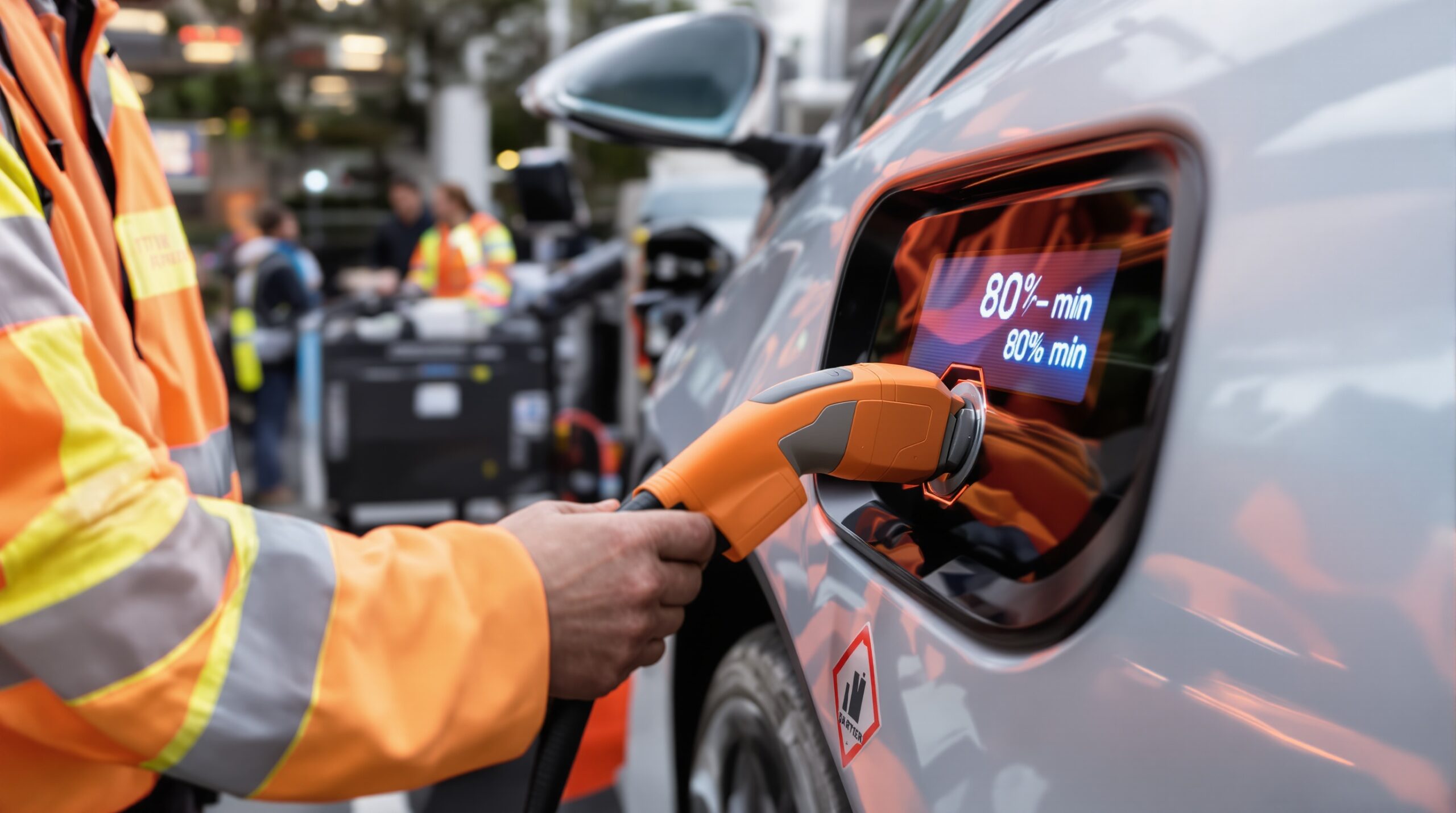
A prototype solid-state battery reached 80 percent charge in five minutes during controlled laboratory testing, researchers report. The result suggests electric vehicles could refuel almost as quickly as gasoline cars. If verified at scale, it would change charging expectations and infrastructure planning worldwide. This milestone also highlights rapid progress across materials, interfaces, and manufacturing approaches for solid-state systems.
The claim centers on an aggressive fast-charging benchmark for automotive packs. Achieving 80 percent in five minutes equals an average 9.6C charge rate. That figure meaningfully exceeds today’s best commercial lithium-ion charging performance. It also challenges thermal, electrical, and mechanical limits across vehicles and charging stations.
What the Five-Minute Claim Really Means
Charging 80 percent in five minutes would transform road-trip routines. Drivers could recover hundreds of kilometers in a short stop. For a 75 kilowatt-hour pack, adding 60 kilowatt-hours in five minutes requires 720 kilowatts on average. Peak power could reach higher levels to overcome internal resistance and tapering.
Today’s public chargers for cars typically peak around 350 kilowatts. Delivering 700 kilowatts or more requires thicker cables and active liquid cooling. It also demands careful grid interfacing to manage local peaks. Therefore, technology advances must align with infrastructure upgrades and intelligent charging strategies.
How Solid-State Designs Enable Faster Charging
Solid-state batteries replace the liquid electrolyte with a solid ion conductor. Developers pursue sulfide, oxide, and polymer-hybrid chemistries for this layer. The solid electrolyte can suppress lithium dendrites under specific conditions. It can also enable higher voltage cathodes and ultra-thin or anode-free designs.
Fast charging requires rapid ion transport and stable electrode interfaces. Solid electrolytes must combine high conductivity with low interfacial resistance. Engineers add protective interlayers to reduce reactivity and contact loss. They also manage stack pressure to maintain intimate contact during cycling.
Sulfide, Oxide, and Polymer Approaches
Sulfide electrolytes offer high ionic conductivity and good processability. They typically need moisture control because sulfides can release hydrogen sulfide gas. Oxide electrolytes provide chemical stability and high thermal tolerance. However, they can be brittle and demand precise ceramic processing.
Polymer and polymer-ceramic hybrids supply flexibility and easier lamination. Their conductivity improves with temperature, aiding fast charging after preheating. Many programs combine ceramic fillers with polymer matrices to balance performance. Each approach presents unique manufacturing and safety tradeoffs.
Interface Engineering and Anode-Free Concepts
Fast charging stresses the anode interface, especially with lithium metal. Anode-free solid-state cells deposit lithium directly on a copper current collector. This removes anode manufacturing steps and boosts energy density. It also concentrates risk at the plating interface under high currents.
Interlayers and gradient compositions can stabilize lithium plating. Designers tune surface energies to promote uniform deposition and stripping. They also optimize pressure, temperature, and electrolyte elasticity to prevent voids. These strategies target high-rate performance without destructive dendrite growth.
Power Delivery and Charging Infrastructure Implications
Delivering several hundred kilowatts reliably requires robust connectors and cables. Liquid-cooled leads reduce temperature rise during extreme sessions. The emerging Megawatt Charging System targets heavy vehicles with multi-megawatt capacity. High-power passenger charging may adopt similar concepts at lower ratings.
Sites need strong grid connections or on-site buffering. Battery energy storage can shave peaks and reduce demand charges. Smart scheduling and preconditioning coordinate pack temperature and state of charge. These measures align the vehicle’s capabilities with station availability and economics.
Thermal Management and Safety Considerations
Five-minute charging dumps intense heat into cells and busbars. Solid-state electrolytes reduce flammable liquid content, improving intrinsic safety. However, pack designs still require advanced cooling plates and heat spreaders. Timely preheating can raise conductivity and limit interfacial losses.
High rates can trigger localized hotspots and mechanical stress. Engineers model temperature gradients and current density distribution carefully. They validate designs using calorimetry and thermal runaway tests. Solid-state cells can raise abuse tolerance, yet they still need protective control strategies.
Cycle Life and Durability Under Extreme Rates
Endurance at high rates matters as much as a single fast session. Developers must show minimal swelling, impedance rise, and capacity fade. Industry targets often require hundreds of rapid cycles with constrained degradation. Results must hold under realistic temperatures and pack configurations.
Meaningful metrics include areal capacity and cathode loading. Automotive targets usually exceed three milliamp-hours per square centimeter. Balanced cathode loading and near-unity N/P ratios preserve energy density. Data at these loadings demonstrates true system relevance beyond coin cells.
Manufacturing and Scaling Pathways
Translating lab cells into automotive formats remains challenging. Roll-to-roll lamination, dry coating, and co-sintering are active areas. Yields must improve to control cost and ensure consistency. Manufacturers also need supply chains for precursors and moisture-controlled production lines.
Compatibility with existing electrode equipment lowers capital needs. Dry cathode processes could remove solvent recovery steps. Precision calendering and edge sealing protect interfaces during life. These practical considerations determine whether breakthroughs reach showrooms on time.
Independent Verification and Standardized Testing
Third-party validation remains essential for extraordinary claims. Cells should pass industry-standard protocols for performance and safety. Relevant tests include USABC fast-charge profiles and ISO 12405 procedures. Additional assessments cover vibration, thermal shock, and nail penetration behavior.
External labs can confirm data across temperatures and aging conditions. Pack-level demonstrations reveal thermal and electrical integration challenges. Robust evidence builds confidence among automakers and charging partners. Investors also seek clear milestones tied to certified results.
Consumer Experience and Charging Network Readiness
Five-minute charging changes driver expectations for road trips. Navigation systems could route to ultra-high-power stations automatically. Dynamic pricing and reservations may help manage station throughput. Meanwhile, vehicles will prepare packs with predictive thermal preconditioning.
Connector ergonomics and cable cooling will affect usability. Station operators must maintain uptime and calibration under heavy loads. Clear session feedback helps users trust aggressive charge profiles. These service details matter as much as headline power numbers.
Environmental and Grid Impacts
Ultra-fast charging introduces intense, short-duration grid demands. Local buffering can smooth spikes and enable renewable integration. Time-of-use strategies encourage charging during cleaner grid periods. Lifecycle assessments must consider electrolyte production and recycling pathways.
Solid electrolytes can reduce flammable solvents and fluorinated salts. Recycling processes may need adjustments for ceramic-rich composites. Designing for disassembly facilitates future material recovery. Aligning performance gains with sustainability goals strengthens the overall case.
Competitive Landscape and Timelines
Multiple companies pursue fast-charging solid-state platforms simultaneously. Automakers partner with specialized cell developers and materials suppliers. Pilot lines aim to validate repeatability and improve yields. Pre-production milestones often precede limited fleet trials under real conditions.
Commercialization timelines depend on scale, cost, and reliability. Achieving automotive warranties requires years of rigorous testing. Early deployments may target premium vehicles or fleets first. Broader adoption follows once manufacturing costs and field data stabilize.
What to Watch Next
Independent data on cycle life at five-minute charging matters most. Look for results at realistic areal loadings and capacities. Seek pack-level demonstrations with continuous, repeated ultra-fast sessions. Monitor how performance holds across winter and summer extremes.
Infrastructure pilots will reveal site-level challenges and solutions. Standards bodies will shape connector compatibility and safety requirements. Automaker announcements will clarify production intent and model timelines. These indicators will confirm whether the breakthrough is truly scalable.
Bottom Line
Reaching 80 percent charge in five minutes marks a striking achievement for solid-state cells. The advance promises gasoline-like refueling experiences for future electric vehicles. It also demands equally bold progress in thermal management and charging infrastructure. Practical success requires alignment across materials science, manufacturing, and grid planning.
Fast charging at this level needs robust validation and transparent data. Safety, durability, and cost must meet automotive expectations consistently. If developers deliver on these fronts, the market could accelerate decisively. That possibility now looks closer than many expected.
