

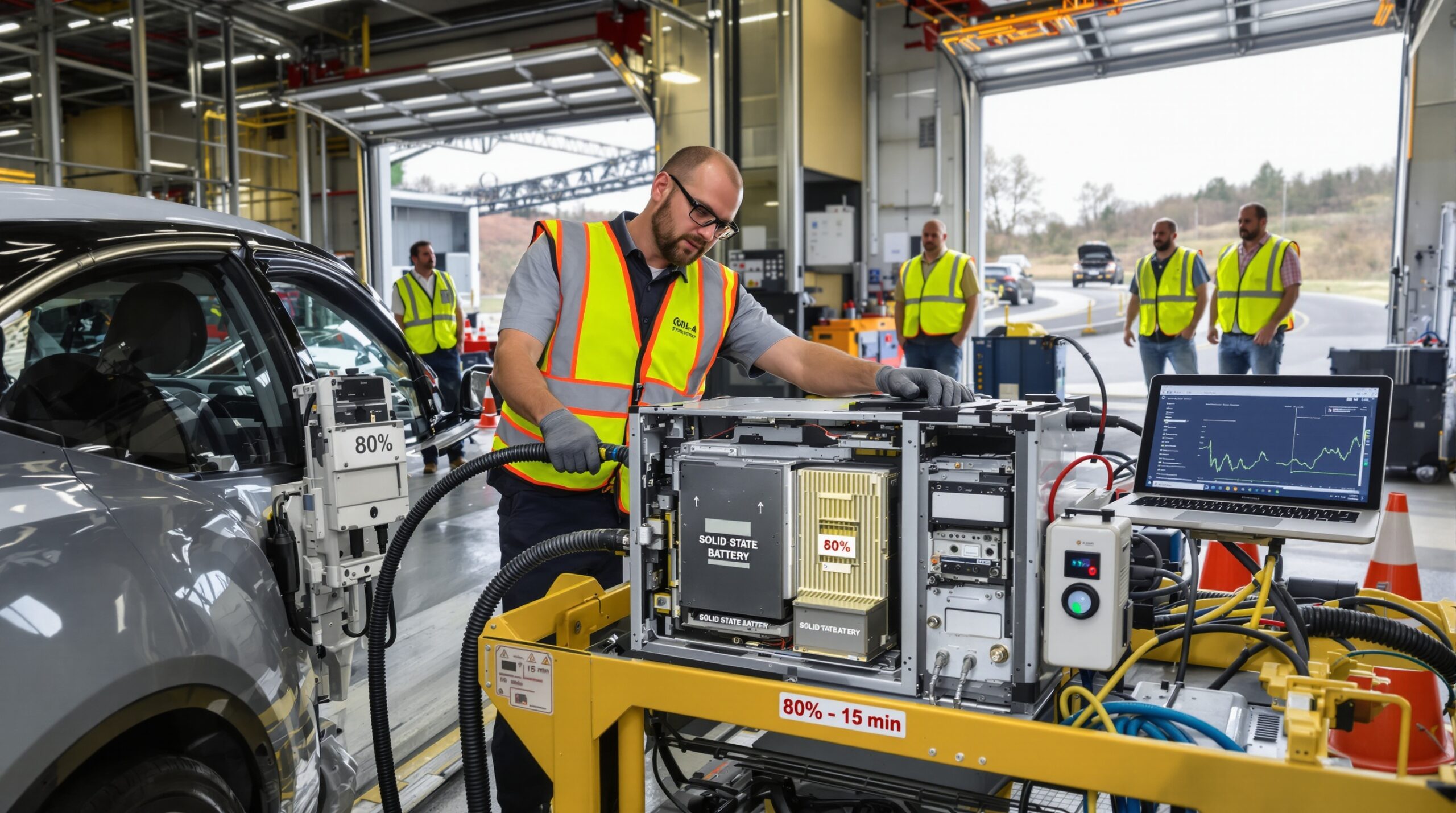
Independent road tests have validated a fast-charge breakthrough for a next-generation solid-state battery. This result arrives under real driving conditions, not lab simulations or carefully staged demonstrations. Such validation matters because it confirms performance outside controlled benches. Together, the findings signal momentum toward practical commercialization.
This breakthrough moves solid-state technology beyond exploratory claims. Solid-state batteries replace flammable liquid electrolytes with ion-conducting solids. The architecture promises higher energy density, improved safety, and faster charging. Those benefits often shrink in real-world testing and temperature extremes. With that foundation, we can examine what changed and why.
What the Fast-Charge Milestone Means
Fast-charge milestones describe how quickly a battery reaches high state of charge. Industry targets often reference reaching 70 to 80 percent within minutes. Charge curves should taper predictably as voltage limits approach. Independent test crews looked for repeatable performance across multiple sessions. They also tracked capacity retention after repeated fast-charge events.
Lab benches control heat, cabling, and power supply quality. Road tests reveal charger variability, wind, grades, and driver behavior. These factors can expose weaknesses in thermal management or interface software. Validation under realistic conditions therefore carries special weight for consumers. This aligns promising research with public expectations for reliability.
How Testers Validated Performance
Independent organizations typically follow documented methodologies and calibration routines. They instrument vehicles with thermal sensors, voltage taps, and precision current shunts. Routes include highway segments, elevation changes, and controlled preconditioning stops. Chargers vary by vendor, power rating, and firmware revision. That variety helps gauge robustness across the real charging ecosystem.
Key data points include charging time to defined thresholds. Testers record ambient temperature, pack inlet temperature, and coolant flow. They monitor cell delta temperatures to detect uneven heating. After charging, they measure recovered energy and state-of-health estimates. The combination paints a holistic picture of charging behavior.
Safety evaluations run throughout the protocol. Testers check for venting, abnormal odors, or swelling. They scan logs for overvoltage events and runaway indicators. Thermal cameras identify hot spots near tabs and interfaces. This vigilance builds confidence in the claimed breakthrough.
Why This Matters for Drivers
Faster charging shortens stops and reduces range anxiety. It enables more flexible trip planning with fewer compromises. Drivers benefit when vehicles negotiate optimal charge profiles automatically. Transparent performance builds trust and improves adoption rates. Convenience today becomes loyalty tomorrow.
Fast charging challenges battery longevity when designs are immature. Solid-state architectures promise better tolerance to high current. Independent endurance data eases warranty planning and residual value calculations. Lower degradation reduces total cost of ownership over several years. Confidence in durability supports fleet procurement decisions.
Implications for Automakers and Suppliers
Automakers must integrate cells with appropriate thermal and mechanical support. Pack designs may adopt pressure management and compliant interfaces. Battery management software must handle new impedance behaviors. Preconditioning strategies should align with charger capabilities and queues. Close collaboration with charger networks becomes essential.
Scaling solid electrolytes requires precise processing and cleanliness. Interfaces between lithium metal and solid electrolytes must resist dendrite formation. Manufacturers need consistent raw materials and tight tolerances. Production lines must support high throughput and quality assurance. Those requirements shape early deployment schedules and costs.
New chemistries often carry initial premiums. Learning curves and volume scaling reduce costs over time. Energy density gains can offset pack costs by enabling smaller packs. Lower cooling complexity may reduce system costs as well. Cost trajectories will shape adoption across market segments.
Grid and Infrastructure Effects
Fast charging demands high peak power at stations. Grid operators must manage loads and demand charges carefully. Onsite batteries and smart queuing can buffer surges. Better predictability increases charger utilization and revenue. These improvements support sustainable business models for networks.
Communication standards coordinate charging profiles and authentication. ISO 15118 features enable plug-and-charge and tariff handling. Open protocols help chargers identify battery limits precisely. Alignment across CCS and NACS reduces friction for drivers. Interoperability testing will remain a continuing priority.
Safety and Reliability
Solid electrolytes reduce flammability compared with liquid systems. They can inhibit dendrite growth under high currents. Designers still must manage pressure and microcracks carefully. Pack architectures incorporate sensors and pressure relief features. Layered defenses raise overall safety margins significantly.
Independent verification supports consumer trust and regulatory acceptance. Publicly shared datasets allow peer scrutiny and benchmarking. Clear test protocols discourage exaggerated performance claims. Transparency helps align marketing with engineering realities. That alignment accelerates healthy competition and innovation.
Remaining Questions and Next Steps
Results must hold across seasons, geographies, and charger brands. Cold weather remains the toughest environment for fast charging. Aged cells may exhibit higher resistance and slower acceptance. Long-term fleet pilots can expose rare failure modes. Manufacturers must scale production without eroding performance.
Regulators will review safety data and certification artifacts. Standards bodies may update test methods to reflect new architectures. Warranties must reflect real fast-charge usage profiles. Recycling pathways should handle new materials and binders. Second-life applications could use retired packs for stationary storage.
What to Watch Over the Next 12 Months
Pilot fleets should publish utilization and uptime metrics. Automakers may announce supply agreements and launch timelines. Independent labs could release corroborating reports and teardown analyses. Public charging providers might pilot higher power cabinets and cables. Watch for clear data sharing commitments alongside claims.
Competitors will push silicon-rich anodes and semi-solid variants. Hybrid approaches may bridge gaps while full solid-state matures. Expect diverse strategies for pack formats and thermal control. Vehicle-to-grid features could complement fast charging benefits. Competition should accelerate innovation and manufacturing improvements.
Conclusion
Independent road tests have verified a significant fast-charge achievement for solid-state batteries. The milestone demonstrates stability, speed, and repeatability under realistic constraints. Major challenges remain in manufacturing, cost, and cold-weather performance. Nevertheless, the foundation for broader deployment now looks stronger. From here, collaboration will determine how quickly drivers experience the benefits.
