

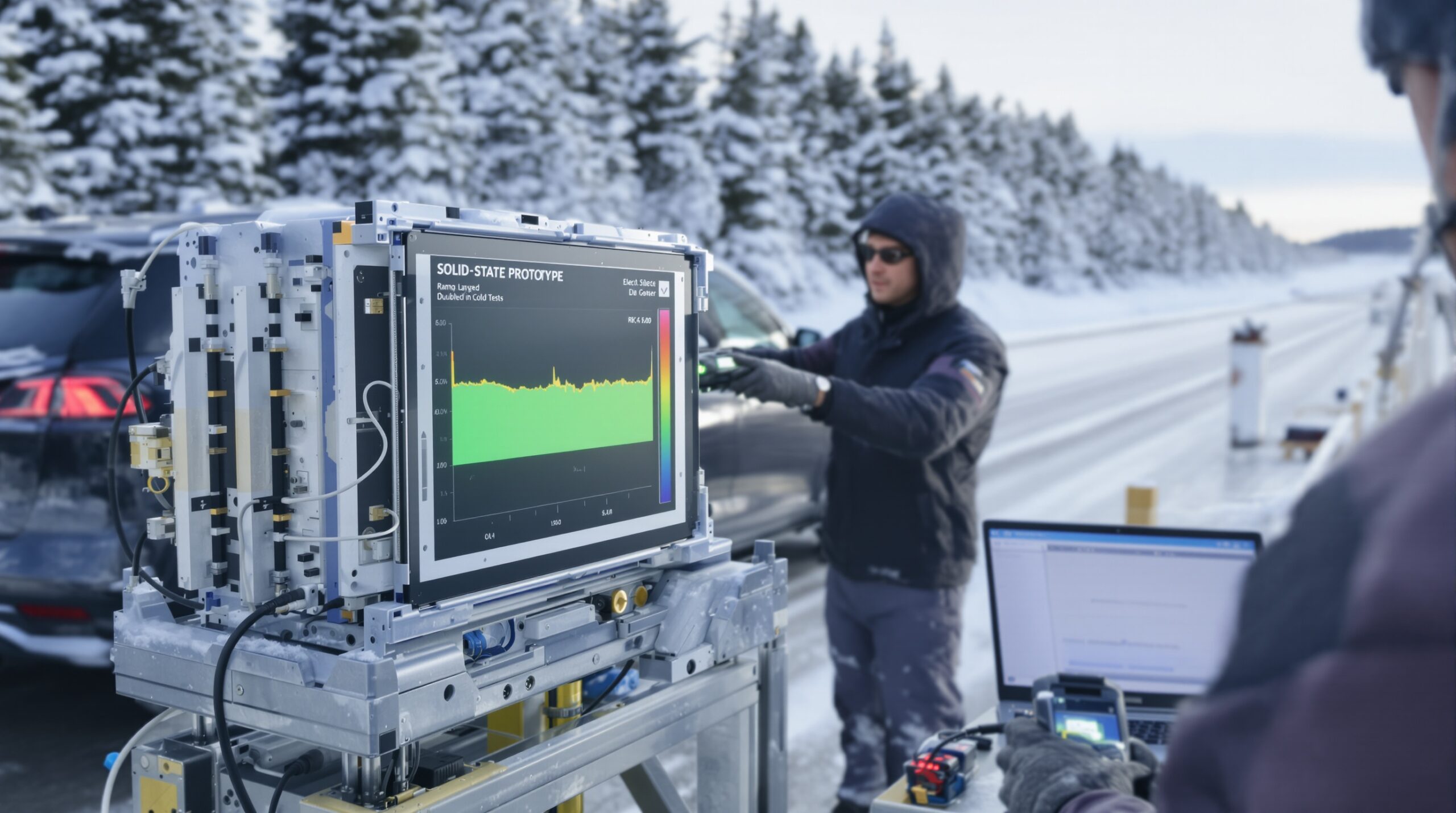
A research team has demonstrated a solid-state battery prototype that doubled driving range during cold weather tests. The result addresses one of electric mobility’s most frustrating pain points. Electric vehicles often lose substantial range when temperatures fall. This prototype reversed that trend and delivered stable performance in the cold.
The team designed the cell to maintain ionic conductivity at low temperatures. The battery used a solid electrolyte and a lithium metal anode. That combination reduced internal resistance and heat loss under load. The data suggests a meaningful step toward winter-ready electric transportation.
Why Cold Weather Reduces EV Range
Conventional lithium-ion batteries rely on liquid electrolytes that slow in the cold. Ions move reluctantly through viscous solvents at low temperatures. Electrode reactions also proceed more slowly when materials cool. These effects raise internal resistance and reduce available energy.
Drivers feel those losses as diminished range and weaker acceleration. Heating the cabin compounds the problem by drawing additional power. Many packs also divert energy to warm cells before charging. These combined penalties strain winter usability for many drivers.
Manufacturers use thermal management to mitigate those losses. Heat pumps, insulation, and preconditioning help offset cold penalties. Those systems add weight, cost, and complexity though. A better battery chemistry could reduce reliance on thermal workarounds.
What Sets the Solid-State Prototype Apart
The prototype replaces flammable liquid electrolyte with a solid ion conductor. The solid layer enables a thin lithium metal anode. That configuration increases energy density while limiting parasitic heating. The design aims to sustain conductivity without heavy thermal assistance.
Engineers focused on the interface between electrolyte and electrodes. They applied coatings that lowered interfacial resistance during cold starts. Those treatments suppressed dendrite formation under high current. The result allowed safe operation without aggressive warmup cycles.
The cathode used a composite structure with tailored porosity. This architecture improved ion transport across the electrode thickness. It also maintained contact under cycling and pressure changes. That stability supported consistent performance across temperature swings.
Mechanical design mattered as well. The stack used uniform pressure management across the cell area. A balanced compressive load reduced microgaps at interfaces. That approach protected conductivity when materials contracted in cold conditions.
How the Team Tested the Prototype
The researchers moved from coin cells to multi-layer pouch cells. They then integrated modules into a test pack. The pack interfaced with a powertrain equivalent to a compact crossover. That setup allowed controlled comparisons with a conventional lithium-ion pack.
Cold-chamber tests simulated subfreezing climates with repeatable profiles. The team ran standardized drive cycles and measured energy usage. They recorded power, voltage, temperature, and degradation metrics. Those measurements captured behavior during discharge and charging.
The protocol included parked cold soak, dynamic driving, and rapid charging. Thermal management operated at a minimal baseline to isolate chemistry effects. Cabin heating loads were applied in separate trials. That separation clarified impacts from auxiliary power demands.
Independent observers reviewed the procedures and raw data. The team shared calibration details and control comparisons. That transparency strengthened confidence in the reported gains. External validation will still be essential before commercialization.
Results From Cold Weather Trials
The solid-state pack delivered roughly double the range during cold cycles. The comparison used the same pack mass and footprint. The powertrain and vehicle mass remained unchanged between tests. That equivalence supported a direct chemistry comparison.
The prototype maintained higher available power at subfreezing temperatures. Drivers would experience stronger acceleration and steadier regenerative braking. Voltage sag remained low during high demand events. That stability improved drivability without heavy thermal assistance.
Fast charging performance also improved from a cold start. The pack accepted higher current with limited preheating. Charge times shortened in the cold chamber compared with the baseline pack. The behavior mirrored lab impedance measurements across temperatures.
Safety performance showed encouraging trends. The solid electrolyte removed most flammable solvents from the cell. Abuse tests recorded controlled responses under fault scenarios. These results support additional safety engineering for future designs.
Implications for Electric Vehicle Design
Better cold weather efficiency unlocks several design opportunities. Engineers could reduce pack oversizing intended to cover winter losses. Smaller packs would lower cost and vehicle mass. Those changes would improve efficiency year-round.
Thermal systems could become simpler with a resilient chemistry. Automakers might shrink heaters and coolant loops for batteries. Simpler systems would save space under the floor. Reduced complexity typically improves reliability and serviceability.
Charging infrastructure would also benefit. Stations in cold regions could deliver higher effective throughput. Vehicles would spend less time warming packs before charging. Faster turnaround helps networks serve more drivers with existing hardware.
Manufacturing and Scale-Up Challenges
Prototype success does not guarantee smooth manufacturing. Solid electrolytes require precise processing and clean environments. Interfaces demand tight tolerances across large areas. Those requirements complicate high-volume production lines.
Costs must drop through materials selection and yield improvements. Many solid electrolytes remain expensive or sensitive to moisture. Protective coatings add steps and capital costs. Producers will need streamlined workflows to stay competitive.
Durability is another priority. Cells must survive thousands of cycles across seasons. Mechanical and chemical stability at interfaces must hold. Consistent performance under real road vibrations remains essential.
Roadmap for Validation and Deployment
The next phase involves larger modules and pack-level pilots. Engineers will refine thermal strategies for mixed climates. Fleets will provide data from diverse duty cycles. Those results will guide product engineering and warranties.
Certifications will follow as designs mature. Safety agencies will evaluate crash, puncture, and thermal runaway resistance. Transport regulators will review shipping and recycling processes. These steps precede any retail launch.
Supply chains need early alignment. Solid electrolyte suppliers must scale facilities with quality controls. Equipment vendors will adapt coating and lamination tools. These moves help shorten time to market.
Context Within the Solid-State Landscape
Automakers and startups are pursuing multiple solid-state paths. Some target sulfide electrolytes with high conductivity and easy processing. Others study oxides with strong stability but tougher manufacturing. Polymers still attract interest for flexible designs.
The industry seeks a balanced solution. Winning chemistries must deliver conductivity, stability, safety, and cost. Cold weather performance adds another demanding metric. This prototype shows the benefit of prioritizing low-temperature behavior.
Competition will accelerate learning. Shared test methods and independent comparisons will clarify tradeoffs. Cross-industry partnerships could spread manufacturing know-how. Collaboration often shortens the path from lab to road.
What to Watch Over the Next Two Years
Look for third-party validation at pack scale. Independent labs should confirm cold chamber results and cycle life. Fleet pilots in cold regions will provide direct feedback. Those milestones will indicate readiness for integration.
Watch for charging performance improvements at low temperatures. Reliable fast charging without lengthy preheating would change winter routines. Metrics should track time to charge and energy throughput. Those figures matter for drivers and station operators.
Monitor warranty targets and degradation curves. Manufacturers must guarantee capacity retention across seasons and years. Predictable winter range builds driver confidence. Durable chemistries reduce total cost of ownership.
Environmental and Safety Considerations
Solid electrolytes reduce use of volatile organic solvents. This change lowers some manufacturing emissions and safety risks. Enhanced safety performance can reduce protective materials and weight. Those gains improve vehicle efficiency and sustainability.
Recycling pathways will need adaptation for new materials. Processors must handle solid electrolytes and lithium metal safely. Early design for disassembly will help recyclers manage materials. Circular strategies can stabilize supply and reduce impacts.
Bottom Line
The prototype’s cold weather results mark a notable advance for solid-state technology. Doubling range in the cold reshapes winter expectations. Drivers could plan trips with fewer compromises and less preconditioning. The data points toward more robust year-round electrification.
Significant engineering work remains before mass production. Manufacturing, durability, and cost must align with automotive requirements. Transparent validation and careful scale-up will determine success. The breakthrough sets a clear direction for the industry.
If future trials reproduce these gains at scale, winter range may stop dominating purchase decisions. That shift would expand the market for electric vehicles in cold regions. It would also ease infrastructure planning and energy demand forecasting. Momentum now depends on rigorous testing and practical engineering.
