

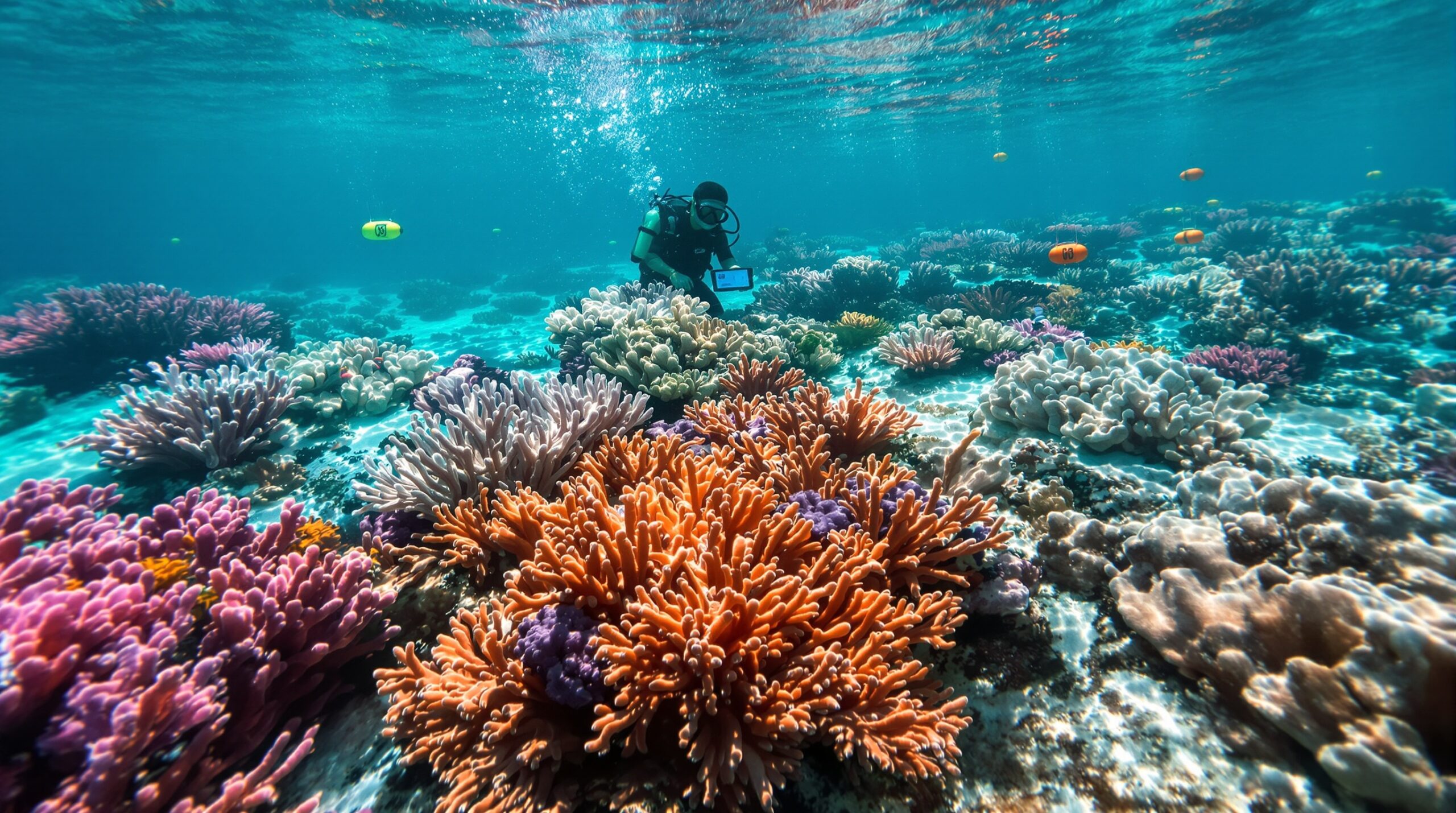
Mass bleaching now threatens tropical reefs with increasing frequency and severity. Restoration teams are therefore testing new tools alongside traditional practices. One emerging tool uses precise gene editing to bolster coral heat tolerance. A carefully contained open-ocean pilot has now evaluated this approach in situ. The results highlight promise, while underscoring the need for strict oversight and transparent monitoring.
Context matters for interpreting these findings responsibly. As of 2024, documented in-ocean work with gene-edited corals remained highly limited. Regulators and scientists prioritized containment, stepwise trials, and extensive risk assessments. Teams typically used anchored nursery structures that isolate test colonies. This pilot followed that cautious playbook within an open-ocean setting.
What the pilot set out to test
The project aimed to evaluate whether gene-edited juvenile corals tolerate heat stress better in ocean conditions. Researchers targeted host genes associated with the cellular stress response. They focused on pathways tied to protein folding, oxidative balance, and membrane stability. The team used CRISPR-based edits during early developmental stages. They then raised edited and non-edited siblings under identical hatchery conditions.
Species selection reflected restoration priorities and biological feasibility. The team included a fast-growing branching coral for structural habitat recovery. They also included a more stress-tolerant massive coral for durability. Edited and control cohorts came from the same parental crosses. That design helped isolate editing effects from genetic background differences.
From nursery tanks to contained ocean structures
Researchers established contained ocean nurseries on a degraded reef site. Divers mounted coral microfragments onto standardized ceramic plugs. They then affixed the plugs within enclosed frames that minimized accidental dispersal. Teams installed redundant barriers and fine mesh panels. They also positioned the structures to avoid strong currents during spawning seasons.
Environmental permitting required rigorous safeguards. Agencies reviewed biosecurity plans and emergency retrieval protocols. Independent advisors reviewed the monitoring design and success criteria. Local stakeholders participated in siting decisions and operational reviews. The project emphasized transparency and community engagement from the outset.
How heat tolerance was measured
The team used a mix of physiological and ecological indicators. They tracked survival, growth rates, and bleaching severity over seasonal cycles. Divers measured photosynthetic efficiency using pulse amplitude modulated fluorometry. They quantified symbiont densities and chlorophyll a concentrations in small tissue samples. They also assessed calcification using buoyant weight measurements.
Controlled heat challenges complemented ambient monitoring. Technicians ran ramped thermal stress trials within enclosed in-water units. They raised temperatures following standardized bleaching protocols. They then recorded time to bleaching onset and recovery dynamics. They compared edited corals directly against non-edited siblings under identical conditions.
Reported performance under elevated temperatures
Edited corals showed stronger performance during heat stress periods relative to controls. They maintained higher photosynthetic efficiency at peak temperatures. They also exhibited fewer visible bleaching signs during thermal spikes. Recovery after stress abated appeared faster in edited cohorts. Growth rates in non-stress periods remained comparable between groups.
These differences persisted across both species, with variation in magnitude. Branching corals showed pronounced performance gaps during acute events. Massive corals displayed more modest but consistent advantages. Notably, edited corals avoided severe decline during the hottest intervals. Controls showed greater physiological strain and slower recovery metrics.
Molecular and cellular signals supporting the observations
Lab analyses suggested plausible mechanisms for improved tolerance. Edited corals showed stronger induction of heat shock proteins during thermal stress. Antioxidant enzyme activity increased more rapidly in edited tissues. Lipid membrane integrity markers remained more stable at high temperatures. Transcriptomic profiles indicated reduced inflammatory signaling during peak stress.
Symbiont communities remained stable in the edited group during heat events. Controls showed shifts toward less productive symbiont compositions under stress. Microbiome profiles in edited corals remained diverse and balanced. Those patterns align with reduced dysbiosis during thermal challenges. Together, these signals support a biologically coherent tolerance response.
Crucial boundaries and biosecurity safeguards
Researchers drew a clear line between gene editing and gene drive technologies. This project did not use gene drive systems. Edits targeted coral resilience traits without biased inheritance mechanisms. Reproductive containment served as another critical safeguard. Juvenile colonies did not reach reproductive maturity during the trial window.
Teams implemented strict handling and retrieval procedures. Divers inspected barriers before and after storms. They removed and sterilized any detached materials promptly. Gear decontamination followed detailed protocols to prevent offsite transfer. Emergency plans outlined steps for rapid nursery depopulation if needed.
Regulatory oversight and ethical considerations
Permitting authorities required environmental assessments and risk mitigation plans. External ethics advisors reviewed the pilot scope and limits. The project maintained a public registry of methods and monitoring data. Stakeholder workshops invited feedback and surfaced practical concerns. Indigenous and local communities contributed knowledge and priorities to the design.
Importantly, the team emphasized climate mitigation as the ultimate solution. Gene editing cannot replace emissions cuts or ecosystem protection. It can, however, complement broader conservation strategies under strict governance. Responsible use depends on clear goals, adaptive management, and transparency. This pilot’s design reflected that responsibility framework throughout operations.
How this approach fits within the restoration toolbox
Managers now evaluate multiple resilience strategies concurrently. Assisted gene flow moves warmer-adapted genotypes into cooler reefs. Selective breeding combines heat-tolerant traits across populations. Probiotics and microbiome manipulation aim to stabilize coral holobionts. Shading and localized cooling provide temporary relief during extreme events.
Gene editing offers precision but demands caution. It can target host genes that regulate stress responses directly. It can also complement symbiont selection approaches. Integrated strategies may provide the best path for near-term resilience. Coordination helps avoid duplication and unintended trade-offs across interventions.
Limits, uncertainties, and trade-offs
Several questions require longer observation periods. Longevity and lifetime reproduction effects remain unknown in edited corals. Stress tolerance may trade off with growth or disease resistance. Fitness costs could emerge under nutrient stress or acidification. Multi-stressor testing will help clarify these potential trade-offs.
Gene flow risks also demand ongoing attention. Containment reduces near-term dispersal from nursery structures. However, later outplanting decisions would need further review. Managers would need clear thresholds for broader deployment. Independent replication would also strengthen confidence in results and safety.
A roadmap for monitoring and decision points
The team outlined a staged monitoring plan with clear gates. Year one focuses on survival, bleaching, and physiology trends. Years two and three evaluate growth, disease, and storm resilience. Years four and five assess reproductive development and potential gene flow. Each stage includes predefined triggers for pausing or adjusting activities.
Data transparency remains central to the roadmap. The project commits to open access datasets and protocols. External reviewers will audit methods and results annually. Stakeholders can track progress through public dashboards and reports. This approach supports trust and adaptive management over time.
What “open-ocean” means in this pilot
Open-ocean here refers to in situ nurseries anchored on natural reefs. The pilot did not involve unrestricted outplanting beyond contained structures. Containment reduced ecological exposure and aided monitoring. This distinction matters for interpreting both risks and benefits. It also clarifies the project’s careful, limited scope.
Future steps would require additional approvals and safeguards. Managers would evaluate cumulative impacts alongside regional programs. Cross-institutional replication would test robustness across environments. Long-term stewardship arrangements would cover maintenance and incident response. These measures help align innovation with precaution.
Why the findings matter for reef futures
Reefs face warming trends that already exceed past variability. Coral losses cascade into fisheries, tourism, and coastal protection impacts. Any tool that safely extends coral tolerance deserves careful evaluation. This pilot offers early evidence under real ocean conditions. The findings encourage further study within strict guardrails.
Practical restoration demands multiple, complementary actions. Managers can combine habitat protection, water quality improvements, and assisted evolution. They can scale methods that prove both safe and effective. They must also sunset methods that show unacceptable risks. This balanced approach supports resilient reef management under climate stress.
The bottom line
This contained open-ocean pilot reported enhanced heat tolerance in gene-edited corals. The benefits appeared across species and metrics. Safeguards, oversight, and community engagement anchored the work. Important uncertainties remain and warrant extended monitoring. Continued caution and transparency will determine whether this tool earns a broader role.
Meanwhile, emissions reductions remain the decisive lever for reef survival. Restoration can buy time only when paired with mitigation. Science can help corals endure near-term temperature shocks. Policy can limit the long-term magnitude of those shocks. Together, these efforts offer the best chance for living reefs ahead.
