

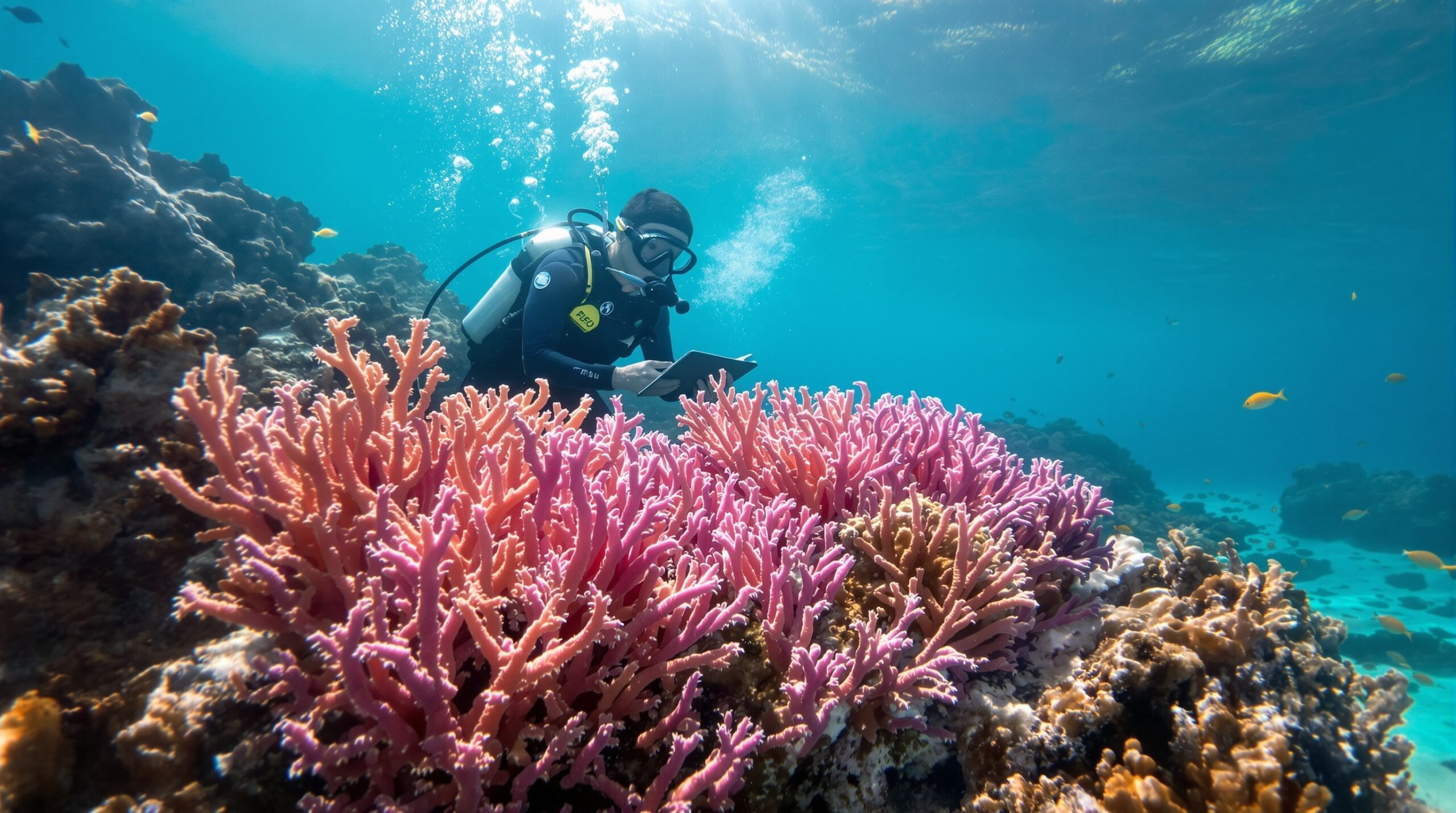
Scientists report that gene-edited coral can withstand heat stress better than unedited counterparts in controlled experiments. The results strengthen confidence in an ambitious goal: restoring reefs at meaningful, ecosystem scales. Researchers emphasize that the work remains early-stage and carefully contained. However, the findings align with a growing body of assisted evolution science. Together, these advances offer a pragmatic pathway while emissions reductions remain essential.
What the new results show
Teams edited coral embryos and then exposed juveniles to elevated temperatures simulating marine heatwaves. The edited corals maintained higher photosynthetic efficiency and experienced reduced bleaching compared with controls. They also showed improved survival during prolonged heat stress in laboratory tanks. Importantly, the edited corals preserved symbiont densities under temperatures that typically cause bleaching. These outcomes suggest heat tolerance can be enhanced through targeted genomic changes.
The research complements past demonstrations in coral models and closely related cnidarians. It builds on earlier gene editing work that validated methods in coral embryos. The latest experiments focus on traits linked to thermal resilience, not only developmental processes. Therefore, the results mark an important step toward functionally meaningful edits. Yet, researchers caution that field performance still requires rigorous testing under real reef conditions.
How scientists edited corals
Researchers used CRISPR-Cas9 to target candidate genes involved in stress responses and symbiosis regulation. They microinjected ribonucleoprotein complexes into fertilized coral eggs during brief spawning windows. The edits created mosaic juveniles, a common outcome for early coral applications. Scientists screened larvae to confirm mutations before thermal trials. This pipeline allowed efficient selection of edited individuals for stress testing.
Candidate genes reflect pathways implicated in heat tolerance, including antioxidant defense and cellular stress signaling. Some edits modified regulatory regions that influence gene expression under heat. Others focused on factors that help maintain symbiosis during thermal stress. Delivery techniques minimized off-target effects by using transient CRISPR complexes. Still, teams performed sequencing to assess editing precision and detect unintended changes.
Why heat tolerance matters
Coral bleaching occurs when thermal stress disrupts the partnership between corals and symbiotic algae. Prolonged anomalies of even one degree Celsius above local summer maxima can trigger bleaching. Repeated heatwaves have increased in frequency and intensity across major reef provinces. In 2023 and 2024, NOAA confirmed a widespread global bleaching event. Many reefs now face compounding stressors that degrade recovery capacity between heatwaves.
Heat-tolerant corals could better withstand peak temperatures and maintain functions that support reef ecosystems. Increased tolerance would help preserve growth, habitat complexity, and fish biomass. It would also sustain coastal protection and tourism value under rising thermal extremes. However, thermal tolerance alone cannot offset acidification, pollution, and overfishing. Therefore, genetic tools should complement broader conservation and climate mitigation strategies.
Context within the assisted evolution toolkit
Assisted evolution includes selective breeding, hybridization, acclimation, and symbiont manipulation approaches. Selective breeding identifies naturally resilient coral genotypes through rigorous screening. Hybridization can introduce genetic variation that sometimes yields heat-tolerant offspring. Acclimation protocols condition corals to moderate heat stress before outplanting. Gene editing adds precision by targeting known pathways, potentially accelerating desired outcomes.
Each approach offers benefits and trade-offs for restoration programs. Breeding retains natural variation but requires many generations. Acclimation effects may fade without continued exposure. Symbiont manipulations can enhance tolerance but sometimes reduce growth. Gene editing promises speed and specificity, yet demands thorough risk assessment. Consequently, integrated strategies will likely deliver the best reef outcomes.
Symbiont partnerships remain pivotal
Coral resilience depends heavily on the identity and performance of Symbiodiniaceae symbionts. Scientists culture heat-tolerant strains and test their compatibility with different coral hosts. Some strains resist bleaching but may slow host growth under normal conditions. Edited coral may pair more stably with resilient symbionts during heatwaves. Therefore, matching host genotypes and symbiont strains remains a critical design choice.
Scaling restoration from lab to reef
Scaling requires consistent production of edited larvae during spawning events. Hatchery teams fertilize eggs, perform microinjections, and rear larvae in biosecure systems. Juveniles settle on engineered substrates that support growth and handling. Technicians outplant corals using standardized methods across prepared reef sites. Logistics must cover permits, vessel time, monitoring, and maintenance during early establishment.
Genetic diversity remains essential for long-term resilience and adaptation. Programs should use multiple genotypes and avoid genetic bottlenecks. Managers can design mosaics that mix edited, bred, and wild-sourced corals. This approach spreads risk and supports ecological functions across changing conditions. Meanwhile, repositories and cryobanks safeguard genetic resources for future efforts.
Monitoring and performance metrics
Field evaluation should track survival, growth, bleaching resistance, and reproduction across seasons. Teams should record symbiont stability and community interactions. Sensors can measure temperature, light, and pH at restoration plots. Genetic assays verify edit persistence and potential gene flow. Transparent data platforms help managers refine strategies across sites and years.
Risks, safeguards, and ethical considerations
Gene editing introduces risks that require layered safeguards. Off-target edits could impair fitness under non-stress conditions. Enhanced heat tolerance might trade off with growth or disease resistance. Edits could spread beyond intended areas if not carefully managed. Comprehensive testing and staged releases can minimize these risks.
Ethical frameworks emphasize transparency, public engagement, and equitable benefit sharing. Indigenous and local communities hold deep relationships with reefs. Restoration projects should involve them from planning through evaluation. Programs must share findings, acknowledge uncertainties, and respect cultural values. This inclusive process strengthens legitimacy and long-term stewardship.
Regulatory and governance landscape
Regulatory pathways vary across countries and territories. Some jurisdictions treat gene-edited organisms differently from transgenic organisms. Environmental release typically requires risk assessments, permits, and monitoring plans. International agreements influence governance for marine genetic interventions. Clear, adaptive rules can enable innovation while protecting ecosystems.
Economics and partnerships
Large-scale restoration demands sustained funding and coordinated partnerships. Tourism, fisheries, and insurance stakeholders have strong incentives to participate. Public funding can support infrastructure and workforce training. Private investment can scale production and deployment capacity. Cross-sector consortia can align science, logistics, and stewardship for durable outcomes.
Next research steps
Teams must test edited corals across diverse reef environments. Mesocosm experiments can bridge laboratory and field conditions. Researchers should evaluate multiyear survival and reproductive success. They should also measure heritability and potential gene flow consequences. These studies will inform deployment standards and adaptive management frameworks.
Modeling can guide where edited corals offer the greatest benefit. Climate projections can identify thermal refugia and high-risk areas. Spatial planning can integrate water quality improvements and herbivore protection. Early deployments may target sites with robust governance and monitoring capacity. Learning networks can share results and refine practices quickly.
What success could look like
Successful programs would maintain coral cover through successive heatwaves. Restored reefs would continue providing habitat and coastal protection. Fisheries would benefit from stable nursery grounds and productivity. Tourism would retain vibrant reef experiences and local employment. Communities would gain resilience while global mitigation advances.
Outlook
Gene-edited coral demonstrates a promising boost to thermal tolerance under controlled conditions. The work complements breeding, symbiont management, and habitat protection. Responsible scaling will require careful evaluation, transparency, and strong partnerships. Meanwhile, rapid emissions cuts remain vital for reefs to survive. With both, restoration can move from boutique projects to meaningful reef-level impact.
