

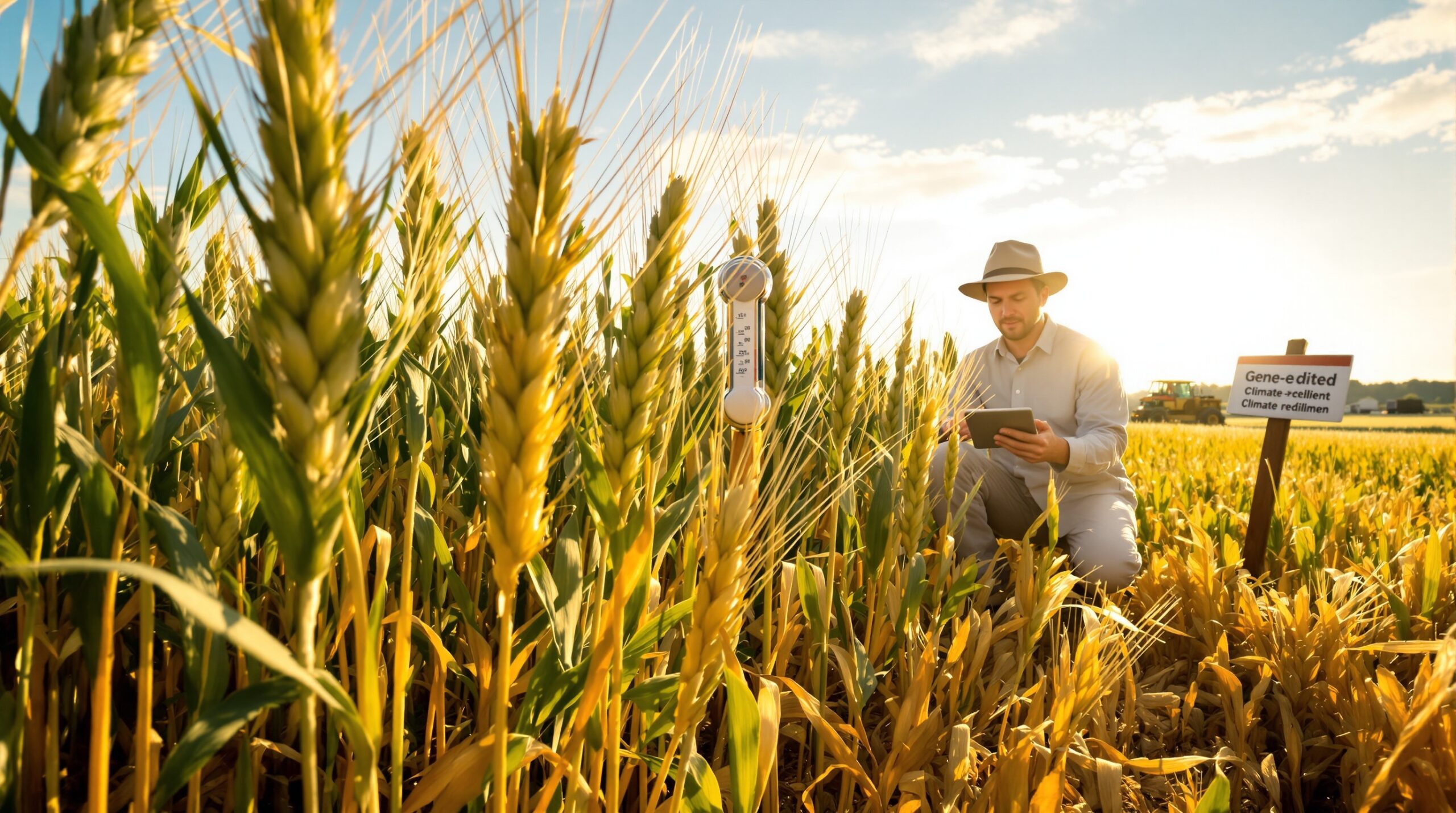
Gene-edited wheat is advancing as a defense against punishing heatwaves affecting farms worldwide. Scientists are designing precise DNA edits that help plants keep cool, protect pollen, and hold yield. These efforts aim to stabilize harvests as temperatures swing more wildly. The approach marks a pragmatic shift toward building climate resilience into staple crops.
Heatwaves have become longer, hotter, and more frequent across major wheat belts. Wheat yields suffer when extreme heat hits during flowering and grain filling. Each 1°C of warming can reduce global wheat yields by about six percent. Those losses threaten food prices, farmer incomes, and national reserves, so durable solutions matter.
Why heatwaves imperil wheat yields
Wheat is especially sensitive during flowering, when pollen must survive and fertilize florets. Temperatures above the mid‑30s Celsius can impair pollen viability and spikelet fertility. Heat also accelerates development, shortening grain filling and reducing final grain weight. The damage multiplies when heat combines with drought and hot nights.
Heat stress disrupts proteins, membranes, and photosynthesis in leaf tissues. Plants generate reactive oxygen species that damage cells under thermal stress. Stomata often close to conserve water, which restricts cooling and carbon uptake. Together, these responses depress biomass and yield if exposure persists.
How gene editing changes the breeding toolbox
Traditional breeding has delivered valuable heat tolerance, but it is slow and imprecise. Gene editing allows breeders to tweak specific genes or regulatory switches without adding foreign DNA. CRISPR‑based edits can create subtle variants that fine‑tune plant responses under heat. This precision accelerates testing and stacking of traits that work together.
Breeders can mimic beneficial alleles found in landraces, or design new promoter variants. They can also knock out genes that limit stress tolerance. Such flexibility complements genomic selection and speed breeding pipelines. It links molecular targets with field performance much more efficiently.
Targeting heat stress signaling and protection
Heat shock factors and their chaperone partners help plants refold damaged proteins. Editing regulatory regions can elevate protective responses earlier during heat spikes. Improved chaperone activity can stabilize photosystems and membranes under extreme temperatures. Researchers also test edits that enhance antioxidant systems to limit cellular damage.
These protective circuits act as the crop’s first shield against acute stress. With faster and stronger activation, tissues can maintain function longer. That buffer buys time for the plant during critical reproductive windows. The result can be more stable grain set when heat arrives suddenly.
Optimizing stomata for cooling and water economy
Leaves cool through transpiration, which depends on stomatal conductance and density. Editing stomatal development genes can balance evaporative cooling with water savings. Studies in rice and barley show reduced stomatal density can conserve water while maintaining cooling. Wheat researchers are pursuing analogous targets to sustain canopy temperature control.
The goal is to avoid overheating without exhausting soil moisture reserves. Canopies that stay cooler keep photosynthesis productive under heat stress. That stability supports carbohydrate supply for developing grains. Carefully tuned stomata improve resilience across both hot and dry spells.
Adjusting flowering time and heat escape
Shifting flowering to cooler windows can prevent heat damage. Gene editing can fine‑tune flowering genes that sense daylength and temperature. Edited alleles can move heading dates by days rather than weeks. This precision helps farmers match varieties to evolving local heat patterns.
Heat escape complements physiological tolerance within a single variety. Farmers gain flexibility without changing planting calendars drastically. Breeders can combine timing tweaks with other heat resilience traits. Together, those edits strengthen the whole crop system against heat spikes.
Protecting pollen, ovules, and grain set
Reproductive tissues are the Achilles’ heel during heatwaves. Edits that stabilize meiosis and pollen development can safeguard fertility. Research has identified genes that influence chromosome pairing under temperature stress. Tuning their expression can reduce failed fertilization events during hot spells.
Breeders also target sugar transport and hormone signaling in florets. Those pathways support fertilization under stress and early grain development. The objective is simple and crucial for yield: more grains per spike. Protected fertility directly translates into better harvest stability.
Strengthening roots for water and cooling
Deeper, steeper roots help plants access subsoil moisture during heatwaves. Editing root angle and branching genes can shift architecture favorably. Improved water uptake supports transpiration cooling and nutrient delivery. These root traits also bolster resilience during combined heat and drought stress.
Root edits must align with soil types and farming systems. Breeders therefore test lines across contrasting environments and management practices. The best performers keep canopy function during critical growth stages. That field performance confirms whether edited roots provide real advantages.
Evidence from labs, greenhouses, and early plots
Gene-edited wheat lines are moving from controlled experiments into small plot evaluations. Early results show improved photosynthesis and grain set under imposed heat stress. Some lines maintain cooler canopy temperatures during simulated heatwaves. Others preserve spike fertility compared with unedited counterparts under identical stress.
Researchers also draw confidence from related crops showing clear benefits. Edits that adjust stomata, flowering time, and stress signaling improved heat tolerance in rice and barley. Those pathways are conserved and relevant in wheat biology. That cross‑crop evidence guides target selection and validation strategies.
Field testing remains essential because heatwaves vary in intensity and timing. Breeders need multi‑year, multi‑location data to confirm stable benefits. They also monitor any trade‑offs in yield potential and grain quality. This discipline ensures edited varieties perform reliably for farmers.
Implications for food security and farmer livelihoods
Heat‑resilient wheat can stabilize yields in regions facing frequent hot spells. Stable yields support farm incomes and reduce price volatility for consumers. Lower irrigation demand can reduce pumping costs and energy use. These gains matter in water‑stressed districts and heat‑prone plains.
Resilient varieties also reduce disaster risk for public grain programs. Governments can plan reserves with greater confidence during extreme seasons. Millers and bakers benefit from steadier grain quality and supply. That stability supports employment and keeps food shelves dependable.
Regulation, safety, and public trust
Countries regulate gene editing differently based on the type of DNA change. Some jurisdictions exempt simple edits that could occur naturally. Others evaluate edited crops under existing biosafety frameworks. Developers therefore tailor regulatory strategies to each market’s rules.
Safety assessments focus on the product rather than the method in many places. Compositional analyses compare edited grain with conventional varieties. Off‑target edits are monitored with whole‑genome sequencing. Transparency and communication help build confidence among farmers and consumers.
Access, equity, and stewardship
Equitable access ensures smallholders benefit from heat‑resilient wheat. Public breeders and partnerships can release locally adapted lines broadly. Seed systems must support timely, affordable distribution in vulnerable regions. Stewardship guides responsible deployment alongside agronomic best practices.
Open research networks can share data on targets and field results. That collaboration accelerates progress and avoids duplicated efforts. Licensing models can expand access while rewarding innovation fairly. Farmers then receive real choices that fit their environments and markets.
Integrating editing with modern breeding pipelines
Gene editing works best alongside genomic selection and speed breeding. High‑throughput phenotyping captures canopy temperature, fluorescence, and fertility metrics. Those data link edits with performance under realistic heat scenarios. Machine learning models can predict promising edit combinations for testing.
Breeders also track grain quality traits like protein and dough rheology. Comprehensive profiling ensures resilience does not compromise end‑use value. Iterative cycles refine edits and select superior backgrounds. The process steadily turns molecular ideas into farmer‑ready varieties.
Challenges and next steps
Heat tolerance is polygenic and environment dependent, which complicates design. Edits must avoid unintended penalties under cool, favorable seasons. Field trials need robust statistics across diverse locations and years. Breeders must also watch for interactions with pests and diseases.
Scaling seed production and stewardship will require coordinated planning. Clear labels and outreach can address questions about the technology. Public investment can speed validation in harsh environments. With sustained effort, climate‑proof wheat can reach fields at scale.
A practical path to climate‑proof staples
Gene‑edited wheat offers a timely, science‑based response to deadly heatwaves. The strategy strengthens plant defenses, protects reproduction, and stabilizes yield. Evidence from controlled studies and early plots points to real promise. Wider testing will translate promise into dependable performance for farmers.
Breeding teams now integrate editing with data‑rich selection pipelines. Regulators and seed systems are aligning to evaluate products efficiently. Partners across public and private sectors can ensure equitable access. With concerted action, wheat can better withstand the climate shocks ahead.
