

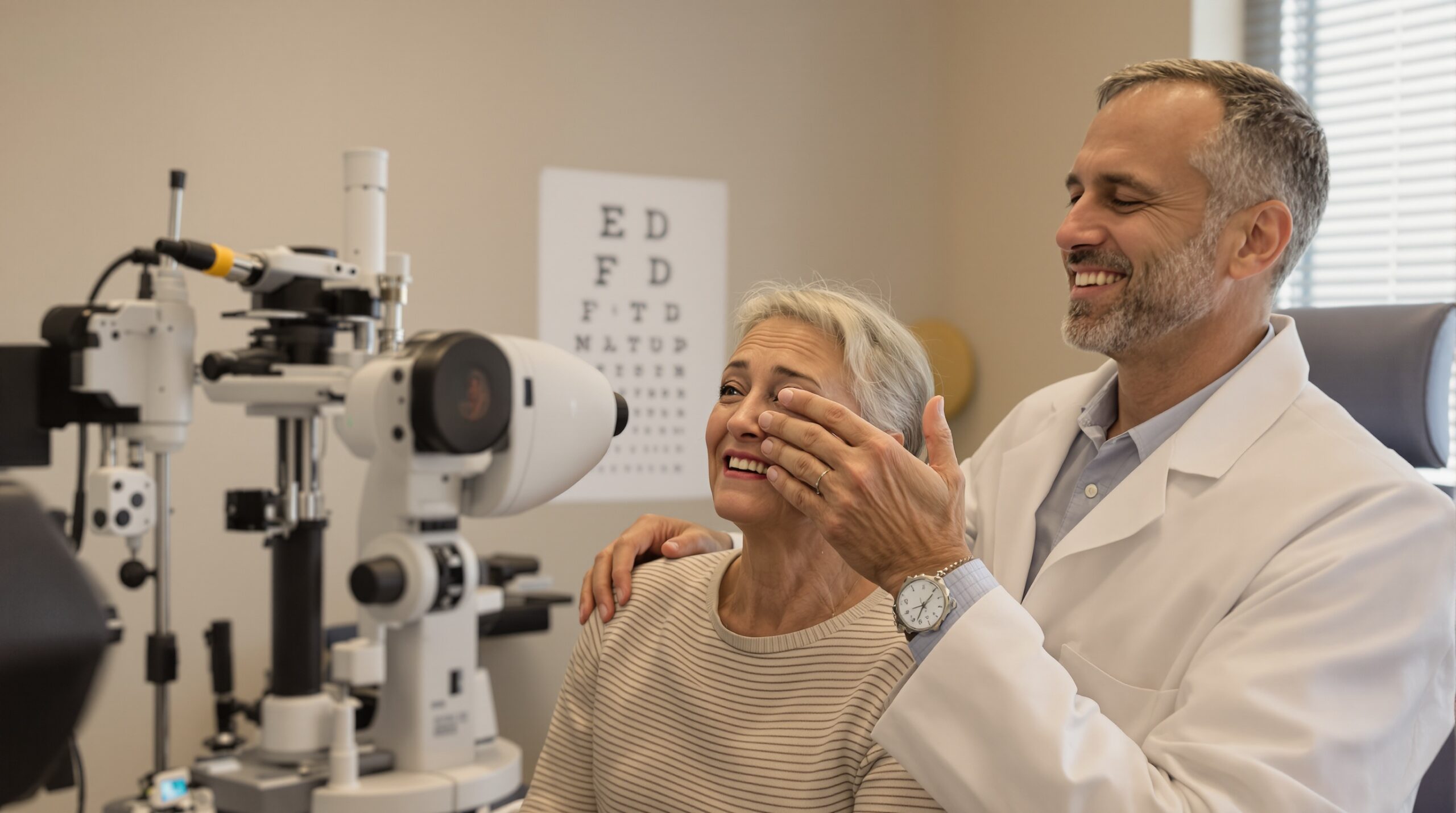
Early clinical results suggest gene editing can partially restore vision in people born with inherited retinal blindness. Researchers are testing CRISPR-based therapies that directly correct disease-causing mutations inside retinal cells. Several participants show meaningful gains on standardized vision tests after a single treatment. These findings are preliminary, yet they mark a pivotal step for precision medicine in ophthalmology.
The first in-human eye editing trials target a severe condition called Leber congenital amaurosis type 10, or LCA10. This disorder stems from mutations in the CEP290 gene that disrupt photoreceptor function. Children often present with poor vision at birth and gradual retinal degeneration follows. Against this backdrop, early improvements carry special clinical and emotional weight for patients and families.
How the therapy works
The investigational therapy uses CRISPR gene editing to modify DNA in living retinal cells. Scientists package the editing machinery into viral vectors, usually adeno-associated viruses adapted for the eye. Surgeons deliver these vectors under the retina through a brief outpatient procedure. The goal is to correct a faulty splice site and restore proper gene expression in photoreceptors.
In LCA10, a common variant within CEP290 causes mis-splicing and cripples photoreceptor maintenance. The editor removes or disrupts the aberrant splice sequence, allowing normal messenger RNA to form. Restored protein production can improve photoreceptor function if viable cells remain. Because photoreceptors gradually die, earlier intervention may unlock greater benefits.
Inside the first human trials
The pioneering study follows a Phase 1/2, open-label dose escalation design. Investigators enroll both adults and children with confirmed CEP290 mutations. Participants receive a single subretinal injection in one eye, with careful steroid management to limit inflammation. Researchers monitor safety and multiple measures of vision over many months.
Primary goals center on safety, including surgical risks and immune responses to the viral vector. Secondary outcomes assess functional vision, such as best-corrected visual acuity and light sensitivity. Mobility in low light and patient-reported outcomes add real-world context. These measures together provide a balanced picture of clinically meaningful change.
Early efficacy signals
Several participants demonstrate improvements that exceed predefined clinical thresholds. Some gain multiple lines on standard eye charts, indicating sharper visual acuity. Others show enhanced light sensitivity, confirmed by full-field stimulus testing. Navigation through a mobility maze also improves for certain individuals, especially under dim lighting.
Not every participant responds, and responses vary in magnitude and timing. Improvements can emerge gradually as photoreceptors recover function after editing. Investigators note that baseline retinal health influences outcomes. These patterns suggest earlier treatment could yield stronger and more consistent benefits.
Safety profile in the eye
Safety findings appear generally manageable at tested doses and techniques. Most adverse events relate to the surgery or transient ocular inflammation. Investigators can treat inflammation with topical or oral steroids, usually resolving signs within weeks. So far, clinical teams have not detected concerning off-target editing in ocular assessments.
What “reversing blindness” means clinically
These improvements do not equate to a complete cure, and expectations should remain realistic. Clinically meaningful gains can still transform daily life and independence. Better light sensitivity can help with orientation, faces, and navigation under varied conditions. Even partial restoration can deliver substantial quality-of-life benefits for people with severe baseline impairment.
How gene editing compares with other eye therapies
Luxturna, an approved gene therapy, treats biallelic RPE65-related disease using gene augmentation. It delivers a working gene copy but does not edit DNA. By contrast, CRISPR directly changes the mutation within the native gene. That distinction matters for conditions where large genes exceed vector capacity or need precise correction.
Antisense oligonucleotides offer another approach, altering RNA splicing without changing DNA. Some antisense programs showed early signals but faced mixed late-stage results. Editing could provide a once-and-done DNA correction with durable expression. However, antisense remains valuable where reversible or repeat dosing offers flexibility.
Key technical questions ahead
Durability remains a central question, since photoreceptors continue degenerating over time. Researchers will track whether improvements persist for years after editing. Retinal imaging and functional testing will help quantify long-term trajectories. Combining editing with neuroprotective strategies could further preserve function.
Delivery also presents challenges despite the eye’s favorable immune environment. AAV vectors have size limits that complicate advanced editors and regulatory elements. Split editors and compact nucleases can help fit within packaging constraints. Future delivery methods may improve efficiency while maintaining surgical safety.
Dosing, selection, and monitoring considerations
Determining the optimal dose requires balancing editing efficiency with inflammation risks. Dose escalation phases refine safety margins and response thresholds. Patient selection matters, including age, mutation subtype, and retinal cell survival. Precision diagnostics, like genetic testing and high-resolution imaging, guide enrollment and interpretation.
Investigators will monitor potential immune responses to both vector and editor. Re-dosing remains uncertain due to neutralizing antibodies against AAV capsids. Alternative serotypes or nonviral delivery strategies could address that limitation. Careful follow-up enables timely management of inflammation and other ocular events.
Ethical and regulatory landscape
Pediatric enrollment requires heightened safeguards and transparent consent processes. Long-term registries help track rare adverse events and sustained benefits. Regulators expect multi-year follow-up for gene therapies affecting the eye. Validated functional endpoints and patient-reported outcomes will shape future approval decisions.
Context within gene editing’s broader progress
Regulators have already approved gene editing for certain blood disorders using ex vivo strategies. Those successes support confidence in the platform’s potential. The eye offers a controlled, compartmentalized setting amenable to in vivo editing. Early retinal data therefore serve as an important test case for broader applications.
What comes next for retinal gene editing
Larger cohorts will help confirm efficacy, safety, and durability across diverse patients. Trials may explore earlier intervention, pediatric dosing, and refined surgical techniques. Companies are advancing programs for additional inherited retinal diseases beyond CEP290. Candidates include dominant retinitis pigmentosa strategies that combine knockdown and gene replacement.
Investigators will also refine outcome measures that capture everyday visual function. Mobility tasks, low-luminance tests, and contrast sensitivity may better reflect real-world benefit. Wearable sensors could provide objective data on navigation and independence. Together, these tools can strengthen clinical evidence for regulatory review.
Guidance for patients and families
Genetic testing is essential to confirm eligibility for mutation-specific trials. Patients can discuss testing options with retinal specialists and counselors. ClinicalTrials.gov lists ongoing studies, sites, and contact information for screening. Patient advocacy groups provide education, travel support, and community connections during participation.
Setting realistic expectations helps families navigate the experimental journey. Early data suggest meaningful improvements are possible, but responses vary. Participation involves surgery, frequent visits, and long-term monitoring commitments. A trusted care team can align goals, risks, and hopes throughout the process.
A measured but hopeful outlook
The first human results show gene editing can restore measurable vision for some people with inherited blindness. Safety appears manageable with current surgical methods and immunomodulation strategies. Larger and longer studies will determine durability, generalizability, and best practices. Even so, these advances signal a turning point for targeted ocular therapeutics.
If future trials confirm consistent benefit, gene editing could join the ophthalmic therapeutic toolkit. It may complement gene augmentation, antisense therapies, and supportive care strategies. Together, these modalities could reshape treatment for a range of genetic retinal disorders. For many families, cautious optimism now feels scientifically justified and deeply personal.
