

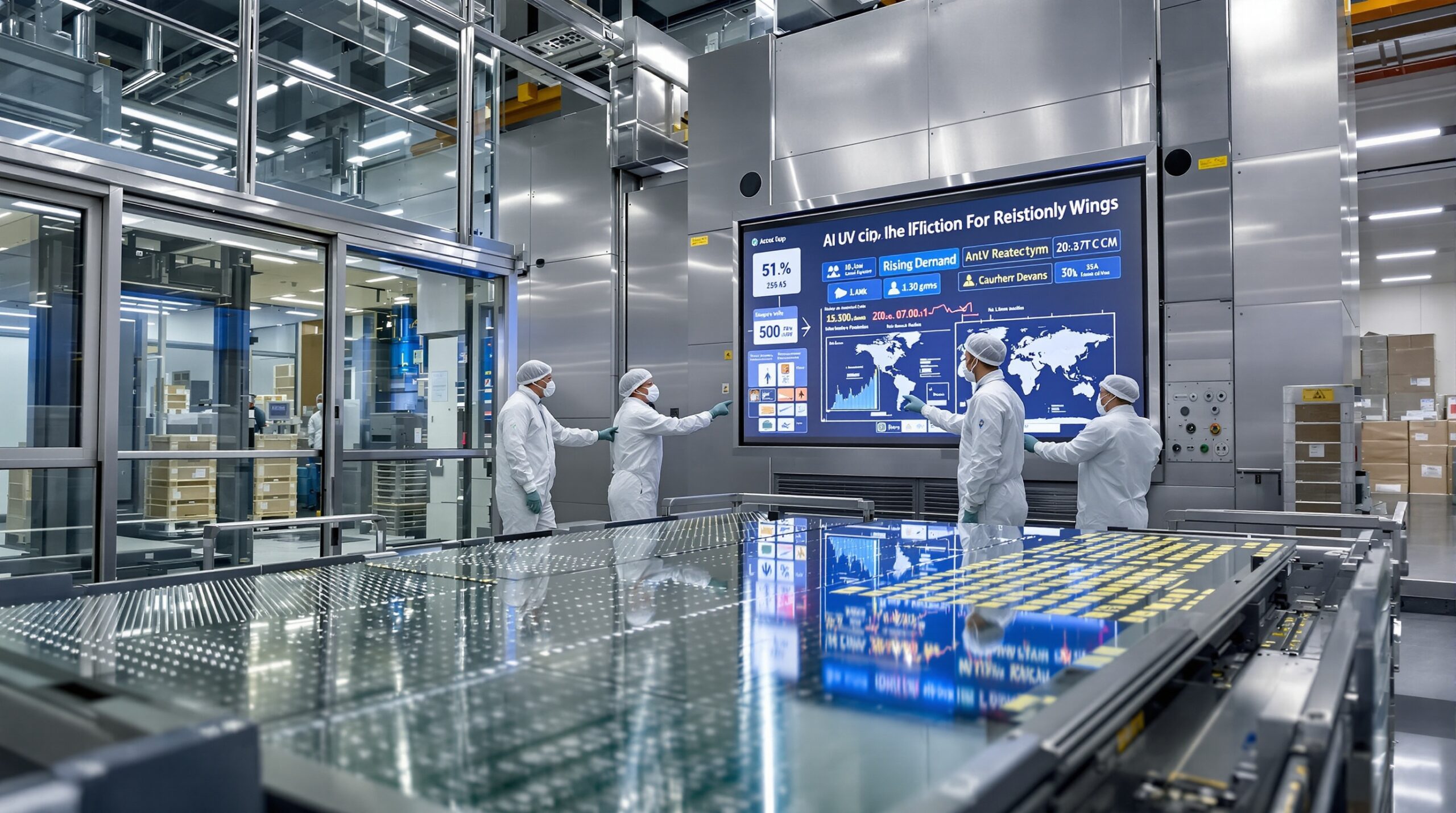
Artificial intelligence is reshaping semiconductor priorities and investment across the world. Training models requires cutting-edge processors produced on advanced process nodes. Those nodes depend on sophisticated lithography machines that define transistor features. Scarcity of these tools has become a decisive industry bottleneck. As competition intensifies, chipmakers are rushing to secure capacity and lock in deliveries.
AI Workloads Drive Unprecedented Tool Demand
Exploding demand for AI accelerators has tightened supply chains from wafers to tools. Leading GPUs and custom AI chips rely on 5-nanometer and below nodes. These nodes require extreme ultraviolet lithography for yield, cost, and performance. Data centers also need high-bandwidth memory, which pushes finer patterning in DRAM. This feedback loop pulls more lithography systems into logic and memory lines.
Foundry customers are booking multi-year wafer capacity to secure AI roadmaps. That behavior ripples upstream to equipment procurement. Against that backdrop, competition for scanners is intensifying across regions and segments.
What Makes Advanced Lithography So Critical
Lithography projects circuit patterns onto wafers using light and precision optics. Deep ultraviolet immersion scanners handle many layers at mature and mid-range nodes. Extreme ultraviolet scanners use a shorter wavelength to print smaller features directly. EUV reduces complex multipatterning steps required by DUV at advanced nodes. Fewer steps can lower variability, improve yield, and shorten cycle time.
EUV tools are engineering marvels with tightly coupled subsystems. They rely on high-power light sources, multilayer mirrors, and advanced stages. Pellicles and resists also affect throughput and defectivity. Typical EUV throughput targets dozens of wafers per hour. Every incremental improvement unlocks meaningful fab productivity and cost advantages.
ASML’s Dominant Role and Tight Supply
ASML is the sole supplier of EUV lithography systems today. The company also sells immersion DUV scanners critical for many layers. EUV tools cost well over $150 million per unit. Installation takes months and requires specialized facilities and teams. The supply chain includes unique optics and subsystems with long lead times.
ASML has carried a large backlog as customers reserve capacity. Many chipmakers place orders years ahead to secure production windows. Tight supply means delivery timing can define product launch schedules. That dynamic raises the strategic value of each tool slot. It also drives competitive behavior across rival chipmakers and geographies.
High-NA EUV Emerges as the Next Inflection
High-numerical-aperture EUV represents the next leap in patterning resolution. The platform targets tighter pitches and reduced multipatterning at advanced nodes. Early systems have begun shipping to leading chipmakers for process development. Tool prices reportedly approach $350 million per unit. Adoption timetables stretch across several years due to complexity and integration.
High-NA promises fewer masks and higher fidelity for critical layers. Yet ramping it requires new resists, mask strategies, and metrology. These dependencies further constrain early capacity and learning cycles.
Memory Makers Expand EUV for HBM and DRAM Nodes
AI accelerators rely on high-bandwidth memory stacks for performance. HBM manufacturing requires fine patterning, tight overlay, and high yields. Leading DRAM vendors have integrated EUV at advanced nodes. Additional layers are migrating to EUV as processes mature. This shift improves parametric control and maintains competitiveness against rising complexity.
Ramping HBM also increases lithography demand for companion logic dies. That interdependence amplifies tool needs across logic and memory fabs. As a result, memory suppliers are competing directly with foundries for scanners.
Geopolitics and Export Controls Shape Availability
Government controls influence which tools reach particular regions and nodes. EUV exports to China face strict restrictions from allied governments. Additional curbs cover certain advanced DUV scanners and subcomponents. These measures affect capacity planning and process choices within China. They also shift global order flows toward permitted destinations.
Chinese foundries continue advancing processes using DUV multipatterning. Public teardowns have shown 7-nanometer class devices made without EUV. Multipatterning raises cost and complexity but remains technically viable. This approach still consumes significant DUV scanner time and masks. Consequently, demand for immersion DUV tools remains elevated across markets.
Supply Chain Bottlenecks Extend Beyond the Scanner
Each EUV system depends on rare, precision components from specialized suppliers. Zeiss provides mirrors and optics with extreme tolerances. Light sources build on technologies from acquired and partnered firms. Mask inspection and metrology require niche equipment, including actinic tools. Photoresists and pellicles must meet demanding EUV conditions.
Lead times compound across these upstream elements. Factory readiness, power, and vibration control add further constraints. Trained installation teams remain in limited supply worldwide. Any bottleneck can delay an entire fab ramp. Therefore, capacity planning now spans a wider ecosystem of partners.
How Chipmakers Are Responding Strategically
Leading companies are signing long-term agreements with equipment suppliers. Some provide prepayments to secure production slots and timelines. Others diversify nodes and sites to spread scheduling risk. Firms are also prioritizing layers most sensitive to performance gains. Those choices help allocate scarce EUV capacity where it matters most.
Additional strategies include tool relocation and shared development lines. Companies also prebuild cleanroom shells to shorten installation cycles. These tactics collectively compress time to high-volume manufacturing.
Advanced Packaging Adds Pressure but Complements Lithography
AI systems increasingly rely on advanced packaging for performance scaling. Chiplets, interposers, and hybrid bonding complement transistor scaling. Packaging capacity, however, has become another bottleneck for accelerators. Co-optimization now extends across lithography, interconnects, and thermal design. This integrated approach improves system efficiency and cost per performance.
Despite packaging advances, front-end lithography remains foundational. Shrinking features still delivers energy and density benefits. Accordingly, demand for advanced scanners will remain strong alongside packaging growth.
Energy, Facilities, and Workforce Considerations
EUV systems consume significant power and require robust infrastructure. Fabs must manage heat, vibration, and contamination rigorously. Environmental controls and utilities can become gating factors. Skilled technicians and engineers are essential for stable operations. Competition for talent now mirrors competition for tools.
Governments are supporting training and workforce programs to ease shortages. These efforts target both equipment operation and process engineering. Successful programs will accelerate regional ramp schedules and yield improvements.
Supplier Landscape and Emerging Alternatives
Nikon and Canon remain important for immersion DUV tools. Those tools support many layers even at advanced nodes. Canon also promotes nanoimprint lithography for certain applications. Adoption remains limited compared with optical scanners today. Inspection vendors like Lasertec enable EUV mask development and control.
Second sourcing EUV is extraordinarily difficult due to system complexity. Collaboration across optics, sources, and masks takes years of investment. As a result, the market remains highly consolidated at the leading edge.
Market Outlook Through the Mid-2020s
AI demand appears durable, though cyclicality still affects semiconductors. Backlogs for advanced scanners will likely stay elevated near term. High-NA adoption should add another wave of constrained supply. Mature-node DUV demand should remain strong for power and automotive. These trends support sustained equipment spending across multiple segments.
Risks include macro slowdowns, policy shifts, and yield challenges. Any rapid node transition can encounter learning curve setbacks. Conversely, breakthroughs in throughput or pellicles could ease constraints. Either path will shape delivery schedules and competitive standings.
Conclusion: Tools Decide Timelines in the AI Era
The AI surge has turned advanced lithography into a strategic choke point. Chipmakers are locking tools early to secure future launches. Suppliers are expanding capacity, yet constraints remain across subsystems. Geopolitics and technology transitions add further complexity and uncertainty. In this environment, timely access to scanners defines leadership and market share.
Investment will continue flowing toward EUV, High-NA, and supporting ecosystems. Companies that align tool roadmaps with product goals will win. Those that lag face delayed ramps and lost opportunities. As AI workloads scale, the lithography race only accelerates further. Every scanner delivery now echoes across global compute capacity and innovation.
