

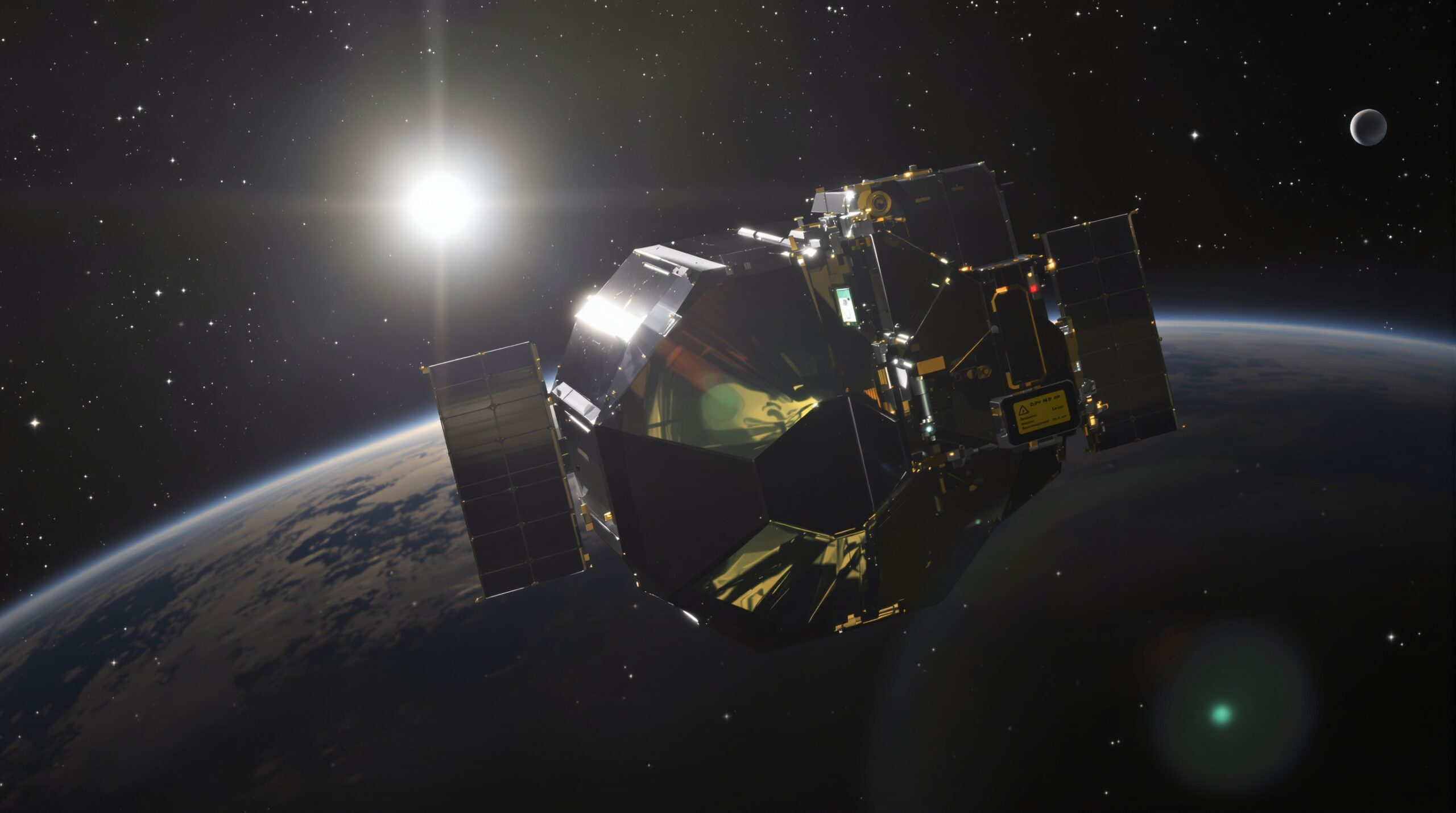
NASA’s James Webb Space Telescope has revealed water vapor signatures around a small, temperate exoplanet. The observation targets K2-18 b, a sub-Neptune orbiting within its star’s habitable zone. Astronomers see hints of a cool, volatile-rich atmosphere shaped by methane, carbon dioxide, and water vapor. The discovery energizes discussion about early evidence for a temperate atmosphere beyond our Solar System.
Researchers emphasize both excitement and caution as analyses mature. The signal appears compelling, yet complex modeling introduces important uncertainties. Water in a small world’s atmosphere would mark a milestone for exoplanet science. Careful follow-up will determine how far the claim can go.
The Target World: A Small Planet in the Habitable Zone
K2-18 b circles a cool red dwarf star located about 124 light-years away. The planet completes one orbit in roughly 33 days. Its radius is about 2.6 Earth radii, and its mass is near 8.6 Earth masses. Those values suggest a volatile-rich world with a significant gaseous envelope.
The star’s dimness places the planet in a temperate orbital zone. The planet likely receives gentle stellar heating compared with hot Jupiters. Its estimated equilibrium temperature falls near the range for liquid water stability. That temperature estimate sparks questions about potential habitability under an atmosphere.
How JWST Measured the Atmospheric Signal
JWST captured starlight filtering through the planet’s atmosphere during transits. This method is called transmission spectroscopy and targets atmospheric fingerprints. Molecules absorb starlight at precise wavelengths, imprinting a barcode in the spectrum. By parsing that code, astronomers infer the atmosphere’s composition and structure.
Team members used JWST instruments designed for exoplanet spectroscopy. Observations included modes on NIRISS and NIRSpec across near-infrared wavelengths. The spectra highlighted absorption features consistent with methane, carbon dioxide, and water vapor. Hubble had previously indicated water, but JWST refined the picture.
Data quality surpassed earlier space telescopes due to JWST’s stability and sensitivity. The improved precision allowed stronger molecular detections and tighter constraints. Analysts employed retrieval codes to fit atmospheric models to the spectra. Those fits pointed toward a hydrogen-rich atmosphere with notable carbon-bearing molecules.
Evidence Suggesting a Temperate Atmosphere
The measured spectral features imply relatively cool limb temperatures. The limb is the thin, backlit ring itself during transit. Methane and carbon dioxide absorptions generally persist in cooler, hydrogen-dominated atmospheres. Water vapor features appear alongside them, reinforcing the overall temperate interpretation.
Researchers proposed a “Hycean” scenario for K2-18 b. That model describes an ocean-bearing world beneath a hydrogen-rich sky. In theory, such atmospheres can shield habitable oceans from harsh space environments. This possibility naturally draws substantial attention and scrutiny.
Competing Explanations and Cautionary Notes
Several caveats temper claims about a temperate, habitable environment. Retrieval models can reproduce similar spectra with different assumptions. Cloud altitude, metallicity, and atmospheric mixing can drive degeneracies. Multiple solutions may fit the data nearly equally well.
High pressures could also reshape the planet’s interior conditions. Under a deep hydrogen envelope, water may become supercritical. Such environments may not support Earth-like habitability. A temperate spectrum does not guarantee a friendly surface.
One early analysis also mentioned dimethyl sulfide, a possible biosignature. That tentative hint lacked robust statistical confidence. Subsequent work has not confirmed that claim with confidence. Scientists therefore stress caution regarding biological interpretations.
The Star Complicates the Atmospheric Picture
Red dwarfs often show spots, faculae, and flares that affect spectra. Unocculted starspots can imprint false molecular signatures in transmission data. The community learned this from other systems, including a rocky planet case. Teams now model stellar contamination more explicitly when interpreting features.
Retrieval Models and Degeneracies
Atmospheric retrievals rely on assumptions about chemistry and temperature structures. Different priors can nudge solutions toward distinct compositions. Degeneracies persist between cloud decks and molecular abundances. Expanded wavelength coverage helps break those degeneracies and strengthen conclusions.
What Observations Come Next
New JWST observations will probe complementary wavelengths and geometries. MIRI spectroscopy can target carbon dioxide and other mid-infrared features. Phase-curve or eclipse observations can map dayside temperatures. Those data test whether the planet’s atmosphere efficiently transports heat.
Repeated transits enable checks against stellar variability and systematics. Teams can compare spectra across epochs to watch for changes. Coordinated ground-based monitoring tracks stellar activity that might contaminate the signal. Community efforts will build a more stable, reliable interpretation.
Why Water Vapor on a Small World Matters
Confirming water vapor around a small, temperate planet would be historic. Earlier water detections involved hot, inflated gas giants. Sub-Neptunes probe a different class, closer to most known exoplanets. Many nearby worlds occupy similar size ranges around cool stars.
This result also informs habitability strategies for future missions. Upcoming observatories will target Earth-sized planets around dim stars. Lessons from K2-18 b refine instrument plans and data analysis methods. Researchers can prioritize wavelength bands that best disentangle key molecules.
How the Scientific Process Handles Early Evidence
Scientific claims strengthen through independent replication and open scrutiny. Teams share data, codes, and priors to enable transparent testing. Competing groups run alternative retrievals and compare outcomes. Robust conclusions emerge from converging results across methods and datasets.
Early excitement motivates careful follow-up and community review. Null results carry equal weight in shaping the narrative. The process rewards rigor over speed when stakes are high. Exoplanet science grows stronger through that deliberate rhythm.
A Cautious Path Forward
JWST has delivered a compelling, nuanced view of K2-18 b’s atmosphere. Water vapor signatures, alongside methane and carbon dioxide, appear persuasive. Yet the planet’s true environment remains uncertain beneath its gaseous veil. Continued observations will clarify whether a truly temperate atmosphere surrounds this small world.
As datasets expand, models will sharpen and degeneracies will shrink. The community will test hypotheses against broader evidence. That approach will determine whether this world hosts a clement sky. The implications could reshape our search for life-ready planets across the galaxy.
