

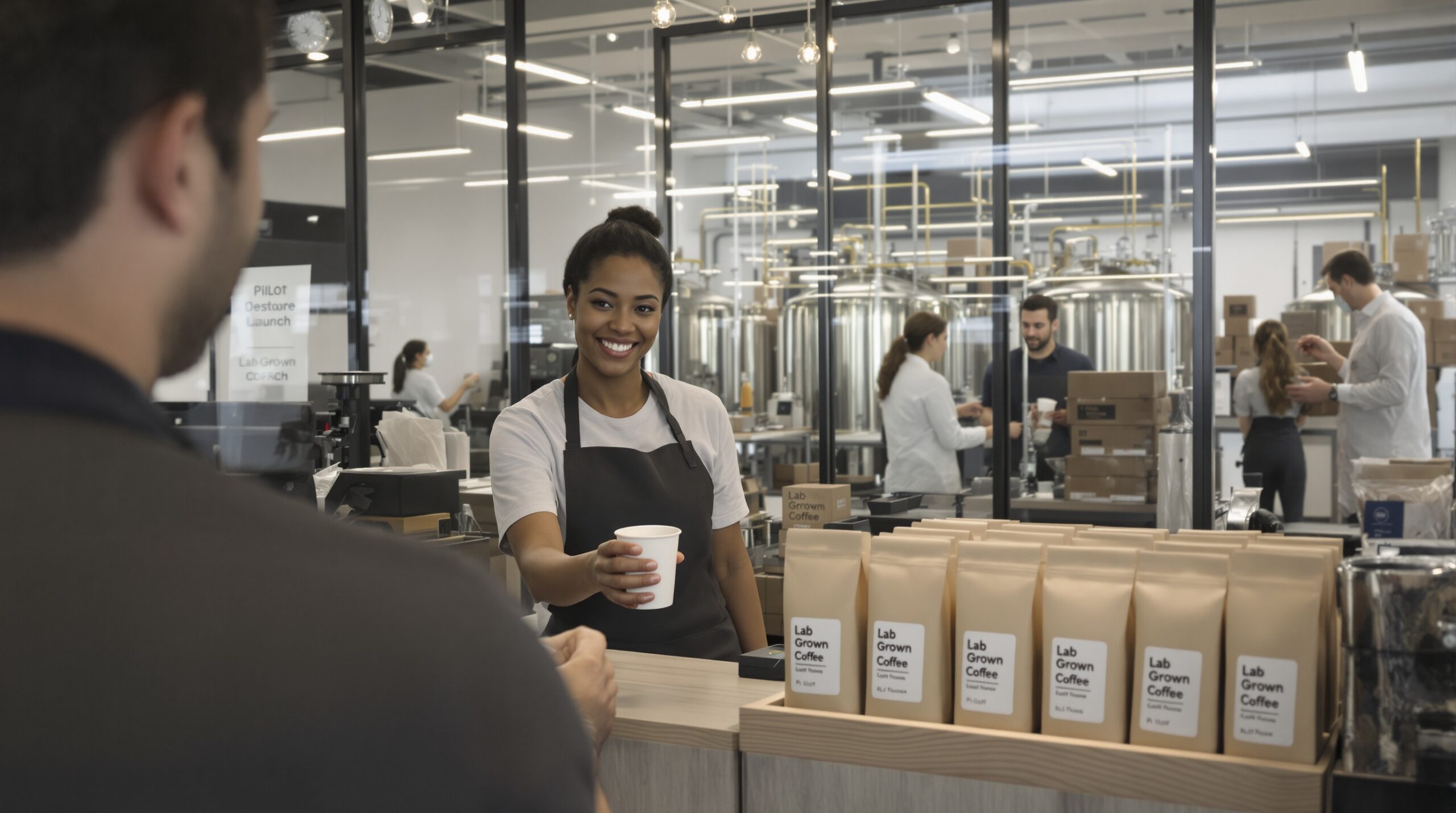
Lab-grown coffee is moving from labs to storefront pilots as fermentation startups scale production capacity. Companies are targeting small retail tests to validate flavor, pricing, and consumer acceptance. These pilots will help translate bench breakthroughs into consistent café experiences. Momentum is building as investors push for commercial evidence.
What lab-grown coffee means
Lab-grown coffee generally refers to coffee alternatives produced without the coffee plant. Teams use microbes or plant-based matrices to recreate flavor, aroma, and caffeine. Precision fermentation platforms can produce key coffee compounds in stainless steel tanks. Some developers blend fermented ingredients with upcycled plant materials to complete the profile.
Approaches differ, but the goal remains familiar coffee experiences with lower environmental risk. Many firms avoid calling these products “coffee beans,” emphasizing brewed beverages or concentrates instead. That positioning helps set correct expectations during early adoption. Pilots will test which framing resonates with everyday drinkers.
Why startups pursue microbial coffee
Arabica production faces climate stress, pests, and volatile prices. Farmers increasingly battle leaf rust and heat-driven yield losses. Demand keeps rising, pressuring sensitive ecosystems and encouraging deforestation. Startups see fermentation as a way to decouple supply from climate risk.
They also target consistency. Bioreactors can run year-round and deliver repeatable ingredient profiles. Brands hope repeatability simplifies product development and quality control. Retailers value stable supply as consumer preferences shift toward premium cold brew and ready-to-drink formats.
Fermentation platforms and production scaling
Precision fermentation uses engineered microbes to produce flavor molecules that mimic roasted coffee chemistry. Biomass fermentation grows fungi or other microorganisms for complex sensory matrices. Some developers combine both strategies to balance cost and complexity. Others design plant-based formulas and use fermentation to unlock roasted notes.
Bioreactors and capacity milestones
Startups typically progress from bench reactors to pilot, then to demonstration scale. Pilot units range from hundreds to thousands of liters. Demonstration plants can reach tens of thousands of liters. These steps de-risk scale-up before building full commercial facilities.
Every scale jump introduces mixing, oxygen transfer, and heat removal challenges. Teams tune media, agitation, and strain stability across scales. Robust downstream processing is equally important for ingredient purity. Pilot store launches often arrive once demonstration output becomes reliable.
Ingredient sourcing and caffeine strategies
Microbes can produce select aroma compounds linked to coffee’s signature profile. Developers may add caffeine from tea extraction or synthetic sources. Some groups explore engineered pathways for microbial caffeine production. That route remains early, but it could simplify supply chains later.
Feedstocks usually include sugars from corn, sugarcane, or other crops. Costs depend on sugar prices and process yields. Companies aim to use renewable electricity and efficient aeration to cut operating emissions. Those choices directly influence lifecycle assessment results.
Approaching pilot store launches
Pilot store launches validate whether lab-grown coffee meets real world expectations. Cafes provide immediate sensory feedback and clear purchasing signals. Startups often start with limited runs and controlled brewing protocols. These pilots generate user data for formulation and messaging tweaks.
Early partnerships often involve independent cafés or regional retailers. Controlled environments help baristas execute precise recipes. Training ensures grinding, extraction, and serving remain consistent. That consistency reduces confounding variables during evaluations.
Menu strategies and brewing formats
Most pilots prioritize cold brew, concentrates, and ready-to-drink formats. Cold applications showcase chocolatey, caramelized notes with fewer roast artifacts. Concentrates reduce variability and simplify multi-store rollouts. Teams may add hot brewed options after dialing roast analogs and acidity balance.
Packaging often highlights sustainability, consistency, and crop resilience benefits. Labels avoid misleading claims while emphasizing familiar coffee rituals. Clear guidance helps consumers approach the product with curiosity rather than skepticism. Barista scripts further shape the first impression.
Pricing and willingness-to-pay
Pilot pricing targets parity with premium cold brew or specialty pours. Consumers accept novelty when value feels clear and tangible. Bundled tastings can frame the experience as educational and fun. That framing builds trust during a category’s formative phase.
Regulatory and labeling considerations
Regulation depends on ingredient composition and market geography. The United States lacks a standard of identity for “coffee.” Companies must ensure ingredient safety and truthful marketing claims. Flavor compounds may follow established flavor regulations when applicable.
United States pathways
In the United States, companies often pursue GRAS determinations for new ingredients. Some complete FDA GRAS notifications, seeking agency “no questions” letters. Others use self-affirmed GRAS with robust expert reviews. Labeling must avoid consumer confusion about composition and origin.
Ready-to-drink products must follow beverage labeling rules. Allergen declarations, nutrition facts, and caffeine content require careful attention. Some products may qualify as flavors rather than food ingredients. Legal counsel typically advises on precise phrasing and placement.
European Union and other markets
In the European Union, novel ingredients may require Novel Food authorization. Developers assess whether each component has pre-1997 consumption history. Flavouring Regulation may apply to specific aromatic compounds. National authorities also interpret claims and category placement.
Other markets follow similar logic with local specifics. Canada uses novel food assessments for certain ingredients. Asia-Pacific frameworks vary widely by country. Global pilots will likely start where pathways look clearer.
Sensory development and quality control
Replicating coffee’s complexity demands careful sensory science. Developers track key volatiles such as furans, pyrazines, phenols, and aldehydes. They target balanced acidity, body, and aftertaste. Trained panels guide iterations alongside consumer testing.
Flavor chemistry and cupping protocols
Teams benchmark against popular arabica profiles across roast levels. They design cupping protocols adapted for non-bean ingredients. Reproducibility matters more than one-off wins. Pilots translate lab cuppings into consistent café preparation.
Quality control covers strain performance, impurity thresholds, and batch-to-batch variation. Analytical labs monitor markers tied to flavor and safety. Developers also track shelf life in refrigerated and ambient formats. Those datasets underpin retailer confidence during scale-up.
Environmental footprint and supply chain impacts
Lifecycle assessments suggest potential land and water savings versus conventional coffee. Fermentation does not drive deforestation or require high-altitude farms. Energy use becomes the dominant footprint driver. Renewable electricity access significantly shapes overall impact.
Energy use, LCAs, and data gaps
Public LCAs remain limited and often rely on assumptions. Companies plan updated assessments as facilities reach stable operation. Transparent boundaries and methodologies will improve comparability. Retail partners increasingly request third-party verification and certifications.
Supply chain mapping now includes feedstock crops, fermentation plants, and packaging. Developers explore circular feedstocks where feasible. Some evaluate captured carbon routes for future media components. Those pathways require significant technical maturation.
Competitive landscape and partnerships
The landscape includes fermentation-first companies and plant-based formulators. Some brands already sell beanless coffee alternatives online or in limited retail. Others still refine pilot lines before public release. Partnership strategies reflect differences in technology maturity and capital access.
Incumbent roasters and retailers
Roasters monitor lab-grown entrants with curiosity and caution. Some pursue collaborations to hedge climate and supply risks. Retailers consider lab-grown coffee for sustainability narratives and innovation pipelines. Early placement often targets progressive markets and trend-forward neighborhoods.
Hospitality partners offer controlled feedback and marketing reach. Barista education becomes central to customer experience. Clear talking points can prevent misconceptions about safety and sourcing. That preparation greatly influences pilot outcomes.
Risks, challenges, and milestones to watch
Cost parity remains a central challenge for fermentation products. Sugar, energy, and capital costs drive unit economics. Companies must sustain high yields and reduce downstream losses. Each incremental efficiency gain compounds across volumes.
Regulatory clarity can influence fundraising and timelines. Transparent safety dossiers build stakeholder confidence. Mislabeling or overpromising could trigger consumer backlash. Careful claims and open communication reduce reputational risk.
Taste will ultimately decide winners. Products must satisfy daily drinkers, not just adventurous samplers. Reliability across batches will separate promising prototypes from scalable brands. Pilot store feedback provides the most valuable reality check.
Outlook for the next 24 months
The next two years should bring more pilots and regional placements. Demonstration plants will feed limited retail launches and partnerships. Brands will refine formulas, targeting specific brew styles and occasions. Expect iterative improvements rather than sweeping overnight change.
Investors will reward teams that convert technical milestones into consumer traction. Retailers will prioritize reliable supply and compelling stories. Regulators will scrutinize claims as visibility increases. Thoughtful execution could turn pilots into lasting menu spots.
Lab-grown coffee’s promise lies in resilience and consistency, not novelty alone. Fermentation can complement traditional coffee rather than replace it. Diversified supply supports farmers and protects forests as climate pressures intensify. Pilot store launches will reveal how well this vision translates to the cup.
With careful scaling and transparent engagement, fermentation startups can earn trust. Success will hinge on taste, price, and reliability. Those fundamentals always define beverage categories over time. The coming pilots will show whether lab-grown coffee clears that bar.
