
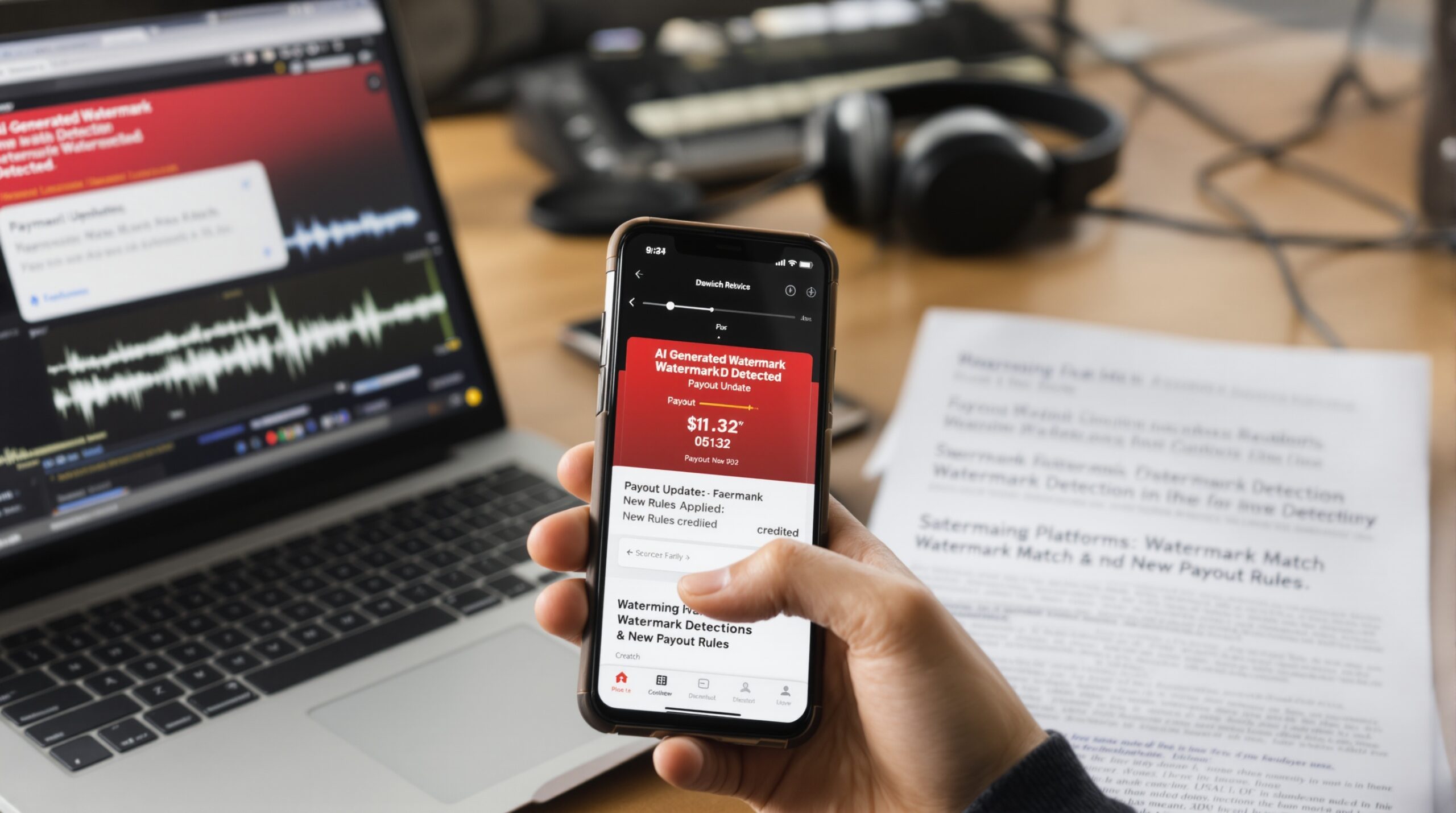
Streaming leaders are moving quickly to address AI’s impact on music. They are deploying watermark detection for synthetic tracks and updating royalty rules. The combined changes aim to protect artists, improve transparency, and reduce fraud. They also seek to align incentives as listening habits evolve with new tools.
These moves follow a surge of AI-generated songs and voice clones online. Labels, artists, and regulators demanded better safeguards and clearer economics. Platforms now promise stronger detection, higher content integrity, and more equitable payouts. The rollout marks a pivotal shift for the digital music economy.
Why Platforms Are Acting Now
AI models can imitate voices, instruments, and production styles with remarkable fidelity. That power creates creative opportunities and significant legal risks. Unlicensed voice clones can confuse fans and dilute the value of rights. Fraudulent uploads also siphon revenues from legitimate artists and catalog owners.
Public pressure has intensified alongside regulatory momentum. The EU AI Act includes transparency obligations for generated content. Tennessee’s ELVIS Act targets unauthorized voice cloning and name, image, and likeness misuse. Major labels and collecting societies also pressed for stronger platform governance.
Platforms now position watermark detection and payout reforms as complementary answers. Detection brings provenance, while payout changes discourage spam and gaming. Together, they aim to boost trust in discovery and monetization. The strategy tackles both supply quality and downstream compensation.
How Watermark Detection Works for AI Audio
Audio watermarking embeds an inaudible signal within the generated sound. The signal remains robust against common edits, compression, and platform workflows. Detection models can later scan audio and identify the watermark’s presence. This approach helps flag synthetic files without degrading listening quality.
DeepMind’s SynthID supports watermarking for AI-generated audio and music. It aims to survive typical remixing and format conversions across platforms. Meta has published AudioSeal for watermarking generated speech segments. Academic labs continue to test resilience against heavy transformations and adversarial attacks.
Watermarks complement existing content identification tools. Audio fingerprints match recordings to known tracks for rights management. Systems from Audible Magic, Pex, and Gracenote already serve many services. Together, fingerprinting and watermarking improve catalog hygiene and provenance clarity.
Platforms also explore provenance metadata in line with C2PA standards. Provenance can record creation tools, edits, and authorship claims. However, metadata can be stripped or altered during distribution. Watermarks, therefore, provide a durable, content-embedded signal for provenance checks.
YouTube Experiments With Embedded Watermarks
YouTube has tested watermarking for AI music through DeepMind’s SynthID. Its Dream Track experiments used AI voices with clear disclosures. YouTube also requires creators to label synthetic content in many cases. The company says detection helps enforce policies and inform viewers.
These tools sit alongside Content ID and music licensing frameworks. The goal is not to categorically block all AI use. Instead, YouTube seeks responsible deployment with consent and attribution. Detection supports that approach by verifying synthetic origins where applicable.
Deezer Deploys Deepfake Detection and Integrity Tools
Deezer launched tools to detect AI voice clones and deepfakes. The company partnered with Universal Music on an artist-centric model. Detection enables faster takedowns of unauthorized impersonations and spam. It also supports payout adjustments that favor professional recordings and engaged listening.
Deezer’s approach combines AI detection with fraud prevention efforts. The company penalizes fake streams and short noise uploads. It targets repetitive content that dilutes royalty pools at scale. The model aims to direct money toward artists that fans actually choose.
Spotify Pilots Detection and Tightens Content Policies
Spotify has not publicized a single watermark standard across its catalog. However, the company tightened rules around synthetic content and impersonation. It works with labels and vendors on detection and enforcement. Spotify also relies on reporting channels to remove tracks that violate its policies.
The platform focuses on fraud reduction and catalog integrity. Its business depends on trustworthy discovery and listener satisfaction. Detection pilots help flag synthetic uploads and suspicious distribution patterns. These steps complement its recently overhauled royalty system.
New Payout Rules Reshape Streaming Royalties
Royalty updates seek to reduce noise and reward meaningful engagement. They also aim to curb manipulation and artificial streaming activity. Several platforms have announced measurable changes over the last year. These policies collectively reshape how money flows to artists.
Spotify Introduces a Modernized Royalty Model
Spotify announced a minimum stream threshold for tracks to earn. Reports indicate a 1,000-annual-stream threshold per song. The change reduces payouts to fleeting or spammy uploads. It also helps concentrate royalties among tracks with real listening.
Spotify adjusted rates for functional and noise content categories. The company introduced financial penalties for confirmed streaming fraud. Distributors face fines when their catalogs show evidence of manipulation. These steps target bad actors while preserving opportunities for independent creators.
Deezer Expands Its Artist-Centric Payouts
Deezer weighs streams toward professional artists and active fan engagement. The model reduces dilution from passive background or noise content. It launched with Universal Music and expanded across markets. The approach aligns payouts more closely with listener intent.
Deezer’s fraud detection integrates with the payout engine. The platform deprioritizes suspicious streams and bot-like behavior. It also boosts streams from fans with deeper engagement. The net effect is to funnel more revenue to core artists.
Apple Music Adds a Spatial Audio Royalty Bonus
Apple Music introduced a royalty uplift for Spatial Audio releases. The bonus rewards artists who deliver immersive mixes to subscribers. Apple positioned the change as support for premium listening formats. Labels adapted release workflows to capture the incremental revenue.
The policy supplements Apple’s existing pro-rata distribution method. It does not replace standard mechanical and performance royalties. However, it signals Apple’s interest in format-driven incentives. That approach could extend to other quality signals over time.
SoundCloud Grows Fan-Powered Royalties
SoundCloud’s fan-powered royalties allocate each listener’s payments to chosen artists. The model contrasts with platform-wide pro-rata pools. It can benefit niche artists with devoted audiences. SoundCloud has expanded eligibility and partner support for the system.
Fan-powered payouts align artist income with direct fan behavior. The structure reduces cross-subsidies from unrelated listening. It also encourages deeper fan engagement strategies across campaigns. Other platforms continue to study their broader scalability.
YouTube Refines Monetization Across Music and Shorts
YouTube shares ad revenue with partners across long-form and Shorts. Shorts revenue sharing replaced a fixed creator fund. Music usage influences revenue pools within Shorts monetization. Disclosure and detection reinforce licensing, claims, and rightsholder payouts.
YouTube’s AI labeling policies support the correct routing of rights. Watermark detection provides an additional layer of verification at scale. The platform continues to balance innovation and protection. Its music incubator initiatives test that balance with industry partners.
What Detection Means for Rights and Revenues
Watermark detection helps distinguish human, assisted, and synthetic recordings. That distinction supports policy enforcement and content disclosures. It also informs routing for monetization and takedowns. Platforms can act faster when provenance signals are strong.
Detection also deters unauthorized voice cloning at scale. It increases the risk of removal and potential penalties. Rightsholders gain clearer evidence trails for enforcement actions. Meanwhile, compliant AI projects can signal provenance and consent.
New payout rules interact with detection in meaningful ways. If platforms recognize AI content categories, they can price accordingly. They can adjust policies to reflect the complexity of rights and demand. This flexibility could refine compensation as the market matures.
Guidance for Artists, Labels, and AI Developers
Artists should review platform policies on AI disclosures and impersonation. Clear labeling can prevent strikes and takedowns. Distributors should pass accurate metadata and attribution fields. They should monitor catalogs for suspicious uploads and mismatched credits.
Labels can test watermarking in approved AI collaborations. Embedded signals can document consent and creation tools. They should also integrate detection results into compliance workflows. These steps reduce disputes and speed revenue routing.
AI developers should adopt robust watermarking from the start. They should publish disclosure tools for creators and partners. Participation in C2PA provenance efforts can add transparency across media. Collaboration with platforms will improve interoperability and reliability.
Policy and Standards Are Taking Shape
Regulators now expect transparency for synthetic media online. The EU AI Act sets a baseline for disclosures. National laws on voice and likeness are expanding their jurisdictional reach. Platforms are aligning product roadmaps with these expectations.
Industry groups promote interoperable provenance standards. The Content Authenticity Initiative and C2PA lead that work. Adoption across cameras, editors, and platforms continues to grow. Audio support is maturing as watermarking research advances.
Standards reduce fragmentation and vendor lock-in risks. They also help independent artists avoid complex, duplicative submissions. Shared protocols can lower compliance burdens across services. That efficiency ultimately benefits listeners and rightsholders alike.
What to Watch Next
Expect broader watermark detection across uploads and catalogs. Platforms will refine thresholds and confidence scoring over time. They will report more transparency metrics about enforcement outcomes. Labels will push for faster takedown and restoration workflows.
Payout models will likely evolve alongside detection signals. Services may pilot bonuses for verified human recordings. They may create distinct rules for consented AI collaborations. These experiments will test listener preferences and perceptions of fairness.
Cross-platform cooperation will also matter significantly. Shared provenance and detection APIs can reduce friction. Artists will benefit from consistent labeling and monetization treatment. Fans will gain a clearer context about how music was made.
The streaming landscape is entering a new phase of accountability. Watermark detection and royalty reforms anchor that shift. The details will change as technology and policy advance. However, the direction favors transparency, consent, and artist value.