

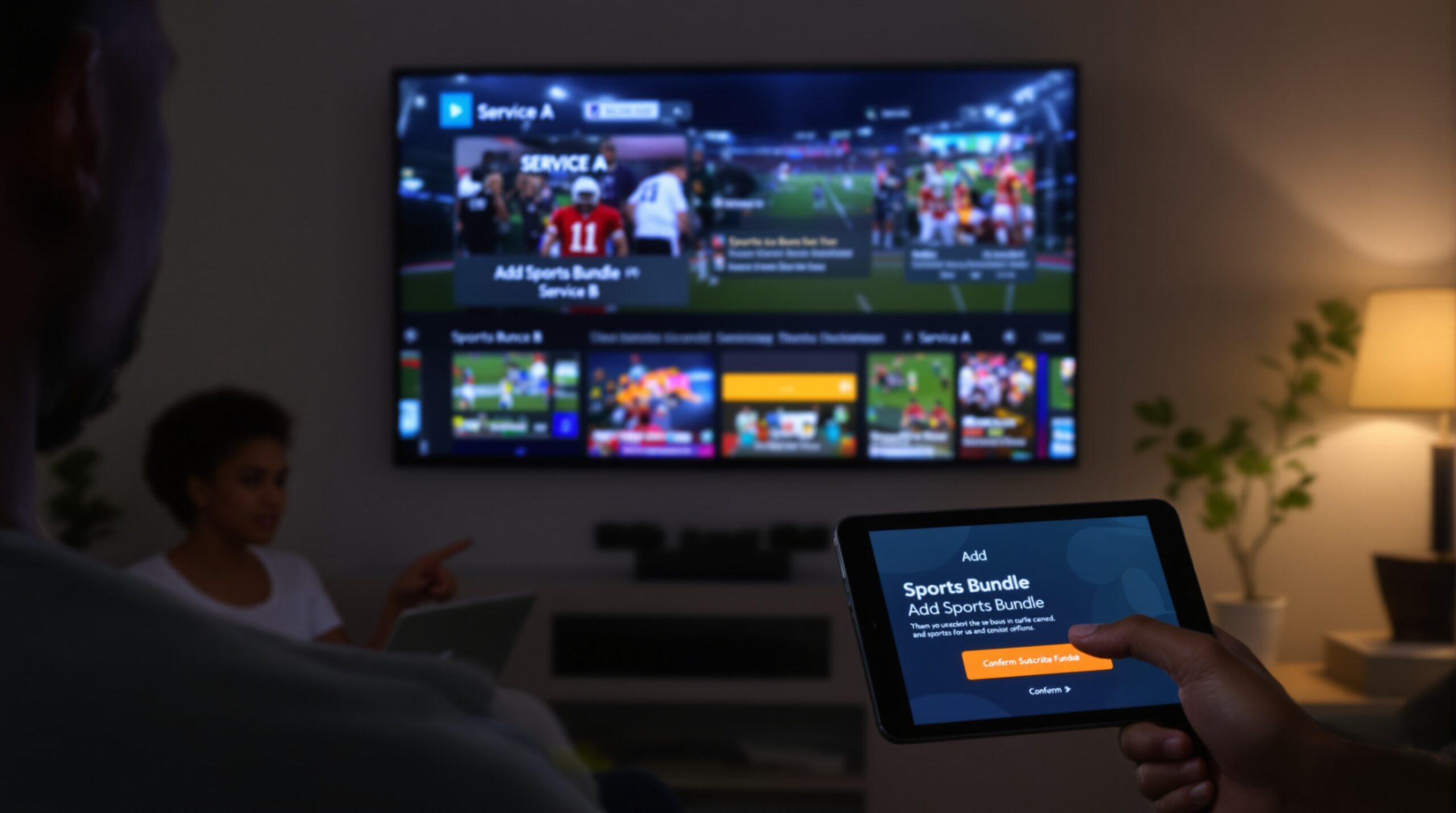
Live sports now anchor streaming growth, retention, and advertising momentum. Platforms court fans with bundles that promise value and simplicity. Rights deals drive audience spikes that general entertainment rarely matches. These trends push services to test new sports packages and partnerships.
Viewers reward reliable live coverage, simple pricing, and broad device reach. Operators respond with cross-service bundles and sports tiers. Each move targets churn while chasing higher ad yields. The result reshapes subscriber strategies across the industry.
Why live sports now anchor streaming growth
Sports deliver appointment viewing and predictable spikes in engagement. Streamers use those events to offset costly scripted programming. Advertisers pay premiums for live, brand-safe inventory. That incentive supports investment in exclusive rights and innovative formats.
Peacock’s exclusive NFL Wild Card game set a U.S. streaming record, according to NBCUniversal and Nielsen. YouTube’s NFL Sunday Ticket shifted fans from satellite to streaming. Apple’s global MLS Season Pass unified a league under one subscription. Netflix added high-profile live events to diversify audience reach.
These milestones raise the bar for live reliability and discovery. They also demonstrate sports’ ability to reduce churn. Platforms now test bundles to amplify those effects. That experimentation accelerates as rights windows renew.
Bundling experiments gather momentum
Cross-service bundles target price fatigue and app fragmentation. The Disney Bundle groups Disney+, Hulu, and ESPN+ at a discount. Verizon packages streaming offers within its mobile plans. Comcast’s StreamSaver integrates Peacock, Netflix, and Apple TV+ for Xfinity customers.
Sports-focused bundles also emerge from industry collaborations. Disney, Fox, and Warner Bros. Discovery announced a joint venture for a multi-network sports service. The venture was later branded Venu Sports and eyed a 2024 launch. Regulators have scrutinized the plan and raised competition concerns.
Carriers and retailers promote bundles that feature sports access. They leverage billing relationships and device promotions to reduce friction. That placement boosts trial and engagement during tentpole events. Consequently, bundling becomes a crucial distribution strategy.
The ESPN, Fox, and WBD proposal faces antitrust questions
The proposed sports service would aggregate linear sports networks and streams. It aims to simplify access for fans without traditional pay television. The Department of Justice filed an antitrust lawsuit in 2024. Regulators argue the collaboration could limit competition and raise prices.
Fubo also sued the companies, alleging anti-competitive behavior around sports rights. That litigation highlights bundling’s legal complexity. Outcomes will influence future joint distribution efforts. The stakes are high for streaming competition and consumer pricing.
Platform playbooks reveal different paths
Each platform tailors sports around existing strengths and audiences. Some emphasize exclusive national rights and marquee events. Others focus on out-of-market packages and local coverage. This diversity shapes bundle structures and pricing.
Amazon leans on Prime scale and commerce integration
Amazon’s Thursday Night Football remains a Prime Video centerpiece. The company invests in production, alternate feeds, and interactive features. Amazon also announced an investment and distribution partnership with Diamond Sports. That plan remains subject to court and league approvals.
Prime Video Channels aggregates third-party sports subscriptions globally. That storefront simplifies billing while expanding selection. It also supports targeted merchandising connected to live moments. These advantages encourage Amazon to test new bundle constructs.
YouTube repositions NFL Sunday Ticket for the streaming era
YouTube acquired residential rights to NFL Sunday Ticket in 2023. The package appears on YouTube and YouTube TV. Innovations like Multiview and Key Plays drive engagement. Seasonal pricing and student offers expand reach and affordability.
Primetime Channels adds a marketplace for league and team services. That marketplace complements YouTube TV’s full channel lineup. Together they create a sports-centric bundle within one interface. Fans benefit from coherent discovery and flexible add-ons.
Peacock and Paramount+ rely on deep rights portfolios
Peacock streams Premier League matches and select Big Ten football. It also carried an exclusive NFL Wild Card playoff game. NBCUniversal used that event to drive paid sign-ups. The service plans more event-led acquisition bursts.
Paramount+ carries UEFA Champions League and UEFA Europa League in the United States. NFL games simulcast through CBS bolster peak usage. Paramount partners with Walmart+ to extend reach via bundles. That distribution supports steady sports-driven engagement.
Apple and Netflix test distinct sports models
Apple’s MLS Season Pass offers every match globally, with minimal blackouts. The service integrates team-oriented content and data-rich features. Apple also streams MLB Friday Night Baseball on select dates. Those rights illustrate a targeted, quality-first approach.
Netflix historically avoided ongoing league rights. The company shifted with live events and premium partnerships. Netflix secured WWE Raw rights beginning in 2025. It also obtained NFL Christmas Day games for a multiyear window.
These additions give Netflix appointment programming beyond series drops. They also improve ad-supported inventory quality. The moves set up potential sports-inclusive bundles. Audience response will determine the scale of future rights.
Max extends sports through the B/R Sports Add-On
Warner Bros. Discovery added sports to Max via the B/R Sports Add-On. The tier features NBA, NHL, and MLB games from Turner networks. Max also carried select NCAA Men’s March Madness games. Promotional periods extended access while pricing evolved.
Bundling Max with wireless plans amplifies reach during playoffs. Those promos demonstrate sports’ utility in acquisition campaigns. Integration within Max keeps sports adjacent to entertainment libraries. That proximity encourages cross-genre viewing.
Distribution partners wield new leverage
Mobile carriers and cable operators broker multistage bundles. They package sports with entertainment and cloud perks. Those offers lower trial risk for hesitant subscribers. They also simplify account management and support.
Device platforms influence discovery through home screen promotion. Connected TV makers highlight live games during tentpoles. Retailers promote gift cards and trials around major events. These placements matter when fans seek quick access.
Pricing, blackouts, and rights constraints complicate bundles
Legacy blackout rules and territorial rights persist across leagues. They often limit complete coverage within a single bundle. Regional sports networks still hold many local games. Direct-to-consumer RSN apps fill some gaps, with added costs.
Customers weigh stacked subscriptions against cable-like totals. That comparison pressures streamers to justify value with extras. Multi-view, alternate feeds, and behind-the-scenes content help. However, clear communication around schedules remains essential.
Contract windows also restrict bundling flexibility. League approvals can slow cross-service packaging. International rights add further complexity and fragmentation. Smart product design can still ease those frictions for fans.
Advertising and data sit at the center of strategies
Sports expand ad-supported tiers with premium slots and higher attention. Streamers pitch dynamic creatives and interactive formats. Shoppable overlays and QR codes connect moments to purchases. Those features convert excitement into measurable outcomes.
Measurement advances support these tactics across platforms and devices. Partners integrate first-party data with clean rooms. That approach targets cohorts while respecting privacy policies. Unified metrics also help price future bundles.
What to watch next as strategies evolve
The next cycle of rights negotiations will shape bundles. NBA packages are reshuffling among major media groups. Outcomes influence app lineups, pricing, and playoff access. They also reveal how leagues weigh reach against exclusivity.
ESPN plans a flagship direct-to-consumer product. Its launch timing and partners could redefine sports packaging. Regulatory decisions around joint ventures will matter. They could enable or constrain broad sports aggregation.
More telecom and retail bundles will likely emerge. Those bundles improve affordability and simplify onboarding. Expect enhanced features like bet integrations and commerce. International expansion will test models across new rights landscapes.
Bottom line for consumers and platforms
Live sports drive subscriptions, retention, and high-value advertising. Bundles promise simplicity but face structural limits and oversight. Platforms will keep testing mixes of rights, product features, and partners. Fans should see clearer options during major seasons.
Success will depend on reliability, transparent pricing, and discovery. Services that respect fan habits will win sustained engagement. Those that overcomplicate access risk churn during offseasons. The race is on to balance breadth and value.
Streaming’s sports era rewards flexibility and focus. Bundles will evolve alongside rights and technology. The next breakthroughs will blend content, commerce, and community. For now, live games sit at the strategy’s center.
