

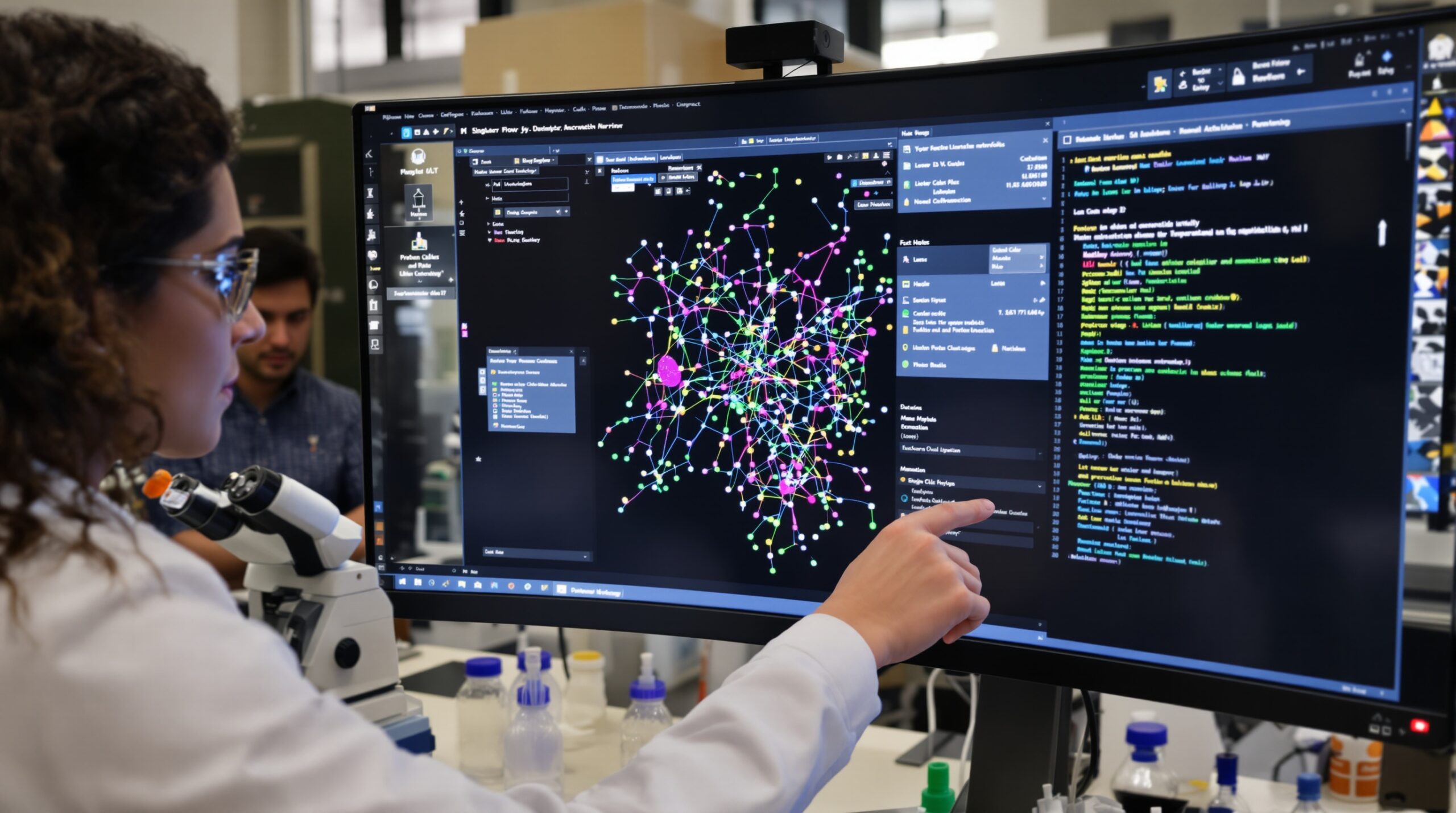
Drug discovery depends on knowing which proteins interact inside specific cells. Many approaches blur those interactions across diverse populations. A new AI model resolves that complexity at single-cell scale. It maps protein interaction networks cell by cell, revealing context that bulk analyses miss. As a result, researchers can prioritize drug targets with greater precision.
Why Single-Cell Interaction Maps Matter
Proteins rarely act alone inside cells. They form dynamic complexes and pathways that shift across states and conditions. Bulk assays average those dynamics, hiding cell-type specific vulnerabilities. Single-cell mapping restores that resolution and biological nuance. Consequently, target discovery becomes faster, clearer, and more actionable.
Diseases often arise from miswired interactions rather than isolated protein faults. Cancer subclones, for example, rewire signaling differently from surrounding cells. Autoimmune cells may show unique receptor coupling patterns. Pathogens can hijack host interactions in specific cell subsets. Therefore, cell-resolved networks guide interventions where they matter most.
What the Model Does Differently
The model infers protein interactions for individual cells, not averaged populations. It integrates molecular readouts from single cells and nearby spatial context. It learns how interactions change across types, states, and microenvironments. It outputs network edges with confidence and directionality when supported. This design improves biological relevance and practical utility.
Integrating Diverse Single-Cell Data
Single-cell data come from many platforms with complementary strengths. CITE-seq links RNA and surface protein measurements in the same cell. Imaging mass cytometry and spatial proteomics add tissue context. Single-cell proteomics measures peptides directly but with sparser coverage. Together, these sources create a richer inference landscape.
The model aligns modalities using shared anchors and biological priors. It corrects batch effects while preserving true cellular variation. It leverages known pathways to guide integration without overfitting. It uses cell neighborhoods to capture paracrine and microenvironment effects. This integration improves the fidelity of inferred interactions.
Graph Learning on Contextual Networks
Protein interactions form graphs with nodes and edges. The model applies graph representation learning to these structures. It initializes graphs with curated protein interaction knowledge. It then refines edges using single-cell observations and perturbation responses. In effect, prior biology informs learning while data drive context specificity.
Graph neural networks capture higher-order dependencies among proteins. They model condition-specific rewiring under stimuli or drug exposure. Attention mechanisms highlight influential neighborhoods within networks. Regularization strategies reduce spurious coexpression artifacts. As a result, predicted edges reflect function rather than mere correlation.
Interpretable Outputs for Biologists
Biologists need transparent reasons behind predictions. The model provides edge-level confidence, directionality hypotheses, and contextual metadata. It traces supportive evidence to specific cells and conditions. It summarizes subnetworks enriched in particular cell types. These features help scientists evaluate and act on predictions.
Moreover, the interface supports hypothesis testing and exploration. Users can query how edges change across patient cohorts. They can visualize pathway rewiring under candidate compounds. They can export prioritized interactions for validation experiments. This workflow aligns closely with laboratory decision making.
Training Signals and Validation Strategies
Reliable models rely on solid training signals. The system learns from curated interaction databases and literature-derived edges. It incorporates genetic perturbation outcomes that report functional dependencies. It also uses phospho-proteomics and signaling readouts where available. These signals ground predictions in mechanistic evidence.
Validation requires diverse benchmarks and careful controls. Researchers compare predictions with independent interaction databases. They test recovery of pathway relationships across cell types. They assess robustness against platform noise and missing data. Importantly, they validate high-confidence edges with targeted experiments.
Speeding Target Discovery and Prioritization
Target selection benefits from context-aware vulnerability maps. The model identifies proteins that centralize control within disease-relevant cells. It reveals synthetic lethal partners specific to certain subclones. It highlights upstream regulators with broad downstream impact. Consequently, discovery teams can prioritize targets with clearer rationale.
Drug projects often fail due to off-target risks. Single-cell interaction maps expose off-target networks across tissues. They flag proteins that interact hazardously in critical cell types. They also suggest safer target isoforms or complexes. This information reduces safety surprises later in development.
Combination therapies require knowledge of pathway crosstalk. The model maps compensatory routes that drive resistance. It proposes dual targets that block escape mechanisms in key cells. It estimates where synergy is most likely based on topology. Teams can then design smarter combination strategies earlier.
Connecting Predictions to Wet-Lab Experiments
Predictions require experimental follow-up for confidence. The platform generates ranked lists with assay-ready metadata. It suggests CRISPR or degrader experiments targeting specific edges. It recommends cell models and readouts matched to predicted contexts. In turn, new data refine the model in an iterative loop.
This loop creates a virtuous cycle between computation and biology. Early experiments validate key assumptions and features. Later experiments probe complex, condition-specific interactions. Each iteration increases precision and reduces uncertainty. Ultimately, teams progress to candidates with stronger mechanistic backing.
Applications Across Therapeutic Areas
Cancer research gains immediate advantages from single-cell networks. Tumors show heterogeneous states with distinct interaction wiring. The model reveals vulnerabilities specific to resistant subpopulations. It also clarifies microenvironmental interactions enabling immune evasion. These insights drive both targeted and immunotherapy strategies.
Immunology also benefits from cell-resolved mapping. T cells and B cells change interaction patterns across activation states. Autoimmune pathology often reflects miswired receptor signaling. The model helps isolate problematic nodes within these pathways. That clarity supports selective modulation without broad immunosuppression.
In neurology, cell-type specificity is crucial. Neurons and glia exhibit distinct interaction landscapes. Off-target effects can be particularly harmful in neural tissues. Single-cell maps inform safer target and biomarker choices. This reduces risks in a historically challenging domain.
Data Quality, Bias, and Ethical Considerations
Model quality depends on data representativeness and rigor. Underrepresented tissues can skew interaction priors and outputs. Technical artifacts may mimic or obscure true edges. The system includes checks for bias and calibration drift. Still, teams must review results with domain expertise.
Patient privacy and data governance remain essential. Single-cell data often include sensitive clinical metadata. De-identification and consent frameworks must guide integration. Secure computation and access controls protect participants. Responsible use increases trust and research impact.
Known Limitations and Future Improvements
Not all protein interactions are observable in current datasets. Transient or low-abundance complexes challenge detection. Spatial resolution may miss microdomains within crowded tissues. Perturbation coverage remains incomplete across proteins and cell types. These gaps limit certainty for some predictions.
Future versions can expand coverage and depth. New single-cell proteomics will improve direct measurement of proteins. Better spatial methods will refine cell-cell interaction inference. Larger perturbation atlases will strengthen causal learning. Continuous benchmarking will maintain reliability and trust.
Implications for R&D Productivity
Time and cost pressures shape modern drug discovery. Faster target triage saves resources and reduces attrition. Single-cell interaction maps improve early decisions and risk assessments. They align computational insights with experimental priorities. Ultimately, they help teams advance better programs sooner.
Practical Adoption and Workflow Integration
Adoption requires careful change management and training. Cross-functional teams should define evaluation metrics and guardrails. Data engineering must support secure, scalable pipelines. Visualization tools should meet biologists where they work. With these steps, organizations can realize clear benefits.
Conclusion: Toward Mechanism-Driven Precision Discovery
Understanding interactions at single-cell scale transforms discovery. The model connects molecular detail to therapeutic action more directly. It clarifies which targets matter, where, and when. It also reduces safety risks and improves combination logic. With continued validation, this approach can reshape drug development.
