
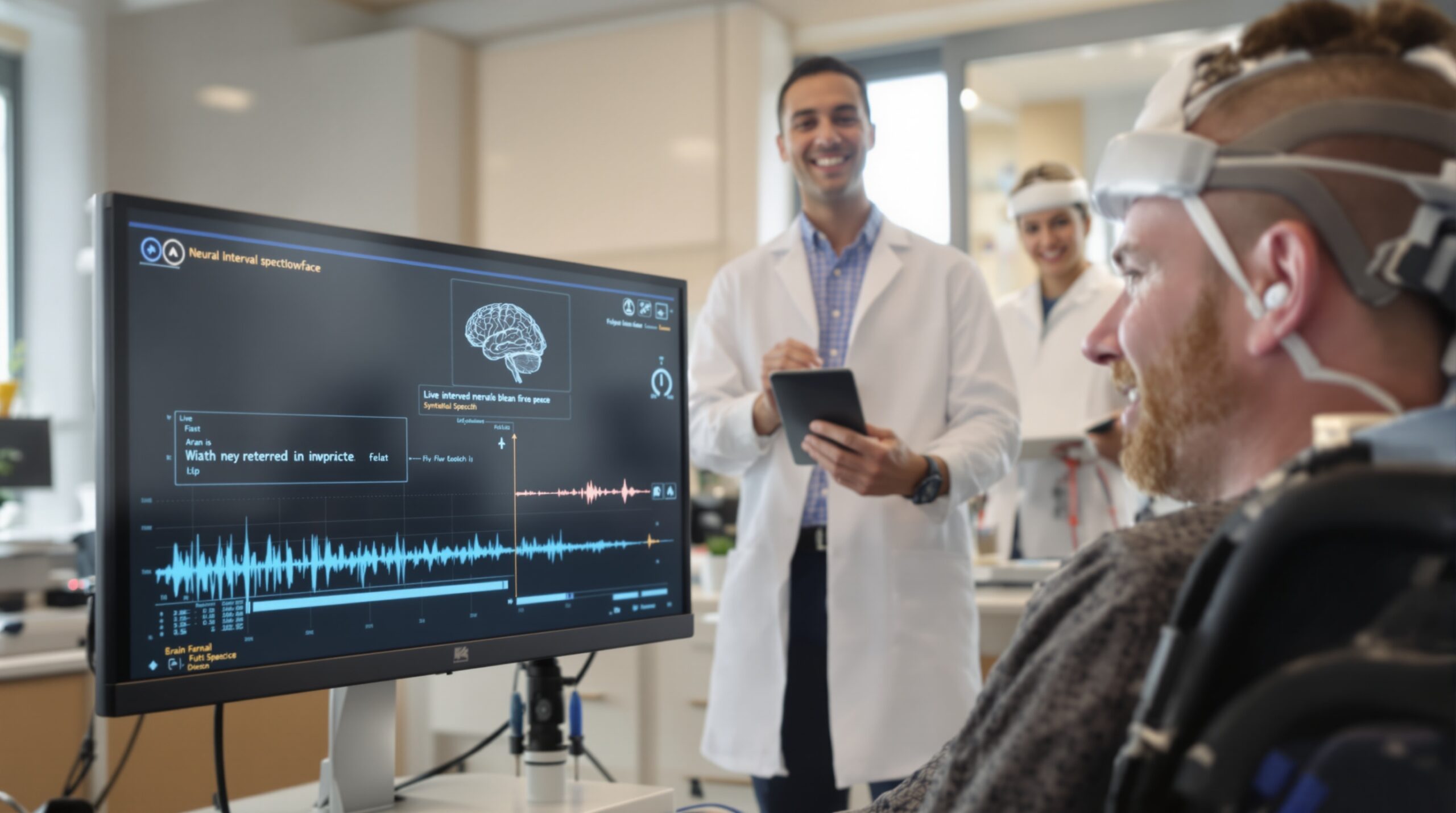
Artificial intelligence now decodes brain signals into fluent speech with striking accuracy and speed. The advance turns silent neural activity into understandable words and natural prosody. For people with paralysis, this capability promises a dramatic communication breakthrough. The path to everyday clinical use is becoming increasingly clear and achievable.
Paralysis can leave cognition intact while severing the body’s ability to speak. Traditional assistive devices remain slow and effortful for many users. Directly translating intended speech from the brain offers a more natural channel. Momentum is building as engineering and neuroscience converge on robust, patient-centered solutions.
How Brain-to-Speech Decoding Works
Modern systems follow a consistent pipeline from neural signals to language. First, sensors capture activity in speech-related brain areas. Next, algorithms extract patterns and map them to units like phonemes or characters. Finally, language models assemble words and synthesize expressive, intelligible speech.
Capturing Neural Activity From Speech Networks
Researchers often record signals from motor and premotor regions controlling the vocal tract. Electrocorticography uses thin electrode grids on the cortical surface. Intracortical arrays capture spiking activity from individual or clustered neurons. These methods prioritize signal clarity while balancing surgical risk and long-term stability.
Noninvasive options are also advancing, including high-density EEG and MEG. These approaches reduce surgical burden but face lower signal resolution. Teams combine smarter sensors with better denoising and alignment methods. The goal is reliable decoding under comfortable, practical conditions.
From Neural Features to Words
Software converts raw neural streams into features that represent articulatory intentions. Models track spectral power changes, oscillations, and spike rates. Deep networks then predict phonemes, graphemes, or articulatory states over time. Training involves aligned speech attempts and ground-truth transcripts or phonetic labels.
Language models improve accuracy and fluency by enforcing linguistic structure. They correct improbable sequences and fill gaps caused by noise. Beam search selects likely word sequences from many candidates. This combination yields speech that sounds coherent, contextual, and humanlike.
Synthesizing Natural, Expressive Speech
Once text or phonemes are decoded, synthesis systems produce audio. Neural vocoders generate smooth, expressive waveforms in real time. Some teams animate a digital avatar to convey prosody and emotion. These outputs match conversational dynamics better than spelling interfaces or typing systems.
Clinical Milestones and Measured Performance
Early proof-of-concept work decoded small vocabularies at modest speeds. A 2021 study achieved meaningful communication using a 50-word set. Decoding accuracy improved with user training and better models. These foundations set the stage for larger vocabularies and faster rates.
By 2023, two teams reported major leaps in performance. One intracortical system decoded intended speech at over 60 words per minute. Another ECoG-based system produced intelligible speech and facial animation at near conversational rates. Reported word error rates fell markedly under constrained vocabularies.
Noninvasive research advanced in parallel with growing promise. High-density EEG studies decoded limited vocabularies with improving reliability. Functional MRI work mapped semantic representations but remained impractical for daily use. Together, these efforts outline complementary paths toward safer, scalable access.
Implications for Breakthrough Paralysis Therapies
For people with locked-in syndrome, this technology could restore spontaneous conversation. Users might speak through an avatar during video calls or clinic visits. They could order food, express preferences, and share emotions fluidly. The experience aligns with natural speech rather than laborious spelling.
Personalization strengthens outcomes and preserves identity. Systems fine-tune acoustic profiles to approximate a user’s former voice. Therapy teams can tailor vocabularies to daily needs and environments. Over time, models adapt to physiological changes and usage patterns.
Integration with existing assistive tools will broaden utility. Decoders can feed text to screen readers, messaging apps, and home assistants. Clinicians can combine speech prostheses with mobility or eye-tracking systems. This interoperability supports independence across diverse settings and tasks.
User Experience and Training Considerations
Effective deployment depends on comfort, reliability, and predictability. Users need fast setup, minimal recalibration, and stable performance. Short daily calibration routines can refresh model alignment. Clear feedback helps users refine their internal strategies over time.
Therapists play vital roles in onboarding and support. They guide positioning, cue training, and vocabulary selection. They also monitor fatigue and adjust sessions to maintain accuracy. This team-based approach increases long-term adherence and satisfaction.
Technical Challenges Still Facing the Field
Signals can drift with small physiological or hardware changes. Decoders must maintain accuracy across days and activities. Continual learning methods help preserve alignment without catastrophic forgetting. Robustness under movement, emotion, and distraction remains a practical requirement.
Hardware pushes must match software strides. Fully implantable, low-power systems reduce infection risk and maintenance burdens. Wireless telemetry needs secure, high-throughput links that conserve battery life. Edge inference can reduce latency and protect user privacy.
Ethical, Privacy, and Safety Considerations
Neural data carry deeply personal information about intentions and health. Strict consent, data minimization, and encryption are essential. Users must control when recording starts, what is stored, and who accesses data. Transparent policies build trust and safeguard autonomy.
Misdecoding can cause confusion or harm if left unchecked. Interfaces should display confirmations for sensitive communications. System logs and fail-safes aid troubleshooting and accountability. Oversight boards can review updates to manage algorithmic risks responsibly.
Regulatory Pathways and Clinical Validation
Clinical trials must demonstrate safety, reliability, and functional benefit. Outcome measures should reflect real-life communication goals. Regulators will expect rigorous evidence across multiple users and contexts. Post-market surveillance can track durability and rare adverse events.
Standards will help align developers, clinicians, and payers. Common benchmarks enable fair comparisons across systems and datasets. Interoperability guidelines can ease clinical integration and service support. Coverage decisions will depend on documented improvements in quality of life.
What Makes the New AI Approach Distinct
The newest systems pair precise neural features with powerful language models. They decode phonetic intentions and then enforce linguistic plausibility. Prosody-aware synthesis delivers expressive speech with minimal lag. Together, these elements enable fluent, fast, and more natural conversations.
Importantly, the approach supports flexible vocabularies and topics. Users need not memorize rigid phrase banks or icons. The model generalizes to unseen words with contextual cues. This adaptability brings communication closer to everyday speech patterns.
Future Directions Worth Watching
Researchers aim to reduce calibration and improve long-term stability. Self-supervised learning may leverage unlabeled daily signals. Multimodal systems could combine brain, muscle, and eye signals. These fusions promise resilience against noise and fatigue.
Noninvasive options continue advancing toward practical performance. Better sensors, smarter decoding, and adaptive headsets may close gaps. Portable ultrasound and novel electrophysiology are under exploration. Safety and comfort will remain central design constraints.
Ethical frameworks will mature alongside technical capabilities. Stakeholders are developing governance for data stewardship and consent. Patient advocates will shape priorities and access models. Inclusive design should reduce bias across languages and dialects.
Outlook for Patients and Clinicians
The trajectory points toward usable, clinic-ready neuroprostheses for speech. Continuous collaboration will speed refinement and validation. With careful regulation and equitable access, benefits can reach diverse communities. The promise of restored conversation is moving from lab to life.
Progress invites both optimism and responsibility. Teams must prioritize safety, privacy, and user agency throughout deployment. With those commitments, AI can amplify human connection after paralysis. The next generation of voice may arise directly from thought.