

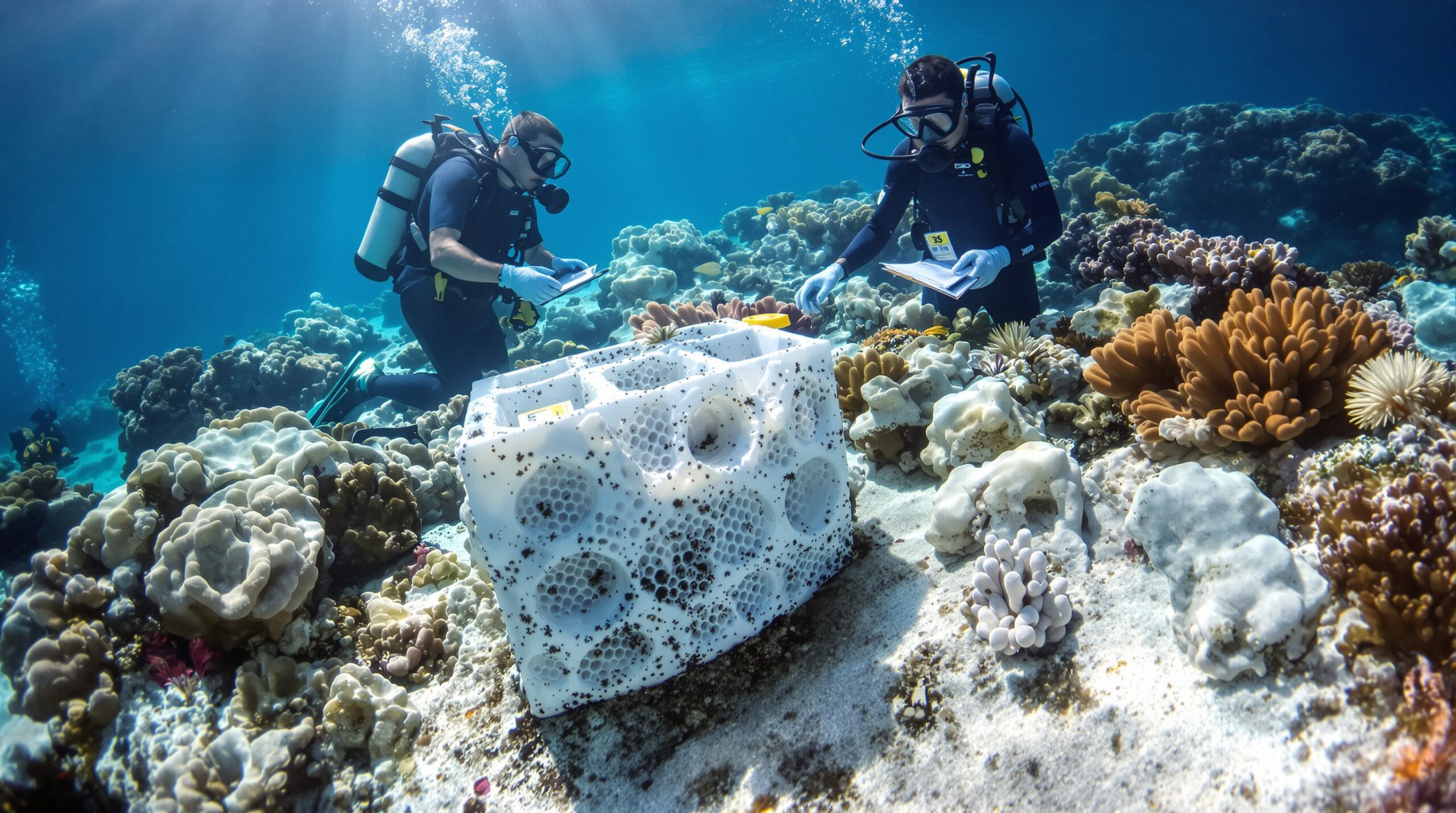
Researchers are using 3D-printed substrates to help coral reefs recover after bleaching. These engineered structures provide stable, hospitable surfaces where coral larvae can settle and grow. The approach complements established restoration methods and addresses persistent post-bleaching bottlenecks. As trials expand, the technique offers a promising, scalable tool for reef resilience.
Warming oceans drive more frequent, severe bleaching events across tropical regions. Bleaching strips corals of symbiotic algae, reduces energy reserves, and raises mortality risks. Surviving colonies often face weakened skeletons and intensified competition with algae. Against that backdrop, researchers sought designs that restore nursery habitat quickly and efficiently.
Why Bleaching Stalls Natural Recovery
After bleaching, reef frameworks often collapse into loose rubble. Unstable rubble prevents coral larvae from attaching and surviving wave action. Algae and cyanobacteria colonize surfaces quickly and outcompete coral recruits. Herbivore declines and sedimentation further suppress settlement and early growth.
Storms and heatwaves increasingly interrupt recovery windows. Even when some larvae arrive, suitable microhabitats remain scarce. Without stable, complex surfaces, recruits fail during early, vulnerable stages. Therefore, engineers focused on substrates that create microrefugia and stability at meaningful scales.
The Core Idea Behind 3D-Printed Substrates
3D-printed substrates mimic natural reef complexity using precisely designed textures and cavities. Designers tailor geometry to guide flow, reduce scour, and shade heat-stressed microzones. The features enhance larval settlement, reduce grazing risk, and limit sediment accumulation. Standardized modules also enable rapid production and consistent performance across sites.
Digital models allow quick iterations based on ecological feedback. Teams can optimize groove depth, surface roughness, and crevice size for target species. They can also integrate mounting points for fragments and sensors. With adjustable parameters, the same platform adapts to varied reef conditions.
Materials and Manufacturing Choices
Projects often use ceramic or terracotta because they are inert and durable underwater. Terracotta provides micro-porosity that can encourage biofilm and coralline algae. Some teams test limestone powders and calcium carbonate composites as alternatives. Others explore biodegradable polymers for temporary scaffolds in sheltered locations.
Manufacturers avoid toxic binders, heavy metals, and sharp additives. Proper firing or curing ensures structural integrity and chemical stability. Texture emerges from both print resolution and post-processing techniques. The chosen material must balance longevity with ecological compatibility and deployment cost.
Ecological Design Features That Matter
Microtopography influences where coral larvae prefer to settle. Shaded crevices can reduce thermal stress and predation during heatwaves. Ridges and pits disrupt sediment deposition and retain larvae during currents. Surfaces conducive to crustose coralline algae offer natural settlement cues.
Designers also consider hydrodynamics and turbidity. Modules can redirect flow to improve oxygenation without dislodging recruits. Elements may deflect sand and reduce scour around growing corals. This ecological engineering helps early life stages survive stressful conditions.
Evidence From Field Trials and Pilot Programs
Pilot studies report promising settlement and survival on 3D-printed units. SECORE International and partners tested ceramic “seeding units” in the Caribbean. Those units enabled large-scale larval outplanting with minimal handling. Reported settlement and survival compared favorably with nearby natural substrates in several trials.
In Hong Kong and Abu Dhabi, Archireef and collaborators deployed terracotta reef tiles. Teams reported improved coral attachment and stability relative to bare rock. Reef Design Lab developed printed habitat tiles and modules used in Australia. These projects demonstrate practical deployment workflows and durable performance.
Combining With Larval Reseeding and Microfragmentation
3D-printed substrates pair well with larval propagation and microfragmentation. Larvae can settle directly onto units in controlled nurseries. Technicians can attach microfragments to predesigned mounting points on site. Together, these steps blend genetic diversity with fast structural growth.
Deployment Methods and Practical Logistics
Modular units simplify transport, diving operations, and site assembly. Crews can click, peg, or screw modules together underwater. Teams often secure tiles using marine-safe adhesives and mechanical anchors. Anti-scour skirts and keyed edges reduce movement during storms.
Local manufacturing lowers shipping emissions and allows designs tailored to local species. Portable printers and regional partners can supply remote projects. Standardized molds and print files streamline training and quality control. With refined logistics, deployment scales without sacrificing ecological performance.
Benefits and Limitations of the Approach
3D printing delivers precision, repeatability, and quick design updates. Ecological performance improves when designs reflect local conditions and species. Substrates can stabilize rubble fields and create structured nurseries swiftly. These features help accelerate recovery during narrow post-bleaching windows.
Limitations remain important and practical. Materials and printing can be costly at massive scales. Severe storms may still dislodge units without robust anchoring. Most critically, continuing heatwaves can overwhelm restoration gains.
Monitoring Success With Clear Metrics
Teams track settlement density, recruit survival, growth rates, and species composition. Structural complexity and carbonate production indicate broader habitat recovery. Fish and invertebrate assemblages reflect ecological function, not just coral cover. Photogrammetry and acoustic monitoring help measure changes over time.
Environmental DNA sampling can reveal community shifts beyond visual surveys. Data support adaptive management of geometry and material choices. Transparent reporting builds trust with regulators and funders. Shared protocols also enable comparisons across regions and projects.
Permitting, Standards, and Community Participation
Permitting typically requires environmental assessments and engineering documentation. Standards for materials, leachates, and durability help reduce ecological risks. Community involvement enhances stewardship and long-term maintenance outcomes. Training local divers creates jobs and improves project continuity.
What Comes Next for 3D-Printed Reef Substrates
Researchers are testing AI-driven design optimization informed by field data. Robotic placement could accelerate installation while improving precision. Some teams explore carbonate printing using industrial byproducts, including brine derivatives. Others combine shading devices and cooling strategies with settlement features.
Climate Context and Responsible Framing
Restoration cannot substitute for rapid emissions reductions. 3D-printed substrates help, but heat stress sets the broader trajectory. Effective conservation links local restoration with global climate action. That integrated strategy offers the best path for reefs and communities.
Getting Projects Ready for Scale
Scaling requires supply chains, training programs, and financing mechanisms. Standard contracts and warranties can attract institutional investors. Insurance products may share storm and heat risks among stakeholders. Clear governance ensures accountability during multi-year restoration commitments.
Conclusion: A Practical Tool for a Hard Problem
3D-printed substrates create stable, biologically friendly real estate for coral settlement. They complement larval reseeding and fragment outplanting strategies. Early projects report encouraging survival and growth across several regions. With careful design and honest framing, this technique can accelerate reef recovery.
The approach empowers local teams while aligning with rigorous monitoring. Continued innovation should improve performance and reduce costs further. Meanwhile, strong climate policy remains essential for lasting reef futures. Together, these efforts can keep coral ecosystems alive and functioning.
