

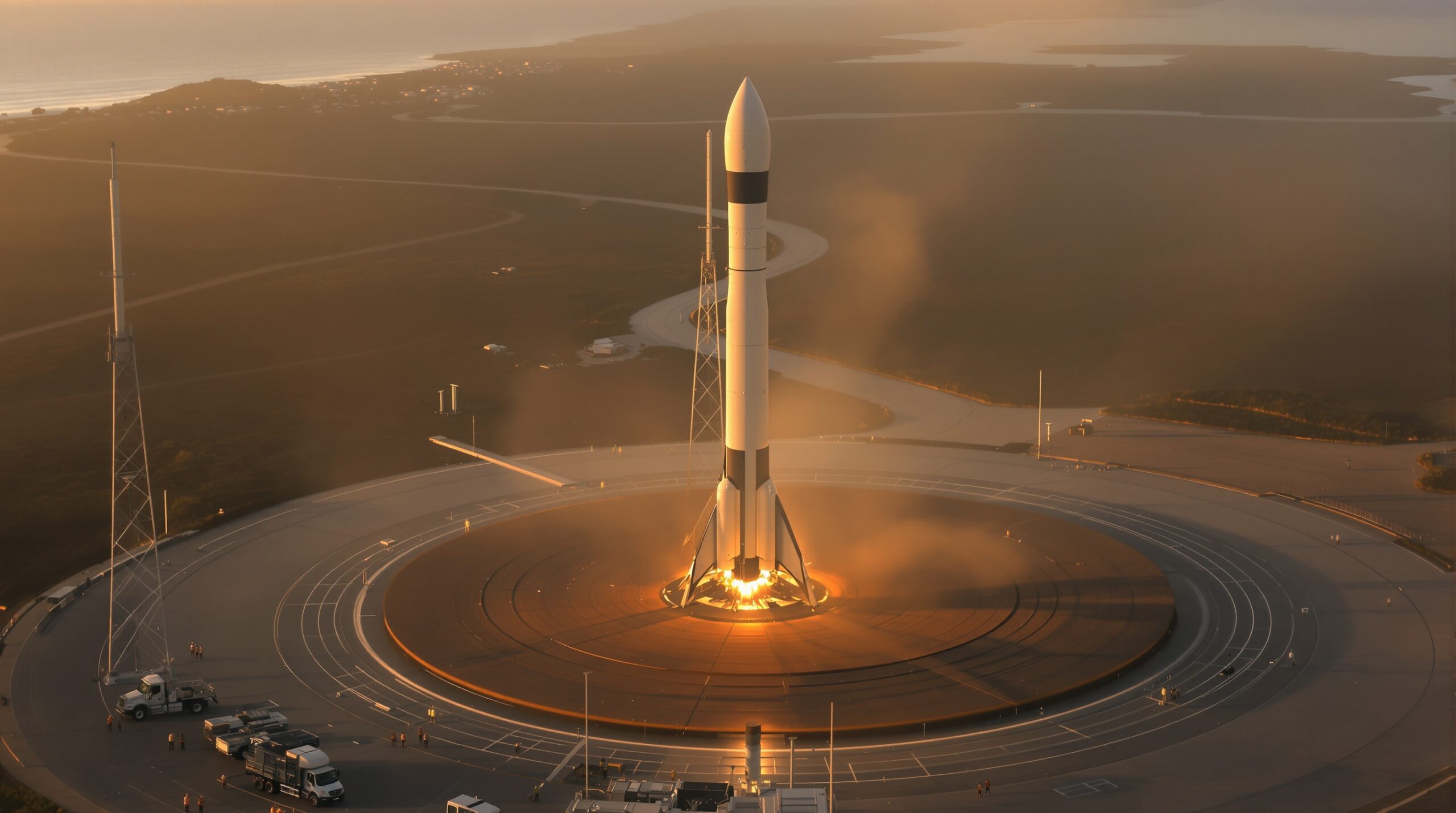
A new reusable rocket prototype successfully performed a vertical landing after completing a hypersonic test flight. The vehicle returned under power, touching down on a designated landing pad with minimal drift. The demonstration showcased precision guidance, thermal protection, and robust engine control under demanding conditions. The test advances reusable launch technology beyond previous suborbital and low-velocity trials.
The flight achieved speeds exceeding Mach five, entering the hypersonic regime where heating and control become especially challenging. Engineers designed the trajectory to explore high dynamic pressure and temperature environments. They then executed a controlled descent and landing. This end-to-end sequence validated hardware, software, and operations in a single integrated campaign.
Why This Hypersonic Landing Test Matters
Hypersonic testing expands the envelope for reusable rockets that must endure extreme heating and forces. Reentry at such speeds stresses materials, guidance systems, and engines beyond routine conditions. Proving a controlled landing after hypersonic exposure reduces risk for orbital-class ambitions. It also accelerates timelines for frequent, reliable reuse.
The test provides crucial data for thermal models and structural margins. It also offers insight into engine relight reliability after intense heating. With validated performance, teams can refine designs and reduce conservative mass buffers. That improvement increases payload capacity and lowers operational costs.
Flight Profile and Hypersonic Regime
The vehicle launched on a vertical trajectory supporting high-energy ascent. It accelerated using a throttleable engine designed for deep throttling and rapid restarts. The plan called for a controlled push into hypersonic speeds. It then executed a guided return to the landing zone.
Ascent and Peak Conditions
During ascent, the rocket maintained stable attitude through gimbaled thrust and aerodynamic surfaces. The guidance software tracked energy and altitude targets while monitoring structural loads. Engineers capped maximum dynamic pressure to protect hardware from excess stress. The vehicle then pitched for a trajectory that ensured safe separation from populated areas.
Instrumentation measured skin temperatures, pressure distributions, and vibration across multiple stations. These measurements verified preflight simulations under hypersonic conditions. The test team watched telemetry for deviations in controllability or heating. The real-time data supported decisions on the timing of the return burn.
Reentry and Aerothermal Loading
As the rocket reentered dense air, heating rates increased and shock interactions developed. The vehicle’s thermal protection system managed convection and radiation from the surrounding plasma. Sensors tracked material performance at joints, control surfaces, and leading edges. Control algorithms balanced attitude to distribute heating and reduce peak loads.
The rocket used body flaps and reaction control thrusters to maintain stable orientation. The guidance system adjusted angles of attack to manage lift-to-drag ratios. These adjustments shaped the energy dissipation profile during descent. They also positioned the vehicle for the landing burn corridor.
Engine Relight and Landing Burn
The engine restarted at a planned altitude, initiating a deceleration burn. Deep throttling enabled precise control of vertical velocity near the pad. The autopilot aligned the vehicle above the touchdown point using GPS and inertial data. Landing legs deployed and locked before contact with the surface.
The final seconds required stable thrust and tight attitude control. The rocket reduced residual horizontal velocity to near zero. It then descended the last meters at a controlled rate. The touchdown produced minimal dust and no observable rebound.
Guidance, Navigation, and Control Advances
The test validated an integrated guidance, navigation, and control stack across extreme regimes. The navigation solution fused inertial sensors, GPS, and radar altimetry. This fusion reduced drift during high dynamics. It also improved landing accuracy under varying winds.
Control laws adapted between hypersonic, transonic, and subsonic phases. They coordinated aerodynamic surfaces, thrusters, and engine gimbals. The onboard software updated targets based on real-time conditions. This approach allowed robust corrections without excessive propellant use.
Propulsion Innovations and Throttle Control
Reusability requires engines that tolerate multiple starts and rapid transients. The engine demonstrated reliable ignition after thermal exposure and vibration. Its injector design supported smooth throttling over a wide range. That stability reduced landing oscillations and plume-induced disturbances.
Engine health monitoring played a critical role. Sensors measured turbopump speeds, chamber pressures, and temperatures. The controller enforced limits to prevent hardware excursions. These protections safeguarded the landing sequence against cascading failures.
Thermal Protection and Structural Design
The vehicle combined reusable thermal protection materials with robust structural joints. Tiles, coatings, and insulation handled repetitive heating. Designers focused on minimizing maintenance between flights. This strategy reduces turnaround time and overall costs.
Structural design considered load paths from aerodynamic forces and landing impacts. Engineers used high-temperature alloys and composites at critical locations. They introduced expansion joints to manage thermal gradients. These features protected integrity across a wide temperature range.
Landing Operations and Ground Safety
Landing operations followed strict safety protocols and range procedures. The team maintained a clear hazard area around the pad. Redundant kill and safing systems remained armed throughout descent. Fire suppression equipment stood ready near the landing zone.
Post-landing, crews secured the vehicle and vented residual propellants. They conducted quick-look inspections for thermal or structural damage. The ground team then transported the rocket to a processing facility. Turnaround metrics will guide maintenance planning for future flights.
Data, Telemetry, and Verification
Telemetry bandwidth supported high-rate data on temperatures, pressures, and structural strains. High-speed cameras captured plume interactions during landing. The team correlated these observations with simulation predictions. Early results show strong agreement across key parameters.
Engineers will perform non-destructive inspections to confirm internal conditions. They will also analyze recovered sensors for calibration drift. This verification helps refine models and safety margins. Accurate models reduce unnecessary mass while preserving reliability.
Economic and Operational Implications
Reusable rockets promise lower launch costs through rapid refurbishment and high flight cadence. Hypersonic-capable vehicles expand mission profiles and flexibility. They can support orbital insertion, cargo return, and responsive launch tasks. Operational savings grow as reuse cycles increase without heavy repairs.
Consistent landing accuracy lowers recovery costs and infrastructure needs. Shorter refurbishment times reduce labor and facility demands. Over time, these efficiencies improve market access for small and medium payloads. They also encourage new commercial and governmental applications.
Environmental Considerations
Reusability reduces hardware waste and manufacturing emissions per mission. Engine choice and propellants influence local air quality impacts. Operators assess noise, water use, and plume effects near landing pads. Compliance plans address wildlife and habitat protections.
Future designs may adopt cleaner propellants and reduced-leak systems. They may also implement smarter trajectories minimizing overflight risks. Environmental monitoring around test sites supports adaptive management. Data-driven adjustments can limit community impacts while enabling innovation.
Regulatory Oversight and Safety Protocols
Such tests occur under strict regulatory frameworks and range rules. Operators coordinate with aviation and maritime authorities to protect public safety. They issue notices and enforce exclusion zones during operations. Regulators review mishap plans and emergency response capabilities.
Transparent reporting strengthens public trust and industry learning. Independent data reviews improve confidence in performance claims. Over time, lessons inform updated standards and best practices. These improvements support reliable, repeatable testing at higher energies.
Industry Context and Comparisons
Vertical landings have transformed launch operations over the past decade. Suborbital and orbital boosters have shown reuse benefits repeatedly. This hypersonic landing expands the validated envelope for returning stages. It builds on earlier demonstrations with higher heating and control demands.
Multiple companies pursue similar capabilities with varied architectures. Some favor stainless steel structures and methane engines. Others use carbon composites and different propellant choices. Each approach trades mass, cost, and refurbishment complexity.
Cross-industry collaboration can accelerate progress on materials and software. Shared standards for telemetry and interfaces may also help. Lessons from aviation support safer operations and maintenance. The test contributes valuable data to this collective effort.
What Comes Next
Engineers will review the full dataset and update models accordingly. They will probe margins for heating, loads, and guidance stability. Subsequent flights will expand altitudes, energies, and landing profiles. The program will also test rapid inspection and refurbishment processes.
Upcoming milestones may include payload integration and longer mission durations. Teams will validate avionics resilience against cumulative stress. They will also improve software robustness for off-nominal events. Each step aims to prove dependable reuse with minimal ground time.
Continued success could reshape launch economics and availability. It could enable more experiments, satellites, and exploration missions at lower cost. Broader access strengthens scientific and commercial opportunities globally. This hypersonic landing brings that vision closer to reality.
By uniting advanced propulsion, materials, and control, the prototype demonstrated a crucial capability. It landed vertically after braving hypersonic conditions. The achievement underscores the maturity of reusable architectures. It also sets a clear direction for the next generation of launch systems.
