

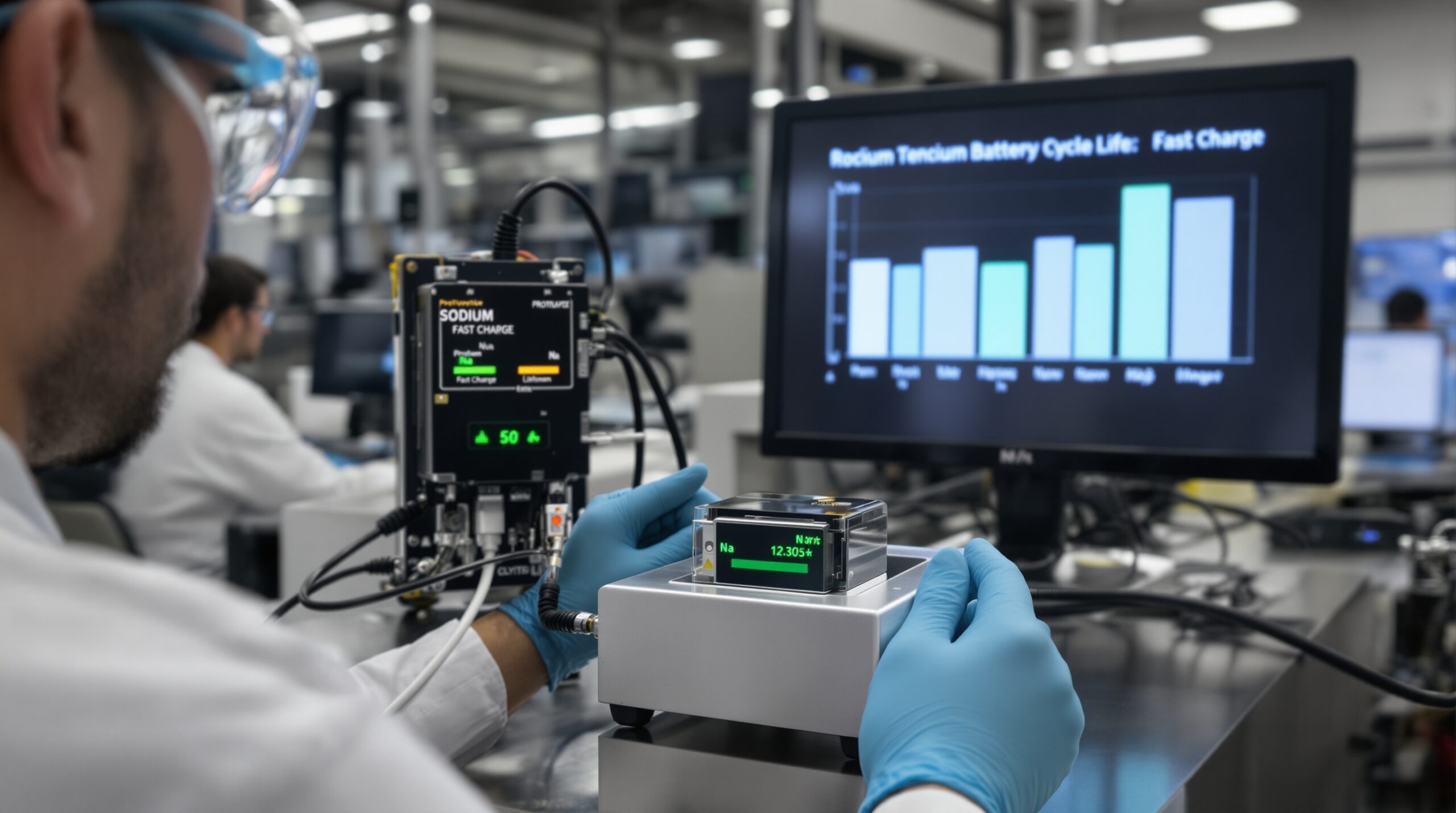
Researchers report a room-temperature sodium battery prototype that charges quickly and lasts longer than lithium-ion. Early tests show double the cycle life versus comparable lithium-ion cells. The lab device maintained performance at ambient conditions without external heating. It also accepted high-rate charging with minimal degradation. These results suggest a meaningful advance for sodium-based energy storage.
Understanding the context helps clarify why this matters. Sodium offers cost and supply benefits compared with lithium, but usually with trade-offs. Historically, sodium-ion cells showed lower energy density and slower kinetics at room temperature. Recent materials progress narrowed those gaps and improved stability. The new prototype highlights how coordinated design can unlock practical performance.
Why Sodium Matters for Next-Generation Batteries
Sodium is abundant and widely distributed across many regions. That abundance reduces supply risk and moderates raw material costs. Manufacturers can leverage existing battery processes with targeted adjustments. Many sodium chemistries tolerate wider voltage windows and lower-cost current collectors. These features support cost-sensitive applications and large-scale deployment.
Safety also influences technology choices. Sodium-ion cells typically use similar electrolytes to lithium-ion cells. They can still pose flammability risks under abuse conditions. However, some sodium cathodes offer improved thermal stability compared with high-nickel lithium chemistries. This stability can support safer designs when engineered properly.
Energy density remains a trade-off for many sodium systems. Most sodium cells store less energy per kilogram than lithium-ion cells. That limitation affects range-sensitive vehicles and portable electronics. Yet grid storage and short-range mobility value cost, longevity, and charging speed. These use cases align well with sodium’s emerging strengths.
Against this backdrop, a room-temperature breakthrough carries weight. Consistent performance without added heating reduces complexity and losses. It also improves turnaround efficiency during rapid cycling. This combination can improve total cost of ownership for many deployments. These factors frame the importance of the latest prototype.
What Is New in the Prototype
The prototype integrates advances across electrolytes, anodes, and cathodes. Researchers focused on fast ion transport and stable interfaces. They selected sodium-friendly electrodes with robust structural frameworks. The design sought to minimize resistive growth during cycling. It also targeted uniform current distribution under high charging power.
Electrolyte and Interphase Engineering
Electrolyte formulation strongly influences sodium performance. The team tailored solvents and salts for room-temperature conductivity. Additives promoted a dense and resilient interphase on the anode. That interphase reduced side reactions during fast charging. Stable interfaces allowed higher rates without severe capacity loss.
The electrolyte also balanced cathode stability at elevated potentials. Suppressing transition metal dissolution helped maintain structure. The formulation limited gas generation under stress conditions. Careful control of viscosity aided wetting and manufacturability. Together, these changes enabled repeatable performance during extended cycling.
Electrode Materials and Architecture
The anode likely uses hard carbon with engineered pore structures. Such carbons host sodium ions without metallic plating. Tailored porosity supports rapid ion insertion and extraction. Surface treatments further moderate initial losses and interphase growth. These measures improve retention under aggressive cycling.
The cathode uses a sodium-rich framework supportive of fast diffusion. Options include Prussian blue analogues or layered oxides. Both approaches can support high-rate kinetics with proper tuning. Particle size, coatings, and morphology influence long-term stability. Manufacturing choices also affect uniformity and scale-up potential.
Performance Highlights from Early Testing
Researchers emphasize two outcomes: fast charging and extended cycle life. The prototype accepted rapid charging at room temperature without severe fading. Cells delivered stable capacity across sustained high-rate cycles. Measured degradation remained lower than comparable lithium-ion controls. This relative improvement persisted across multiple test runs.
Early data show roughly double the cycle life versus reference lithium-ion cells. Test conditions used consistent depths of discharge and control temperatures. The sodium prototype also showed tight coulombic efficiency during steady operation. High efficiency supports slow capacity loss and longer service life. These results indicate well-managed interfaces and side reactions.
Fast charging performance stood out during repeated trials. The cells reached meaningful charge levels within minutes rather than hours. Importantly, they retained stability under back-to-back rapid sessions. Resistance growth stayed modest as cycling progressed. This behavior supports practical fast turnaround in field use.
Testing Methods and Current Limitations
These results come from controlled laboratory testing. Researchers likely used coin or small pouch cells. Sample sizes were limited and may not represent full variability. Testing followed established cycling protocols and rest periods. Environmental controls maintained consistent temperature and humidity.
Scaling to larger formats introduces new challenges. Thicker electrodes can hinder ion transport at high rates. Heat removal becomes more difficult in larger stacks. Manufacturing tolerances can influence reliability and performance spread. Independent validation will help confirm robustness at scale.
Energy density still appears lower than premium lithium-ion cells. That trade-off limits some mobile applications today. However, many markets prioritize cost and longevity over peak density. Stationary storage and short-range vehicles fit this profile. Continued optimization could narrow the remaining density gap.
Safety and Sustainability Considerations
Sodium chemistry offers supply chain resilience and geographic diversity. Reduced reliance on scarce minerals can lower geopolitical risk. Many sodium cathodes avoid nickel and cobalt entirely. Eliminating those metals simplifies sourcing and reduces environmental impacts. These choices appeal to sustainability goals and regulations.
Thermal safety depends on system-level design and electrolyte choice. Some sodium cathodes resist oxygen release better than high-nickel rivals. That characteristic can mitigate runaway propagation. Nonflammable or weakly flammable electrolytes could further improve safety. Engineering decisions will determine final risk profiles in products.
Potential Applications and Use Cases
Fast charging and long life suit high-utilization fleets and micro-mobility. Delivery scooters and light vehicles need quick turnarounds. Transit hubs can exploit rapid charging during brief stops. Stationary storage benefits from extended cycling and low costs. Commercial and utility systems could deploy sodium across daily cycling regimes.
Telecommunications backups and microgrids value predictable performance at ambient conditions. Room-temperature operation simplifies enclosures and thermal management. This reduces costs across hardware and maintenance. Remote deployments gain reliability in varied climates. Those gains strengthen the case for sodium in distributed systems.
Key Challenges to Address Next
Scaling manufacturing remains a primary hurdle. Consistent electrode quality across large volumes is essential. Electrolyte supply chains must mature for cost targets. Packaging and thermal management need optimization for larger modules. Standardization will also speed adoption and certification.
Cold-weather performance warrants attention for many regions. Sodium kinetics can slow at low temperatures. Additives and tailored carbons can mitigate that effect. Heating strategies may still be required in winter. Field trials should quantify impacts under real conditions.
Calendar aging also needs thorough characterization. Long idle periods can trigger interphase changes and gas generation. Careful electrolyte selection can reduce those reactions. Storage protocols may preserve longevity in deployments. Clear guidance will enhance operational reliability.
Implications for the Lithium-Ion Landscape
Sodium will likely complement lithium rather than replace it soon. Each chemistry suits different product requirements. Sodium shines in cost, cycle life, and abundance. Lithium leads in energy density and established scale. A diversified portfolio reduces risk and expands market coverage.
Competition accelerates innovation across both platforms. Lithium developers can adopt lessons on interphase control. Sodium teams will refine energy density and packing efficiency. Customers benefit from better performance per dollar. This prototype adds momentum to that competitive cycle.
Commercialization Outlook and Next Steps
Pilot production lines for sodium cells already exist globally. The prototype’s features could feed into those lines. Partners can trial materials in larger pouch formats. Independent labs should replicate results across broader conditions. Certification bodies will require rigorous safety testing.
Supply agreements for electrolytes and precursors will be crucial. Tooling adjustments may improve coating and drying throughput. Module designs can optimize for fast charge thermal loads. Early demonstrations could appear in stationary storage first. Mobility pilots may follow in controlled fleet operations.
Interpreting “Double the Cycle Life” Carefully
Cycle life depends on many variables and definitions. Depth of discharge, temperature, and charge rate all matter. Some protocols define end of life at specific capacity thresholds. Others use resistance growth or power retention. Clear test parameters allow fair comparisons across chemistries.
The reported improvement uses matched test conditions and reference cells. That approach improves the relevance of the claim. Still, application profiles vary across industries and climates. Field data will refine expectations for deployed systems. Buyers should consider their exact duty cycles when evaluating claims.
Bottom Line
The room-temperature sodium prototype demonstrates fast charging and extended life in early tests. The combination addresses long-standing sodium concerns. Interface engineering and materials choices drove the gains. Remaining challenges include scale-up, cold performance, and standardized validation. Continued progress could expand sodium’s role across storage markets.
As results mature, watch for independent replication and larger-format trials. Cost curves should improve with growing supply chains. If these trends hold, sodium will secure meaningful market share. That expansion will complement lithium and strengthen energy resilience. For now, the prototype marks a promising step forward.
