

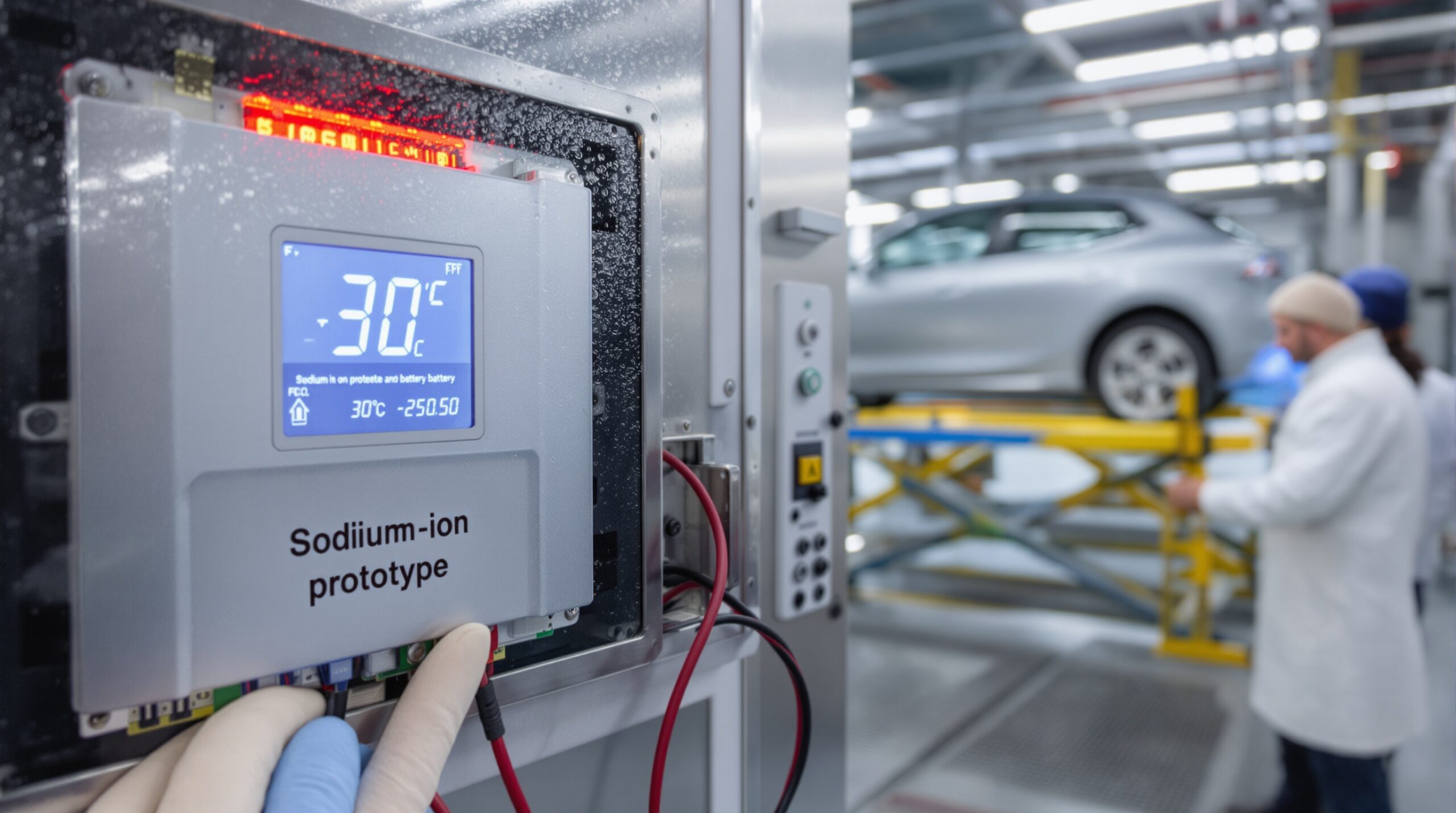
Cold weather still limits many electric vehicles during winter commutes and mountain trips. Range drops, charging slows, and drivers worry. A new sodium-ion battery prototype addresses these issues with strong low-temperature performance. The advance highlights a promising path for affordable and resilient electrification.
Engineers designed the prototype to keep ions moving despite winter temperatures. The design tackles sluggish kinetics, thickened electrolytes, and unstable interfaces. Early test data show stable operation at subzero temperatures with useful power and capacity. That combination could unlock confident cold-weather driving.
Sodium-ion technology delivers compelling value beyond cold performance. Sodium is abundant, widely distributed, and inexpensive to refine. The chemistry avoids cobalt and nickel and reduces supply chain risk. Together, these features attract automakers seeking robust and sustainable battery options.
Why low-temperature performance matters for EVs
Cold weather reduces ion mobility and increases internal resistance inside cells. Vehicles then lose power and usable energy. Drivers sense this as weaker acceleration and faster range depletion. The problem also affects regenerative braking and climate control demands.
Fast charging suffers most at low temperatures. Cells accept less current without damage, which lengthens charging stops. Many vehicles heat packs before charging to protect the cells. That conditioning consumes energy and adds time during winter trips.
Better low-temperature behavior reduces these compromises. Strong performance lowers energy spent on pack heating. It also maintains power, charge acceptance, and accurate range predictions. As a result, winter reliability improves for commuters and fleets.
Inside the sodium-ion prototype
Developers target cold performance through coordinated materials and design choices. They start with an anode chemistry suited for sodium transport. Many prototypes use hard carbon with tailored porosity. The structure accommodates sodium ions with minimal expansion and stress.
Cathodes often use Prussian blue analogs for fast Na+ diffusion. These open-framework materials support rapid kinetics at low temperatures. Some designs also explore layered oxide cathodes for higher energy. Each choice balances voltage, stability, and cost.
Electrolyte formulation drives much of the cold performance. Engineers blend solvents to keep viscosity low in the cold. Ether-based solvents often remain fluid at subzero temperatures. Carbonate blends with appropriate cosolvents also help flow and conductivity.
Additives play a pivotal role in interface stability. Fluoroethylene carbonate often appears in high-performing formulas. The additive helps form a robust solid-electrolyte interphase on hard carbon. A stable interphase reduces impedance growth during cold cycling.
Salt selection and concentration also influence conductivity. Common salts include NaPF6 and sodium bis(fluorosulfonyl)imide. Higher concentrations can widen the electrochemical stability window. However, viscosity and cost must remain practical for manufacturing.
Separator properties matter under cold conditions. Low thermal shrinkage ensures safety during temperature swings. High wettability and thin thickness reduce resistance. These features aid ion transport when electrolytes thicken.
Electrode engineering completes the cold strategy. Developers tune porosity, tortuosity, and binder systems for rapid ion access. Carbon coatings on cathode particles improve conductivity. Thin current collectors and optimized calendering reduce ohmic losses.
Prototypes report solid power delivery at subzero temperatures. Laboratory tests often include -10°C and -20°C cycling. Cells with optimized electrolytes retain substantial capacity at those temperatures. They also sustain higher charge rates without severe degradation.
Thermal management still improves outcomes in vehicles. Packs can precondition cells to moderate temperatures before charging. However, better chemistry reduces the energy needed for heating. That synergy extends range and protects hardware.
Materials and chemistry choices that enable cold performance
Hard carbon anodes
Hard carbon stores sodium in pores and graphitic domains. Engineers control pore size to balance capacity and kinetics. Smaller pores increase energy but slow ion movement. Designers optimize distributions for winter conditions.
Surface chemistry also influences interphase formation. Pretreatments and coatings reduce irreversible reactions. These steps promote a stable and thin SEI. A thinner SEI reduces resistance at low temperatures.
Prussian blue analog cathodes
Prussian blue analogs feature open channels for sodium transport. Water content and defects affect stability and voltage. Manufacturers reduce coordinated water for better lifetime. They also tune particle size for rate capability.
These cathodes offer high power and low cost. However, energy density remains moderate compared with layered oxides. Engineers balance these tradeoffs for target vehicle segments. Cold performance often favors the Prussian blue route.
Electrolytes and additives
Low-temperature electrolytes demand low viscosity and high conductivity. Ether-rich blends deliver favorable transport at subzero conditions. Certain carbonate cosolvents extend stability at higher voltages. Additives shape the interphase for long-term durability.
Formation protocols matter as much as chemistry. Controlled initial cycles build a uniform SEI. Temperature-controlled formation can further improve cold behavior. Manufacturers use precise schedules to achieve consistent results.
Interphase engineering
The SEI controls charge transfer at the anode. A robust SEI minimizes impedance growth during cold cycling. Additives and salts influence its composition and morphology. Analytical tools guide optimization across operating temperatures.
Cathode interphases also deserve attention. Oxidative decomposition can increase resistance at low temperatures. Coatings and stable electrolytes reduce those reactions. The result is better high-voltage stability in the cold.
Performance metrics and testing protocols
Cold-cranking style tests measure pulse power delivery at low temperatures. Engineers apply pulses to evaluate voltage sag and heat generation. Repeated pulses reveal degradation patterns and safety margins. These tests inform pack-level power capabilities.
Rate capability tests examine charge and discharge at different C-rates. Low-temperature rate tests emphasize safe charge acceptance. Data show the maximum current without plating risk. Those limits guide charging strategies during winter.
Impedance spectroscopy tracks resistance changes with temperature and aging. Arrhenius analysis estimates activation energies for key processes. The approach separates transport and interfacial contributions. Engineers then target the dominant limitations with design changes.
Cycle life testing confirms durability under cold duty cycles. Protocols mix deep discharges and partial charges. They include rests that simulate parked conditions. Realistic profiles produce reliable lifetime predictions.
Implications for next‑generation electric vehicles
Stronger low-temperature performance expands the usable thermal window. Vehicles can rely less on pack heaters during winter. That reduces energy consumption and simplifies thermal systems. Drivers gain range and faster roadside charging.
Sodium-ion cells offer competitive safety characteristics. Lower reactivity reduces thermal runaway probability under abuse. The chemistry tolerates wider temperature swings without severe damage. Fleet operators value these resilience traits.
Energy density trails the best lithium-ion chemistries today. Many sodium-ion packs will weigh slightly more for a given range. However, cost and cold performance can offset those penalties. Value-focused segments could adopt the technology quickly.
Grid-connected charging strategies also benefit. Packs may accept higher currents without extreme preheating. Stations spend less time ramping temperatures before fast charging. That change improves throughput and customer satisfaction in winter.
Commercialization outlook and challenges
Manufacturers can adapt many lithium-ion processes to sodium-ion cells. Coating, calendering, and formation share similar equipment. This compatibility reduces capital costs for new lines. Partners can scale production using familiar workflows.
Supply chains for sodium salts and precursors continue to mature. Abundant sodium resources reduce geopolitical risk. Cathode materials avoid cobalt and nickel entirely. These shifts enhance sustainability and cost stability.
Key challenges remain before broad deployment. Energy density must rise to meet long-range expectations. Cold performance must hold under fast charging and deep cycling. Long-term storage at low temperatures needs further study.
Anode plating risk requires careful management at low temperatures. Conservative charging protocols mitigate that hazard. Accurate diagnostics help detect harmful conditions early. Software and hardware cooperate to enforce safe limits.
Automakers will conduct rigorous pack-level validation. Crash safety, venting, and thermal propagation need testing. Cold-weather calendar aging also matters for warranties. Results will determine rollout pace and market segments.
What to watch next
- Pilot lines producing automotive-format sodium-ion cells with cold-certified specifications.
- Validated energy density improvements without sacrificing winter performance or safety margins.
- Fast-charge protocols that avoid plating at subzero temperatures in real vehicles.
- Pack architectures that exploit reduced heating needs during winter operation.
- Independent winter field trials across multiple climate zones and duty cycles.
- Total cost of ownership analyses for fleet use in cold regions.
Bottom line
The new prototype shows that sodium-ion chemistry can thrive in the cold. Careful materials choices and interface control enable this leap. Strong winter behavior strengthens the case for sodium-ion adoption. With continued progress, drivers could see confident cold-weather EVs at accessible prices.
