

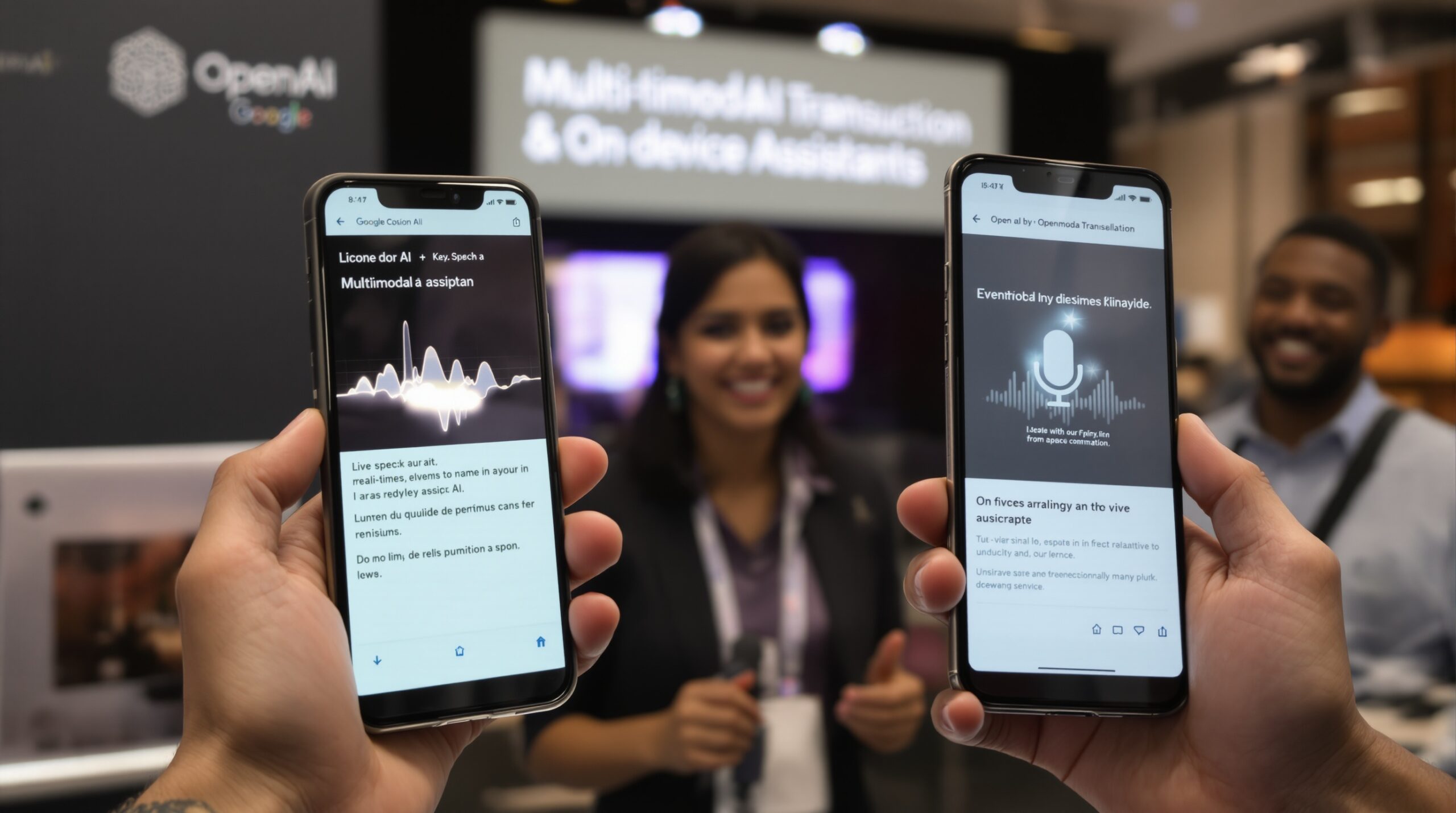
OpenAI and Google are racing to redefine the smartphone experience with multimodal artificial intelligence. Their latest features blend speech, text, and vision into responsive, conversational assistants. These advances place translation and task help within immediate reach. Everyday devices now deliver capabilities once limited to specialized tools.
The shift feels significant for global communication and mobile productivity. It also reflects years of research maturing into practical products. Both companies highlight latency reductions and more natural interactions. The result is smoother conversations that feel closer to human dialogue.
What Multimodal AI Brings to Smartphones
Multimodal AI can understand and generate across speech, text, images, and video. This flexibility enables assistants to see, listen, speak, and reason. Smartphones become portable translators, tutors, and guides. Users benefit from intuitive interactions using voice, camera, and screen.
Low latency is crucial for natural conversation. Interruptions, turn-taking, and emotional cues demand fast response times. New models prioritize streaming outputs and real-time processing. This design supports fluid back-and-forth dialogue with fewer awkward pauses.
OpenAI’s Approach: GPT-4o and Realtime Experiences
OpenAI introduced GPT-4o, a multimodal model optimized for real-time interactions. It handles text, audio, and vision within a unified architecture. GPT-4o powers voice conversations that can translate speech in near real time. The model also understands camera input for context-aware assistance.
Realtime Voice and Translation Capabilities
OpenAI demonstrated conversational translation between languages with quick turnaround and natural prosody. Users can interrupt naturally, and the assistant adjusts immediately. The system preserves tone better than older pipeline translators. Developers can stream audio in and receive audio responses with minimal delay.
This capability supports travel, education, and multilingual collaboration. It also aids accessibility for users navigating different languages. Real-time translation reduces friction in spontaneous interactions. People can communicate more comfortably across language barriers.
ChatGPT App and Realtime API
The ChatGPT mobile app brings GPT-4o’s voice mode to phones. Users hold natural conversations, ask questions, and share camera views. The Realtime API lets developers embed similar experiences within their apps. Streaming protocols deliver continuous updates as the model processes inputs.
These tools make smartphones feel like responsive companions. They also reduce context switching between apps and tasks. Users can accomplish more through conversation and pointing. This pattern aligns with how people already interact in daily life.
Google’s Approach: Gemini Live, Project Astra, and Android Integration
Google advanced multimodal assistance through Gemini across devices. Gemini Live offers real-time conversational voice interactions. Project Astra showcased an AI agent understanding video in continuous context. The demonstrations emphasized low latency and natural turn-taking.
Real-Time Conversations and Visual Understanding
Gemini can describe scenes, locate objects, and answer questions using the camera view. It also tracks conversational context across turns. Users can interrupt, clarify, and switch topics fluidly. The assistant responds with voice that feels expressive and timely.
Google positions these features as everyday utility. They help with cooking, repairs, and navigation. They also support study sessions and creative brainstorming. This situational awareness strengthens the assistant’s usefulness during spontaneous tasks.
On-Device Gemini Nano and System Features
Google deploys Gemini Nano for on-device inference on supported Android phones. On-device models power features like smart replies. They also support summaries in select first-party apps. Processing locally can improve privacy and speed.
Android also offers Live Translate and Interpreter Mode for conversations. Many Pixel features work on-device for faster, private translations. These capabilities help travelers and bilingual households. More features continue moving from cloud to device as hardware improves.
Turning Phones Into Real-Time Translators
Real-time translation requires reliable speech recognition and speech synthesis. It also relies on accurate language understanding and context maintenance. Both companies combine these components within cohesive experiences. The experience now resembles talking with a knowledgeable companion.
Users can point the camera at signs or menus and receive translations. They can also hold bilingual conversations with smooth turn-taking. The assistants manage multiple speakers and alternating languages. This performance makes cross-language meetings more productive and inclusive.
On-Device Versus Cloud: Privacy and Performance
On-device models reduce data transmission and support offline scenarios. They also lower latency by avoiding network round trips. However, larger models usually run in the cloud today. Hybrid approaches balance capability with privacy needs.
Google emphasizes on-device Gemini Nano for sensitive or latency-critical tasks. OpenAI offers APIs that enable privacy controls and token governance. Both platforms expose developer settings for data retention and logging. Enterprises can tailor deployments to compliance requirements.
Latency Improvements Enable Natural Dialogue
Natural conversation depends on low-latency streaming for audio and text. Faster response times reduce interruptions and cognitive load. OpenAI and Google both highlight end-to-end latency gains. These gains result from optimized models and efficient runtimes.
Duplex streaming and partial hypotheses keep conversations moving. The assistant starts speaking before full processing completes. Users feel less waiting and more engagement. The overall experience becomes more satisfying and productive.
Accessibility and Education Benefits
Real-time captions and translations support hearing-impaired users. Visual descriptions assist users with low vision. Multimodal tutoring helps students learn through conversation and examples. Language learners practice pronunciation with immediate feedback.
Teachers can generate examples, summaries, and translations quickly. Students can query complex material using voice and diagrams. The assistant adapts explanations to individual needs. These capabilities broaden access to quality learning support.
Work, Travel, and Everyday Use Cases
Teams can hold multilingual meetings with live mediation. Field workers can translate signage and instructions on the spot. Travelers navigate transport, menus, and services confidently. Everyday tasks become simpler through conversation and camera guidance.
Smartphones act as immediate assistants during errands and projects. People request step-by-step help while staying hands-free. Visual context reduces misunderstandings and follow-up questions. Workflows accelerate without heavy training or scripting.
Developer Ecosystems and Integration Paths
OpenAI’s Realtime API supports audio, text, and tool invocation. Developers stream inputs and orchestrate responses programmatically. Google provides Gemini APIs across Android and the web. These options encourage multimodal features across diverse apps.
SDKs help with microphone access, camera frames, and buffering. Sample apps demonstrate best practices for latency and UX. Tooling also addresses turn-taking and interruption handling. These patterns will likely become standard for conversational interfaces.
Limitations and Responsible Use Considerations
Translation remains imperfect for idioms, dialects, and technical jargon. Background noise can degrade speech recognition accuracy. Battery life and heat constrain continuous on-device processing. Data governance policies must address sensitive content risks.
Both companies promote safety guardrails and usage transparency. They also invest in bias evaluation and red-teaming. Clear disclosures help users understand data handling. Responsible defaults build trust as adoption grows.
Competition and Market Implications
OpenAI and Google set pace for multimodal assistance on phones. Their advancements influence device makers and app developers. Carriers and OEMs will differentiate through tight integration. Consumers will compare assistants on privacy, breadth, and responsiveness.
Partnerships will shape distribution and default experiences. Ecosystems will reward apps that integrate conversational control elegantly. Enterprises will seek governance, observability, and cost efficiency. The winners will align capabilities with real user value.
What Comes Next
Expect more languages, better accents, and richer emotional expressiveness. Vision understanding will become more robust in complex scenes. On-device models will handle broader tasks as hardware improves. Cloud models will deliver deeper reasoning and knowledge.
Cross-app orchestration will grow more seamless. Assistants will handle tasks spanning messaging, email, and documents. Context windows will expand responsibly with user consent. These improvements will make assistants feel truly ever-present.
The Bottom Line
OpenAI and Google are transforming smartphones into capable translators and assistants. Multimodal models reduce friction in daily communication and work. On-device advances enhance privacy and immediacy for key features. Cloud services extend reach with advanced reasoning and knowledge.
Users already benefit from faster, more natural conversations with their devices. Developers gain modern building blocks for voice and vision. Organizations can pilot practical solutions with clear governance options. The momentum suggests a lasting shift in how people use phones.
