

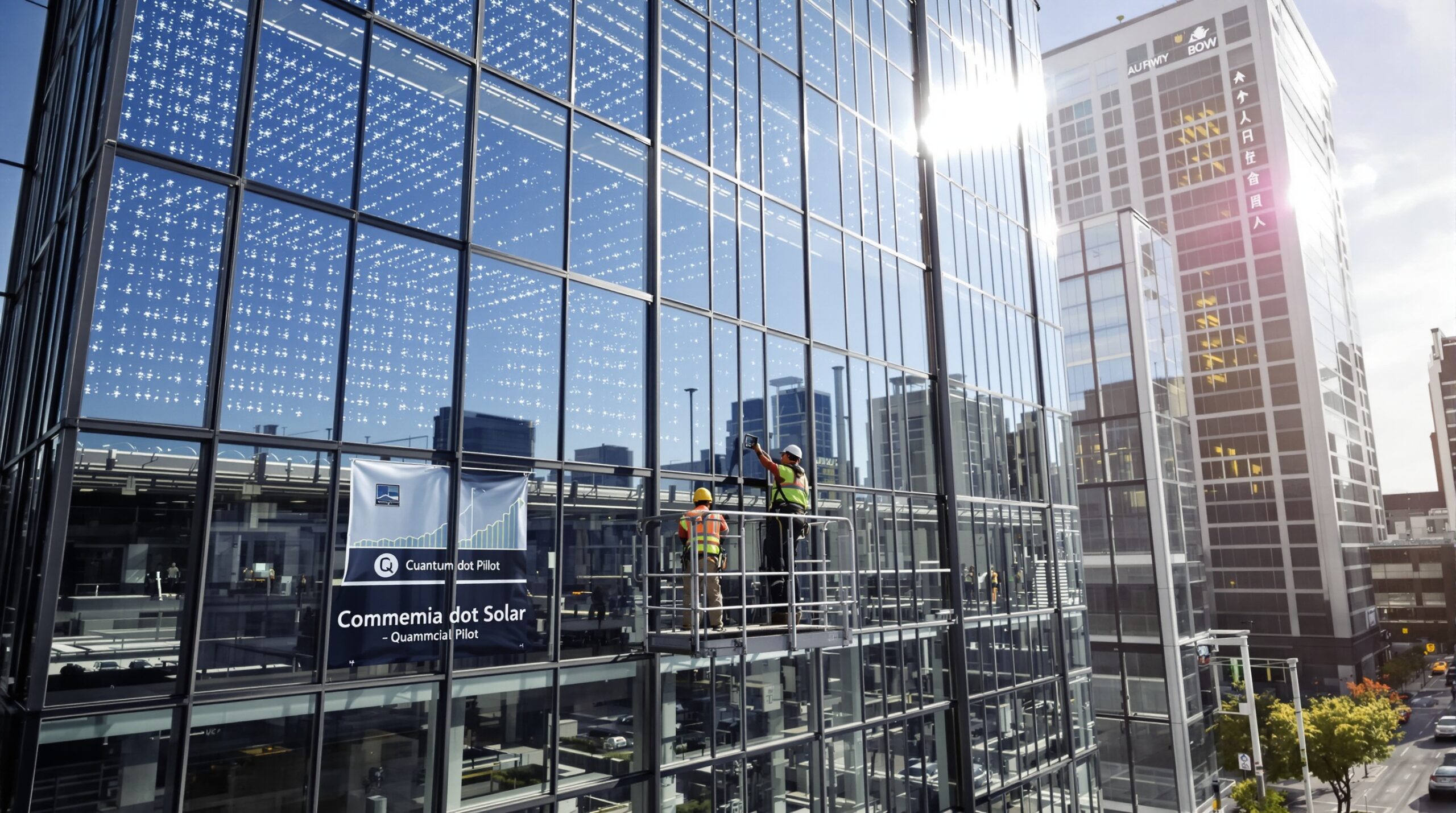
Quantum-dot solar windows are moving from labs into commercial pilots across real buildings. Developers aim to convert expansive facades into distributed power plants. The technology promises clean energy without sacrificing views or daylight. Momentum is building as urban owners seek practical decarbonization options.
How quantum-dot solar windows work
Quantum dots are tiny semiconductor crystals that absorb light and re-emit it efficiently. Manufacturers embed them inside a transparent waveguiding layer within laminated glass. The re-emitted light travels to the glass edges by total internal reflection. Photovoltaic cells at the edges convert that concentrated light into electricity.
This architecture is called a luminescent solar concentrator. It differs from conventional transparent PV that places visible cells across the view area. The concentrator keeps most optics inside the interlayer, preserving aesthetics. The result blends energy generation with architectural transparency and uniform color.
Why the commercial pilot phase is starting now
Several trends align to unlock pilots for building owners. Quantum dots now offer higher stability, brightness, and color control than earlier generations. Glass laminators can integrate functional interlayers using standard production lines. Building codes increasingly encourage on-site generation and electrification efforts.
At the same time, owners must replace aging facades and improve energy performance. Coupling replacement with power generation strengthens project economics. Pilots allow teams to de-risk performance, durability, and operations in the field. Early data then informs scaled deployments on future towers.
Expected efficiency and power density
Power density depends on window size, transparency, and sun conditions. Transparent concentrator windows typically deliver several to tens of watts per square meter. Darker tints can yield higher watts per square meter with reduced visible transmission. Overall building yield scales with facade area and orientation.
These numbers trail rooftop modules on a per-area basis. However, skyscrapers offer massive vertical surface area for energy harvesting. The additive contribution can meaningfully offset common area loads. Pilots will refine realistic annual yields and variability by orientation.
Integrating power-generating glass into tall buildings
Manufacturers supply insulated glass units with embedded quantum-dot interlayers. Frames capture the edges, where small PV strips reside behind the sightlines. Wiring routes through mullions to hidden junction boxes at spandrels. Curtain wall fabricators assemble these units using familiar workflows and tolerances.
Glazing performance still matters for comfort and efficiency. Units must meet specified U-factor, solar heat gain, and visible transmittance targets. The energy layer should not introduce glare or color cast. Teams tune stack-ups to balance daylighting, thermal control, and power output.
Electrical architecture and safety
Designers can group windows into low-voltage DC circuits within a façade zone. DC optimizers or microinverters improve safety and controllability. Systems must comply with PV and building electrical safety standards. Fire stopping at mullions and risers requires careful detailing and inspection.
Certifications typically involve PV module safety and BIPV requirements. Curtain wall fire and impact certifications remain essential for occupancy permits. Pilots help validate assemblies under local authority review. Documentation and mock-ups simplify future approvals and replications.
Economics and procurement considerations
Pilot projects often pair with scheduled façade modernization budgets. Energy generation offsets incrementally improve the glazing business case. Owners evaluate payback using avoided energy purchases and incentives. Renewable certificates and sustainability branding may add measurable value.
Per-area energy output remains lower than rooftop modules. However, rooftops on towers are small relative to building loads. Facades provide a large incremental resource without consuming floor area. Pilots quantify costs, outputs, and operational savings for investment committees.
Occupant experience and environmental performance
Successful designs maintain neutral color and high clarity. Occupants should enjoy views and daylight comparable to premium low-iron glass. The quantum-dot layer can also reduce UV transmission. That benefit protects interiors and contributes to thermal comfort strategies.
Passive shading still improves comfort and reduces cooling loads. Pilots often pair solar windows with smart blinds or spectrally selective coatings. Integrated strategies optimize both energy generation and demand reduction. Commissioning teams track how occupants perceive glare and brightness changes.
Materials, durability, and environmental health
Quantum dots can include various chemistries with distinct trade-offs. Some dots use cadmium-based compounds with established performance and handling protocols. Alternatives include indium phosphide and emerging perovskite formulations. Each path faces specific stability and supply considerations.
Glazing laminates protect the dots from oxygen and moisture. Manufacturers test against UV exposure, temperature cycling, and humidity. Standards-based testing helps predict decades-long service life. Environmental regulations govern restricted substances and end-of-life handling.
What commercial pilots typically include
Pilots often deploy on a defined facade zone or annex. Teams instrument the array with irradiance, temperature, and power monitoring. Operators collect data across seasons for robust modeling. Maintenance crews gain experience with inspections and cleaning protocols.
Stakeholders compare modeled output with measured data. They also track occupant feedback and glare metrics near pilot zones. Procurement teams evaluate lead times and supplier responsiveness. Lessons learned then inform specifications for expansion phases.
Use cases beyond skyscraper curtain walls
Transit shelters and skylights benefit from luminescent concentrators. Atria, canopies, and balustrades add productive glass surfaces. Greenhouses can tailor spectra for plant growth alongside power generation. Universities and airports often host visible demonstration projects.
Policy, codes, and standards landscape
Building-integrated photovoltaics intersect multiple standards families. PV modules must meet safety and performance certifications. Glazing units must pass impact, wind, and fire requirements. Curtain wall systems must satisfy structural and weatherproofing criteria.
Energy codes increasingly recognize on-site generation within compliance paths. Incentive programs may support innovative BIPV technologies at pilot scale. Authorities having jurisdiction will expect clear documentation and testing evidence. Early engagement accelerates approvals and reduces redesign risk.
Installation, operations, and maintenance
Glaziers install units using standard lifting and sealing practices. Electricians complete low-voltage wiring within mullions and spandrels. Commissioning verifies electrical polarity, grounding, and module-level communications. Facility teams add the system to existing maintenance schedules.
Periodic cleaning maintains optical performance and daylight quality. Monitoring platforms detect underperforming sections for targeted service. Replacement strategies mirror conventional insulated glass unit practices. Pilots document these activities to refine long-term budgets.
Data, verification, and performance modeling
High-quality data underpins trustworthy business cases. Teams capture facade orientation, shading, and irradiance data at multiple heights. Models incorporate optical coupling and edge-cell temperature effects. Third-party verification strengthens investor and lender confidence.
Measured results validate energy, thermal, and daylight simulations. Operators then update building digital twins with empirical performance. Accurate models improve grid interconnection studies and incentive applications. Pilots thereby reduce uncertainty for multi-building rollouts.
Market landscape and supply chain readiness
Multiple startups and established glass partners are advancing this category. Research institutions continue improving materials and stability. Laminators and curtain wall firms bring manufacturing scale and certification experience. Pilots help align these groups within reliable delivery timelines.
Supply chains must support consistent interlayer quality and color. Integration with standard spacers, sealants, and coatings remains vital. Clear specifications reduce surprises during factory acceptance testing. Market maturity will accelerate as repeatable assemblies proliferate.
How owners can evaluate pilot opportunities
Start with facade age, condition, and pending capital plans. Identify south and west exposures with strong solar potential. Confirm electrical interconnection capacity and metering options with the utility. Engage code officials and insurers early to shape requirements.
Develop an energy model that includes daylighting and cooling impacts. Compare scenarios for transparency, tint, and array coverage. Request lifecycle analyses covering embodied carbon and recyclability. Require detailed monitoring to validate key assumptions post-commissioning.
Outlook and pathway to scale
Commercial pilots represent a pivotal step toward mainstream adoption. Data from occupied buildings will guide product refinements and standards. Partnerships between glass makers and PV specialists will drive reliability. Cost reductions should follow as volumes grow and processes mature.
Urban decarbonization needs every viable surface working. Quantum-dot solar windows unlock a new frontier on vertical acreage. With measured progress, facades can quietly supply clean power for decades. The city skyline could become an active energy system, not just a silhouette.
