

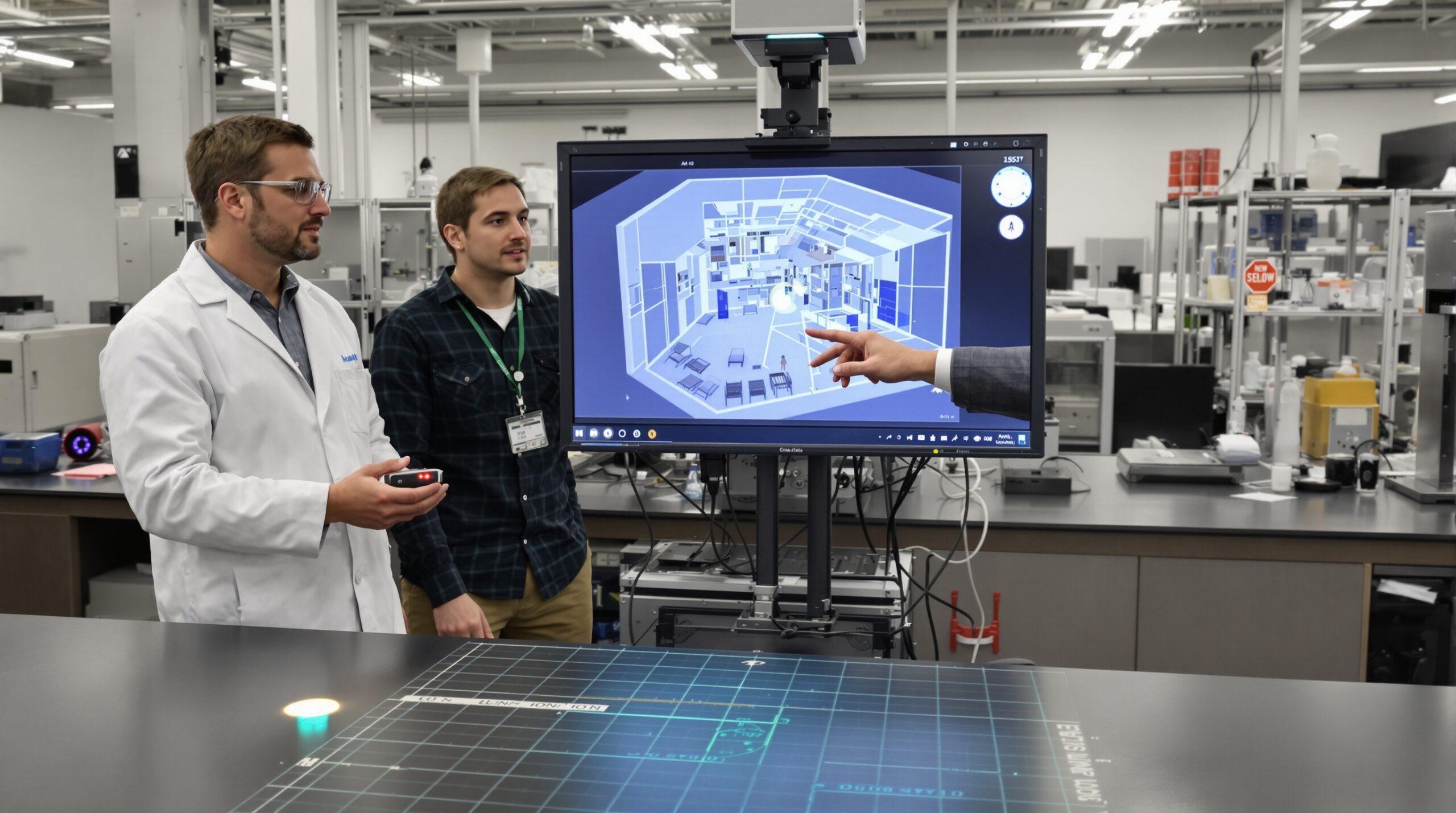
GPS falters indoors, where walls and ceilings scatter or block satellite signals. A new quantum sensor platform fills that gap. Researchers demonstrated centimeter-level indoor positioning using atomic-scale measurement techniques. Their prototype tracked motion precisely without radio beacons, cameras, or external references.
The advance relies on quantum sensors that directly measure acceleration, rotation, and time with exceptional stability. By fusing these signals, the system reconstructs position with unprecedented accuracy indoors. The approach reduces drift that plagues classical inertial systems.
This capability opens options for warehouses, hospitals, tunnels, ships, and factories. It also supports navigation in denied environments. The breakthrough highlights how quantum technologies can deliver practical benefits beyond laboratories. The transition from prototypes to rugged devices is now underway.
Why Indoor Positioning Needs a New Approach
Indoor spaces challenge radio positioning through multipath reflections and signal attenuation. Ceiling heights, metal structures, and moving people complicate propagation. Even well-designed anchors struggle with occlusion and interference. Consequently, many facilities accept meter-level error or expensive infrastructure.
Classical inertial sensors provide short-term stability but accumulate drift over time. Small biases integrate into large position errors. Periodic corrections from beacons, cameras, or maps are required. However, those references may be unavailable, untrusted, or costly to maintain.
Quantum sensors change this tradeoff by improving measurement stability at the source. They leverage atomic transitions that behave identically across devices and time. This uniformity anchors motion estimates to physics, not calibration alone. As a result, drift reduces dramatically.
How Quantum Sensors Achieve Absolute Precision
Atom Interferometer Accelerometers
Atom interferometers cool atoms with lasers and split their quantum wavefunctions along two paths. The paths recombine after controlled pulses. The resulting interference pattern shifts with acceleration. Measuring the shift yields absolute acceleration with very low bias and noise.
These sensors do not rely on spring-mass mechanics. Instead, they reference the wavelength of light and atomic energy levels. This approach produces repeatable scale factors across devices. It also reduces susceptibility to temperature changes and aging effects compared to MEMS.
Quantum Gyroscopes
Quantum gyroscopes measure rotation using similar interferometric principles or ultra-stable optical paths. They sense the Sagnac effect at high resolution. Rotation estimates constrain the navigation equations and limit growth of position error. Better rotation accuracy improves velocity integration and heading stability.
Combining atom-based accelerometers with quantum gyroscopes improves six-degree tracking. The system measures linear and angular motion simultaneously. That fusion maintains centimeter-level position through turns and stops. It also enhances performance in vibration-rich environments like vehicles and industrial floors.
Reference Timing with Atomic Clocks
An integrated atomic clock provides a stable timebase for sensor readout. Precise timing improves phase measurements and synchronization. It also stabilizes dead reckoning in dynamic settings. The clock reduces timing noise contributions to velocity and displacement estimates.
Atomic clocks also enable deterministic calibration routines. The device can periodically self-check sensor phases against known timing references. This capability tightens long-term accuracy. It additionally helps align data across multi-sensor arrays and networked robots.
System Architecture of the Prototype
The prototype integrates a cold-atom interferometer, a compact quantum gyroscope, and a chip-scale atomic clock. Laser systems cool and manipulate atoms inside a small vacuum chamber. Optical fibers route light to an interaction region. Photodetectors read interference fringes with high sensitivity.
Control electronics generate Raman pulses and stabilize laser frequencies. Vibration isolation shields the atoms from environmental noise. Thermal management maintains stable operating temperatures. A microcontroller coordinates measurement cycles and streams data to the navigation computer.
The navigation computer runs real-time estimation algorithms. It fuses acceleration, rotation, and timing data using a probabilistic filter. The system outputs position and orientation at several updates per second. It also estimates uncertainty, which informs downstream decision systems.
Sensor Fusion and Error Correction
Developers implemented an extended Kalman filter with factor graph smoothing. The filter models biases, scale factors, and noise. It learns residual correlations during operation. The smoother reduces drift during stationary periods and repeated motion patterns.
Algorithms recognize microgravity cues, floor impacts, and turn patterns. These features provide natural constraints without infrastructure. The software uses them to correct residual errors. Over time, the system maintains centimeter-level trajectories within tested environments.
Mapping Without Beacons
Some configurations optionally incorporate passive environmental maps. Magnetic field variations provide unique fingerprints. High-sensitivity quantum magnetometers can read these patterns. Matching them against stored maps refines position without active beacons or emissions.
Gravity gradients also vary across buildings due to materials and geometry. Atom interferometers can sense tiny gravity changes. These variations supply additional absolute cues. Together, passive maps further reduce cumulative drift over longer paths.
Demonstrated Performance and Test Conditions
Researchers evaluated the prototype in corridors, stairwells, and factory-like spaces. They tested varying speeds, stops, and turns. Ground truth came from survey equipment and motion capture in controlled segments. The system achieved centimeter-level error over tens of meters.
Longer trials showed bounded drift without external radios. Stationary holds allowed automatic bias re-estimation. The device sustained accuracy during walking and cart motion. It also withstood moderate vibration on a mobile platform.
Performance depended on calibration, environment stability, and motion profiles. Best results occurred with periodic stationary intervals. Controlled temperature improved stability further. The team reported consistent centimeter-scale accuracy under those conditions.
Advantages Over Existing Indoor Positioning Systems
Quantum positioning requires no anchors, tags, or line-of-sight. It resists electromagnetic interference and spoofing. It preserves privacy by avoiding ambient scanning. The device operates silently and passively within existing infrastructure.
Compared with UWB or Wi‑Fi RTT, it avoids deployment costs and maintenance. Compared with vision systems, it works in darkness, dust, and smoke. It sidesteps occlusion problems and flicker. It also complements tags when available for hybrid setups.
Technical Challenges and Limitations
Today’s quantum sensors still face size, weight, and power constraints. Cold atom systems need vacuum and laser subsystems. These modules increase complexity and cost. Ruggedization for industrial environments remains an ongoing engineering effort.
Thermal changes and vibrations can degrade measurements. Careful isolation and control loops mitigate these effects. Startup time may be longer than MEMS devices. Battery life must balance duty cycles, data rates, and cooling requirements.
Passive mapping approaches require initial surveys in some cases. Map drift can occur after building changes. Robust algorithms must detect mismatches gracefully. Continued research targets reliable performance across varied facilities.
Potential Applications
Hospitals can track equipment without Wi‑Fi coverage or tags. Robots can navigate warehouses with tighter tolerances. First responders can maintain location in smoke-filled buildings. Miners can traverse tunnels with confidence when radios fail.
AR headsets benefit from stable pose estimation in complex interiors. Forklifts can operate with improved safety margins. Autonomous carts can share precise maps across shifts. Surveyors can document interior spaces without temporary beacons.
Maritime operations gain navigation where GPS is degraded. Subterranean exploration becomes safer with continuous tracking. Museums can enable guided experiences without dense infrastructure. These use cases highlight broad utility across sectors.
Safety, Privacy, and Regulatory Considerations
Quantum sensors operate passively and emit minimal radio energy. Laser systems stay enclosed and follow safety standards. Devices must meet eye safety and electrical requirements. Manufacturers document safe handling and maintenance procedures.
Because the system does not scan networks or capture imagery, privacy impacts remain limited. Location data stays on authorized devices. Administrators control sharing through defined policies. Compliance frameworks can adopt standard security practices.
Roadmap to Commercialization
Miniaturization efforts target photonic integrated circuits and microfabricated vacuum packages. Stabilized diode lasers shrink optical systems significantly. Rugged optomechanics increase alignment stability. These steps reduce cost and improve reliability in the field.
Vendors pursue chip-scale atomic clocks and compact cold atom sources. They integrate control electronics onto low-power boards. Firmware optimizations reduce cycle times and warm-up delays. Field-calibration tools simplify deployment in busy facilities.
Certification will cover safety, electromagnetic compatibility, and environmental durability. Standards bodies will define performance benchmarks for indoor navigation. Open interfaces will enable cross-vendor interoperability. Pilot programs will validate business value and total cost.
How It Differs From Classical IMUs
Classical IMUs integrate small errors into large drifts over time. Quantum sensors reduce those biases at measurement time. Absolute references tie measurements to physical constants. This approach slows error growth dramatically.
High-grade classical systems achieve good performance with careful calibration. However, they still degrade under temperature and aging. Quantum devices maintain scale factors more consistently. That stability enables centimeter-level positioning with fewer external aids.
What To Watch Next
Expect expanded field trials in complex facilities. Results will quantify performance across seasons and vibrations. Developers will publish datasets and benchmarks. Independent labs will replicate and stress test reported claims.
Hybrid systems will combine quantum sensors with selective infrastructure. Opportunistic corrections from UWB or vision will extend range. Standard APIs will simplify application integration. Tooling will mature for diagnostics and health monitoring.
Cost reductions will follow integration and volume manufacturing. Smaller devices will enter mobile robots and wearables. Software updates will enhance filtering and mapping. These steps will broaden accessibility and impact.
The Bottom Line
Quantum sensors have delivered a meaningful leap for indoor positioning. Centimeter-level accuracy without GPS or beacons is now demonstrable. The technology still must mature for broad deployment. Nevertheless, evidence shows clear potential for real-world navigation problems.
Organizations should evaluate pilot projects where anchors are impractical. They should assess operational benefits against early device constraints. Meanwhile, research will continue expanding robustness and reducing size. The path forward looks promising and highly consequential.
As hardware and algorithms improve, quantum positioning will complement existing tools. It will also enable scenarios impossible today. Indoor navigation will gain a dependable, infrastructure-free option. That shift could redefine how people and machines move through complex spaces.
