
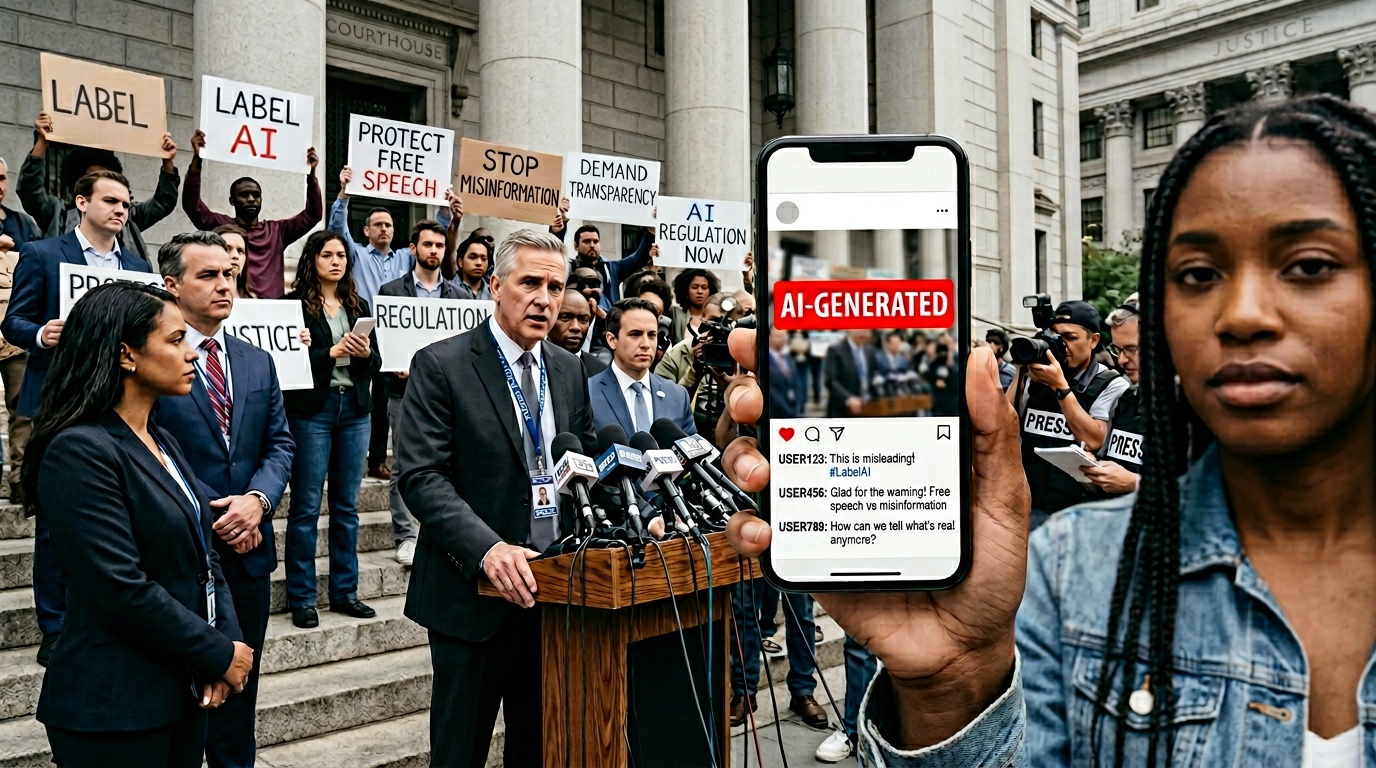
Regulators worldwide are moving to require labels on AI-generated content across major social platforms. They aim to boost transparency, reduce deception, and protect elections and public discourse. The push has sparked a sharp debate over free speech, enforcement, and practical feasibility. Platforms, creators, and policymakers now confront complex tradeoffs and tight timelines.
Public concern has surged as synthetic images, audio, and video grow more realistic. Viral deepfakes have shown how believable fabrications can spread quickly. Lawmakers argue that clear notices can help users understand when AI played a role. Critics counter that compulsory labels could chill expression and mislead audiences.
These proposals differ across jurisdictions, but the core idea remains similar. Mark AI-assisted or fully synthetic content in a consistent, visible way. With elections approaching in many countries, the political stakes feel especially high. The policy fight is now accelerating into rulemaking and product changes.
The Regulatory Push
In the European Union, lawmakers adopted sweeping AI rules with transparency duties. The AI Act requires labeling for deepfakes, with limited exemptions. Platforms and content providers must disclose synthetic media when audiences could be misled. The Digital Services Act also pressures platforms to mitigate systemic risks from deceptive content.
United States policy has advanced through executive guidance and agency actions. A White House executive order directed agencies to develop watermarking and provenance guidance. The National Institute of Standards and Technology supports standards for content authenticity. Several states enacted or proposed rules on AI in political ads and deepfakes.
The Federal Trade Commission has warned firms about deceptive AI marketing. It has pursued cases targeting impersonation and misleading claims. The Federal Election Commission opened a rulemaking on deceptive AI in campaign communications. Congressional proposals would require labels on AI-generated political advertising nationwide.
Other countries are moving quickly as well. The United Kingdom’s regulator is reviewing synthetic media risks under new online safety duties. China requires providers and users to mark deep synthesis content conspicuously. Singapore and other jurisdictions promote provenance standards and voluntary commitments.
Election Integrity Drives Timelines
Upcoming elections have compressed schedules for policy deployment. Regulators fear last-minute deepfakes could swing narratives before fact-checks land. Campaigns increasingly test AI tools for rapid message production. Labeling rules aim to preserve trust without banning lawful political expression.
How Mandatory Labels Would Work
Proposals generally pair user-facing notices with technical provenance signals. Visible labels sit near the content, explaining that AI generated or altered it. Technical signals include watermarks and metadata that travel with the file. Standards help ensure consistent treatment across tools and platforms.
Many policymakers emphasize cryptographic provenance using open standards. The Coalition for Content Provenance and Authenticity supports signed metadata. Adobe, camera makers, and platforms have begun adopting these credentials. Signed records can show who created, edited, and exported a media file.
Design choices matter for clarity and fairness. Some proposals mandate labels for fully synthetic content only. Others capture any material meaningfully altered by AI. Carveouts may exist for news reporting, research, or security operations with context.
Detection, Self-Disclosure, and Mixed Workflows
Enforcement tools combine creator disclosures, platform detection, and provenance checks. Detection systems estimate whether content likely comes from known models. These systems can help, but error rates remain significant. Self-disclosure forms a necessary pillar when detection alone cannot suffice.
Creative workflows often mix human and AI input. Rules must define materiality, not punish de minimis assistance. Clear thresholds reduce disputes and gaming. Guidance should explain examples for audio, images, video, and text.
Arguments From Supporters
Supporters say labeling strengthens user autonomy and media literacy. People deserve to know when an algorithm shaped what they see. Labels can nudge skepticism without banning content outright. They can complement fact-checks, reporting, and educational campaigns.
Proponents emphasize harm reduction for fraud and impersonation. Scammers already exploit voice cloning and image fabrication. Labels can slow virality and help platforms prioritize moderation. They can also deter malicious actors through higher friction.
Election safeguards represent another core rationale. Voters should recognize synthetic endorsements, speeches, and photos. Clear disclosures can reduce confusion during information spikes. Transparency also documents provenance for post-election investigations and audits.
Industry supporters see benefits for responsible innovators. Labels reward trustworthy tools that embed provenance by default. Consistent requirements reduce uncertainty across markets and products. Shared standards can lower compliance costs over time.
Concerns From Civil Liberties Advocates
Critics warn that mandatory labels raise free speech issues, especially in the United States. Compelled disclosures can violate constitutional protections. Vague definitions could punish satire, art, and parody. Overbroad rules risk chilling legitimate creative expression.
Advocates also fear viewpoint discrimination in enforcement. Platforms might apply labels unevenly across ideologies. Governments could pressure companies to flag controversial voices disproportionately. Transparency should not become a pretext for censorship by proxy.
Accuracy is another major concern. Detection tools generate false positives and false negatives. Erroneous labels can harm reputations and mislead audiences. Appeals and correction mechanisms must exist and function quickly.
Smaller creators and startups face compliance burdens. Implementation requires tooling, design work, and documentation. Complex rules can lock in dominant incumbents. Policymakers must consider proportionality and support for smaller entities.
Technical and Practical Challenges
Watermarks remain fragile under aggressive editing and resizing. Attackers can remove or spoof them using common tools. Metadata can vanish when platforms transcode or compress files. Cross-platform sharing often strips helpful provenance information.
Generative models evolve quickly and complicate detection. Newer models can bypass current classifiers. Adversarial techniques can fool even strong detectors. Public datasets for evaluation often lag behind real threats.
Audio and video pose unique challenges at scale. Short clips travel without context and spread rapidly. Real-time labeling requires fast and accurate processing. Infrastructure costs can rise sharply during major events.
International interoperability adds further complexity. Legal thresholds differ across regions and sectors. Platforms must map a global policy matrix onto uniform products. Consistent user experiences remain hard to guarantee worldwide.
Measuring Impact Without Backfiring
Research shows that labels can reduce perceived authenticity modestly. However, poorly designed notices can backfire or confuse. Clear language and placement matter greatly for effectiveness. Continuous testing should refine formats and explanations.
Platform Responses and Industry Moves
Major platforms have rolled out early labeling policies. Some require creators to disclose synthetic or altered content. Others add automated labels when tools detect AI signals. Enforcement varies by media type and context.
Several companies now support provenance standards. Adobe promotes Content Credentials using signed metadata. Camera manufacturers plan hardware support in future devices. Newsrooms and creative suites are integrating provenance workflows.
AI model developers also participate in the ecosystem. Some image and video generators add C2PA metadata by default. Others experiment with watermarking that survives compression. Text watermarking remains challenging and often unreliable.
Platforms say user education is essential alongside labels. Help centers explain synthetic media and disclosure rules. Policy updates encourage creators to avoid misleading edits. Partnerships with fact-checkers continue to expand coverage.
Global Landscape and Legal Precedents
European rules now anchor a strong transparency model. The AI Act defines deepfake obligations and limited exceptions. The Digital Services Act enforces systemic risk management for platforms. National regulators will supervise practical implementation and compliance.
China’s deep synthesis rules require conspicuous labels for synthetic media. Providers must prevent misuse and enable traceability. These requirements reflect a more centralized enforcement approach. Companies face penalties for noncompliance and harmful outcomes.
International organizations encourage shared approaches. UNESCO’s AI ethics guidance emphasizes transparency and accountability. G7 discussions have highlighted watermarking and provenance tools. Cross-border cooperation can reduce fragmentation and loopholes.
Courts and Oversight Will Shape Boundaries
Courts will likely test compelled labeling against free speech protections. Narrow tailoring and clear definitions will matter. Oversight bodies will review enforcement and due process. Transparency reports can reveal errors and improvements.
What Comes Next
Expect phased rollouts tied to elections and major events. Regulators will issue guidance clarifying scope and thresholds. Platforms will iterate on notices and provenance pipelines. User feedback will drive refinements across interfaces and policies.
Standards development will remain a focal point. C2PA and related efforts will expand capabilities and adoption. NIST and partners will publish test methods and benchmarks. Open tools can support smaller companies and creators.
Measurement will determine long-term policy durability. Policymakers will study impacts on misinformation and user trust. Researchers will test different labels across demographics and contexts. Results will guide future legislative adjustments and investments.
Education will complement technical interventions. Media literacy programs can teach users to interpret labels. Journalists can explain synthetic media trends and risks. Civil society can monitor enforcement fairness and bias.
The debate will continue as technology advances. New models will challenge detectors and provenance schemes. Innovators will seek robust markers resilient to manipulation. Policymakers will weigh safeguards against expressive freedoms continually.
Mandatory labels promise transparency, but they are not a cure-all. Effective systems require design, testing, and accountability. Guardrails must protect expression and encourage responsible innovation. The coming year will reveal which balances can endure.