

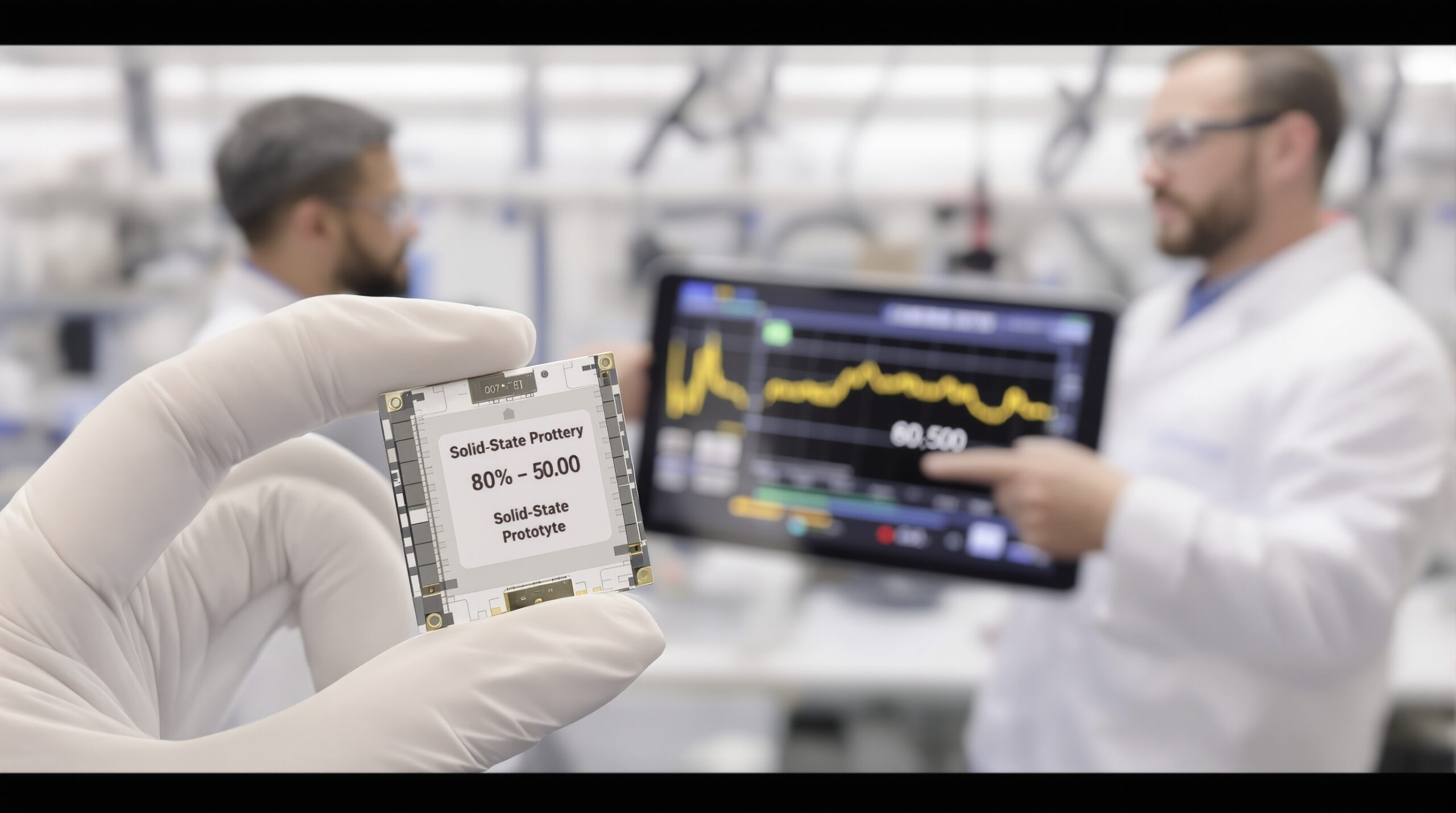
Researchers have unveiled a lab-scale battery that reaches 80 percent charge in five minutes. It uses a solid-state electrolyte engineered for rapid ion transport and stability. The prototype demonstrates extreme fast charging while maintaining promising safety characteristics. The announcement positions solid-state technology closer to practical, high-power applications. However, important engineering steps remain before mass adoption occurs. This development invites careful examination of methods, limits, and implications. Understanding those details clarifies what the breakthrough actually means.
What enables the five-minute, 80 percent result
The team built a solid-state cell that minimizes resistance at every critical interface. They paired a highly conductive electrolyte with electrodes designed for rapid ion movement. The architecture reduces diffusion distances and optimizes electronic pathways inside the cathode. Simultaneously, it maintains mechanical integrity under high current loads. This combination allows very high charge rates without catastrophic heat buildup. The approach targets the bottlenecks that normally limit fast charging. Each choice pushes the system toward unprecedented power capability.
Solid-state electrolyte properties
Solid-state electrolytes replace flammable liquids with ceramic or polymer materials. Several families deliver room-temperature ionic conductivities near liquid levels. Sulfide glass-ceramics can reach around ten millisiemens per centimeter. Garnet oxides often achieve around one millisiemens per centimeter. Polymers remain lower at room temperature but improve when warmed. The reported cell employs a solid electrolyte formulated for fast lithium transport. That property underpins the aggressive five-minute charging goal.
Solid electrolytes also offer strong thermal stability and reduced volatility. These characteristics mitigate fire risk under abuse or failure. Mechanical strength helps resist lithium filament growth across the separator. However, dendrites can still nucleate under extreme conditions. The research addresses this risk through composition and interface design. By balancing conductivity and stiffness, the electrolyte better tolerates high currents. Such tuning directly supports rapid charging.
Electrode and interface design
Fast charging demands electrodes with short ion pathways and robust electronic connectivity. The cathode uses engineered porosity and conductive networks for efficient transport. Interfacial coatings reduce impedance and protect against side reactions. On the anode side, a stabilized lithium interface distributes current more uniformly. This strategy lowers local hotspots that trigger dendrite formation. The cell also maintains controlled stack pressure for consistent contact. Together, these features enable repeatable performance under high power.
How the fast-charge test was conducted
Achieving 80 percent in five minutes implies a very high C-rate. Charging at that level requires careful thermal and electrical management. The researchers used a controlled environment to monitor temperature and voltage continuously. A predefined charge protocol limited stress as voltage approached upper limits. The cell likely used thin electrodes to shorten diffusion distances. External pressure maintained reliable interfaces throughout the charge. These measures ensured safety while validating the rate capability.
Laboratory tests often emphasize power over energy density at first. The goal is to prove what the chemistry can tolerate. Later stages prioritize thicker electrodes and practical capacities. The team acknowledges that transition as a critical next step. Scaling from coin cells to large formats introduces new constraints. Those constraints include uniform pressure, heat removal, and mechanical stability. Careful engineering governs each subsequent milestone.
Performance, safety, and thermal behavior
Solid-state systems aim to reduce thermal runaway risk compared with liquid cells. Nonflammable electrolytes and higher thermal stability provide inherent safety advantages. The prototype reported minimal temperature rise during peak charging. That outcome reflects efficient transport with limited parasitic heating. Reduced impedance growth also improves round-trip efficiency. Safety features should persist at scale for real impact. Thermal management remains essential even with these inherent benefits.
The researchers also track degradation under repeated fast charging. High rates can accelerate interfacial changes and mechanical fatigue. Protective coatings, optimized pressures, and tailored electrolytes help slow those processes. The team reports promising retention over early cycling windows. However, full life testing requires thousands of cycles and months of evaluation. Independent replication will strengthen confidence in longevity claims. Comprehensive data will guide reliable product targets.
Remaining challenges before commercialization
Translating laboratory success into mass production is difficult. Manufacturing solid electrolytes at scale requires precise atmosphere control. Sulfide materials can react with moisture to form undesirable byproducts. Ceramic processing demands consistent densification and low defect rates. Interfaces must stay intimate across large areas and many layers. Achieving those conditions on high-speed lines is nontrivial. Each challenge adds cost and complexity that must be addressed.
Electrode thickness presents another critical hurdle. Thick electrodes determine practical energy density and range. They also hinder ion transport during fast charging. The team must retain power while increasing areal capacity. Graded structures, higher conductivity networks, and improved binders can help. Quality control will need advanced inspection and inline metrology. These tools ensure uniformity at industrial throughput.
Pack-level power and infrastructure limits
Consumers often equate five-minute charging with refueling parity. Pack physics complicate that expectation. Charging an average 75 kilowatt-hour pack to 80 percent in five minutes is demanding. The average power would exceed several hundred kilowatts. Peaks could surpass current public charger capabilities. Thermal systems must absorb and dissipate significant heat rapidly. Electrical cabling and connectors would also face higher stresses.
Automakers mitigate these constraints using high-voltage architectures. They also distribute current across many parallel cells. Even then, charge curves typically taper above mid state of charge. Real-world sessions will not maintain peak power continuously. Infrastructure upgrades will further enable such technologies over time. Grid capacity and demand charges influence deployment economics. Coordinated planning improves outcomes for drivers and utilities.
Cycle life and warranty considerations
Automotive packs target long life under varied usage. Manufacturers seek thousands of cycles with controlled degradation. Fast charging often accelerates aging through heat and interfacial growth. Solid-state designs aim to blunt those mechanisms. Stable electrolytes and uniform lithium deposition reduce damage during hard use. Thermal control and smart charging algorithms further limit stress. Long-term data will determine realistic warranty positions.
Implications for vehicles and devices
If scaled, this technology could redefine charging convenience. Drivers could recover meaningful range during a short stop. Fleet operators could improve asset utilization and routing flexibility. Logistics networks would gain faster turnaround for electric trucks. Consumer electronics could benefit from quick top-ups without swelling risk. Drones and robotics could shorten downtime between missions. Faster cycles would accelerate operational readiness across sectors.
Energy density could also improve through lithium metal anodes. Removing graphite decreases mass and volume requirements. More capacity fits into the same footprint. Vehicle range increases without enlarging the pack. However, safety and cycle life must remain competitive. That balance is difficult but not impossible. Continued material advances make progress plausible.
Testing, validation, and standardization
Independent validation will be essential for credibility. Multiple laboratories should reproduce five-minute, 80 percent results. Standardized test protocols ensure fair comparisons and honest reporting. Conditions like temperature, pressure, and electrode loading must be disclosed. Abuse testing will probe worst-case behavior under faults. Certification bodies will evaluate cells for transportation and consumer safety. Clear data will accelerate responsible industry adoption.
Manufacturing readiness levels deserve equal attention. Pilot lines can expose hidden process issues early. Inline sensors will catch defects before they propagate. Recycling and end-of-life plans should develop alongside production. Supply chains must secure precursors at stable quality. Intellectual property and licensing frameworks affect deployment speed. These elements shape the technology’s real trajectory.
Environmental and economic context
Fast charging affects energy efficiency and grid demand. Short bursts at high power increase peak loads. Charging during off-peak windows can balance networks. Solid-state safety may reduce fire risk and associated losses. Material choices influence lifecycle impacts and sourcing risks. Cobalt reduction strategies already benefit sustainability. Economics will depend on yield, throughput, and material availability.
A successful scale-up could lower costs through process simplification. Dry coating and tape casting reduce solvent use and energy. Room-temperature assembly would further cut expenses. Yield improvements compound savings across large volumes. Early adopters may pay premiums for performance. Broader acceptance typically follows cost parity or better. Market forces will reward reliable, safe, and affordable designs.
What happens next
The path forward begins with larger-format prototypes. Pouch cells will test uniform pressure and heat removal. Modules will validate scaling of interfaces and thermal controls. Pack demonstrations will integrate power electronics and safety systems. Field trials will reveal behavior under real driving conditions. Collaborations with automakers and charger manufacturers will be crucial. Coordinated development aligns performance with infrastructure realities.
Regulatory engagement should proceed in parallel. Standards bodies can define test methods and safety requirements early. Clear guidance helps manufacturers invest with confidence. Policymakers can support pilot deployments and grid upgrades. Academic partners will continue exploring material and interface science. Each milestone builds a clearer picture of commercial viability. Progress will rely on transparent data and steady engineering.
Bottom line
The five-minute, 80 percent milestone showcases what solid-state batteries might deliver. The result highlights gains in ion transport, interfaces, and thermal behavior. It also underscores the complexity of scaling extreme fast charging. Pack physics, infrastructure, and cost cannot be ignored. Even so, the trajectory looks increasingly promising. Continued validation and careful engineering will determine the pace. With disciplined development, practical fast-charging solid-state batteries appear within reach.
