

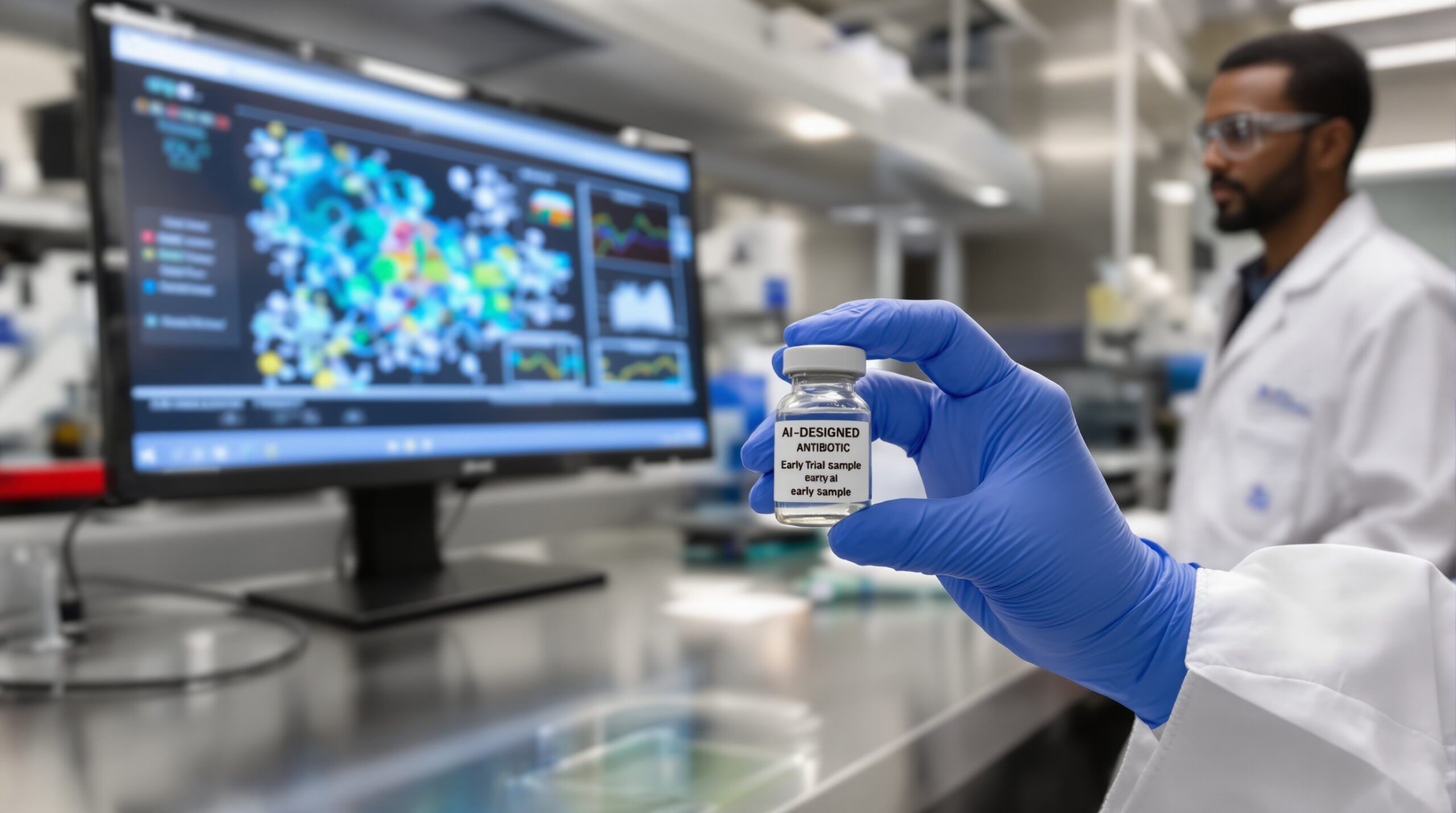
Scientists report that an artificial intelligence designed antibiotic has delivered potent results against drug-resistant infections in early trials. The candidate emerged from machine learning systems trained on large, curated antimicrobial datasets. It demonstrated strong activity against several priority pathogens that challenge hospitals worldwide. These findings mark a notable step for AI in antibiotic discovery and development.
Antimicrobial resistance pressures drug discovery pipelines
Drug-resistant infections threaten patient safety and modern medicine. The Lancet estimated 1.27 million deaths directly attributable to resistance in 2019. Hospital outbreaks strain intensive care units and increase treatment costs. Consequently, policymakers and clinicians urgently seek new antimicrobial options with novel mechanisms.
Traditional antibiotic discovery has slowed over recent decades. Many companies left the field because of scientific risk and economic barriers. Gram-negative pathogens, in particular, present daunting challenges for medicinal chemistry. Therefore, researchers view AI as a powerful tool to reopen discovery avenues.
How AI guided the antibiotic’s design
Researchers built models to predict antibacterial activity and drug-like properties. They used neural networks and graph-based algorithms to evaluate molecular features. The models prioritized compounds that balanced potency, selectivity, and pharmacokinetic potential. As a result, the team generated candidates with favorable profiles early in screening.
Data curation played a crucial role in performance. Scientists compiled high-quality measurements of minimum inhibitory concentrations and cytotoxicity. They integrated physicochemical descriptors and simulated absorption, distribution, metabolism, and excretion. This approach allowed fast iteration between computational design and laboratory confirmation.
Early trial outcomes show robust antibacterial activity
Laboratory studies showed broad activity against key resistant pathogens. The candidate inhibited problematic Gram-negative organisms, including carbapenem-resistant isolates. It also impacted certain Gram-positive strains that complicate surgical recovery. Importantly, potency remained high against strains resistant to multiple existing classes.
Animal models provided further supportive evidence. Investigators used established infection models to test efficacy under clinically relevant conditions. Treatment significantly reduced bacterial burdens and improved survival in specific models. These findings met predefined success criteria for advancement to additional testing.
Spectrum and microbiome considerations
The candidate displayed a focused activity spectrum in head-to-head assays. Narrower activity can help preserve beneficial microbiota during treatment. Such stewardship-friendly profiles reduce risks of Clostridioides difficile overgrowth and dysbiosis. Therefore, clinicians view spectrum control as a desirable design feature.
Safety signals from early testing
Early toxicology screens reported encouraging signals. The compound avoided major cytotoxicity across tested cell lines. Cardiac ion channel assays did not reveal concerning interactions at targeted exposures. Additionally, preliminary animal studies showed acceptable tolerability at efficacious doses.
Investigators emphasized that safety evaluation continues through staged testing. Chronic dosing studies and reproductive toxicology will follow standard protocols. Researchers will refine dosing strategies using pharmacokinetic and pharmacodynamic modeling. These steps guide a cautious progression toward human evaluation.
Potentially novel mechanism of action
Mechanistic studies suggest the candidate targets a pathway underexploited by existing antibiotics. Scientists observed rapid bactericidal effects in select models. Additional assays indicated disruption of essential envelope processes in Gram-negative bacteria. Such novelty could help bypass common resistance mechanisms.
However, researchers continue to characterize the precise molecular interactions. They are applying proteomic profiling and targeted mutational analyses. Structural biology experiments will also probe potential binding sites. This work informs optimization and supports resistance risk assessments.
Why these results matter for patients and hospitals
Drug-resistant infections prolong hospitalization and complicate intensive care. New antibiotics with reliable activity can reduce mortality and length of stay. They also support safe surgery, cancer chemotherapy, and transplantation. Therefore, effective treatments directly protect patients and health systems.
Additionally, a viable AI-designed antibiotic validates an emerging discovery paradigm. Shorter design cycles can cut costs and accelerate experimentation. Faster iteration helps teams adapt to evolving resistance patterns. This momentum could reinvigorate the antimicrobial pipeline across multiple targets.
Key caveats and constraints
The current evidence remains early stage and limited in scope. Laboratory and animal successes do not guarantee clinical effectiveness. Human pharmacokinetics and tissue penetration can diverge from predictions. Therefore, researchers caution against overinterpreting preliminary data.
Resistance development remains an inevitable possibility. Bacteria adapt under selective pressure through multiple genetic routes. Surveillance and combination strategies may help protect durability. Stewardship commitments must accompany deployment of any new antibiotic.
Next steps toward clinical evaluation
Teams are finalizing studies required for regulatory submissions. These include dose-ranging pharmacology, safety pharmacology, and manufacturing scale-up. Quality controls ensure stable potency and consistent impurity profiles. Meanwhile, formulation work supports intravenous and potential oral presentations.
First-in-human studies will emphasize safety and pharmacokinetics. Researchers will test ascending doses in healthy volunteers. They will assess exposure levels relative to preclinical efficacy targets. Subsequently, patient trials will evaluate clinical outcomes in defined infections.
Companion diagnostics and patient selection
Companion diagnostics can improve trial efficiency and clinical impact. Rapid tests help identify patients infected with susceptible organisms. Accurate selection reduces unnecessary exposure to new agents. It also strengthens efficacy signals during pivotal studies.
Economic and policy supports remain essential
Antibiotic markets often fail despite public health value. Pull incentives can reward availability rather than volume. Subscription models and milestone payments support sustainable development. Public-private partnerships may share risks across critical stages.
Global coordination will determine long-term impact. Health systems need procurement frameworks aligned with stewardship. Regulators must provide clear pathways for novel mechanisms. Funders should sustain discovery platforms that demonstrate reproducible value.
What distinguishes AI-enabled discovery
AI can explore chemical space more efficiently than traditional heuristics. It evaluates millions of structures within practical timelines. This capability often reveals non-intuitive chemotypes with useful properties. As a result, teams progress faster through early decision gates.
Interpretability remains equally important for adoption. Scientists increasingly use models that explain key contributing features. Transparent reasoning supports trust and iterative improvements. Furthermore, it helps identify bias and avoid data leakage.
Data quality underpins model performance
Reliable predictions require rigorous datasets and careful validation. Researchers removed confounders and harmonized assay conditions across sources. External test sets evaluated generalization and avoided overfitting. Continuous data updates improved accuracy over successive design cycles.
Perspectives from clinicians and microbiologists
Clinicians emphasize the need for clinically meaningful endpoints. Mortality, microbiological eradication, and functional recovery remain central measures. Microbiologists highlight resistance surveillance and mechanism confirmation. Both groups call for balanced enthusiasm and careful stewardship.
Importantly, hospital pharmacists consider formulary integration and access. Practical dosing, stability, and drug-drug interactions matter daily. Antimicrobial stewardship committees will shape usage protocols. Their guidance minimizes misuse and preserves effectiveness.
Implications for global health equity
Access to new antibiotics must extend beyond wealthy regions. Resistant infections burden low-resource settings disproportionately. Equitable licensing and tiered pricing can broaden availability. Technology transfer may also support regional manufacturing capacity.
Additionally, surveillance networks should include diverse geographies. Resistance patterns vary by region and care setting. Inclusive data improve model training and clinical strategies. This approach ensures benefits reach communities with greatest need.
What to watch as evidence accumulates
Observers should track mechanism confirmation and resistance frequency. Clinical pharmacokinetics in difficult tissues will be crucial. Safety profiles must remain clean at target exposures. Comparative effectiveness versus standard-of-care will guide adoption.
Regulatory interactions will also shape timelines. Priority designations can accelerate reviews and trials. Postmarketing commitments often include resistance monitoring. Real-world evidence will complement randomized trial results.
Conclusion: cautious optimism with concrete progress
The reported results present encouraging progress for AI-enabled antibiotic discovery. Early trials showed potent activity against relevant resistant pathogens. Safety findings support continued development under regulatory oversight. Together, these advances strengthen confidence in the approach.
However, many steps remain before routine clinical use. Robust human data and stewardship frameworks will determine real impact. Continued collaboration across disciplines will accelerate responsible progress. For now, cautious optimism appears justified by the evidence presented.
