

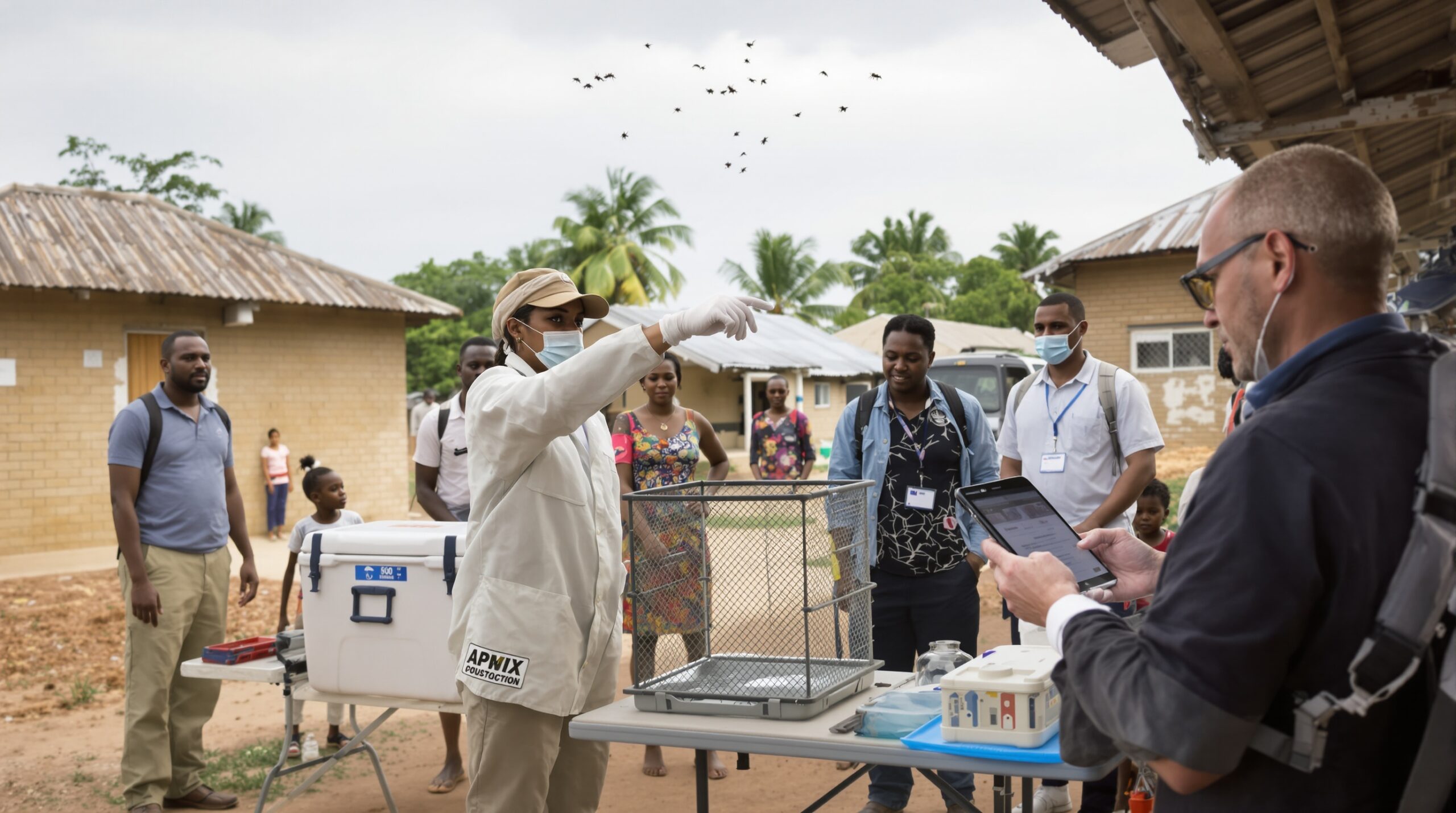
Scientists have begun testing a gene-edited mosquito designed to block malaria transmission in a real-world village setting. The team is running the study in large screened enclosures built within a rural community. This approach keeps conditions realistic while ensuring rigorous containment and oversight.
The trial evaluates whether the modified mosquitoes can interrupt the parasite’s life cycle inside the insect. Researchers also examine how the mosquitoes behave and survive in natural environmental conditions. Together, these questions inform future steps and safeguard public health.
Malaria remains a deadly disease, especially for children under five in sub-Saharan Africa. The World Health Organization reports hundreds of thousands of deaths each year. Therefore, new tools that complement nets, sprays, and medicines are urgently needed.
Why Scientists Are Pursuing Gene-Edited Mosquitoes
Conventional malaria control has saved millions of lives, yet progress has stalled recently. Insecticide resistance undermines the performance of treated nets and indoor spraying campaigns. Drug resistance also threatens some frontline antimalarial therapies.
Researchers aim to add a new layer to the malaria toolbox with modified mosquitoes. These mosquitoes do not kill people or cure infections directly. Instead, they reduce the mosquito’s ability to carry and transmit the parasite.
Crucially, this strategy targets the parasite inside the vector, not the human host. That difference complements existing interventions and may slow resistance development. It also allows deployment alongside current programs without replacing them.
How the Gene Edit Blocks the Parasite
The scientists used precision editing to insert sequences that disrupt parasite development. The added genes prompt the mosquito to produce molecules that target malaria parasites. These molecules bind or attack the parasite during key stages in the mosquito.
When an infected mosquito bites a person, it normally delivers sporozoites through saliva. The edit reduces or eliminates those infectious sporozoites in the salivary glands. Consequently, the bite becomes less likely to transmit malaria to a new host.
The team did not employ a gene drive in this village trial. The trait does not deliberately spread through wild populations beyond containment. This stepwise approach aligns with global guidance for responsible testing.
Designing a Real-World Village Trial with Containment
Investigators constructed large semi-field enclosures within a village research site. These enclosures allow sunlight, vegetation, and natural temperatures to influence mosquito behavior. However, they prevent mosquitoes from leaving or entering the study area.
Inside, the team recreated typical household structures, water containers, and resting spaces. They also introduced local mosquito strains as comparators to assess performance. This design provides a realistic yet controlled environment for rigorous measurements.
Before starting, researchers gathered extensive ecological and epidemiological baseline data. They mapped breeding sites and measured mosquito densities across seasons. These baselines support accurate comparisons during and after the trial.
Regulatory and Ethical Oversight
National biosafety authorities reviewed the project and its risk assessments. Independent ethics committees evaluated participant protections and community processes. The study also follows international guidance on genetically modified mosquito testing.
Investigators implemented strict standard operating procedures for containment and transport. They documented emergency response plans and incident reporting pathways. These safeguards ensure transparency and rapid action if issues arise.
Community Engagement and Consent
Engagement teams worked with village leaders, health workers, and residents for months. They held open meetings, household visits, and question sessions about benefits and risks. Community members helped shape research plans and oversight structures.
The project established a grievance mechanism for concerns and complaints. Residents could halt activities within enclosures if issues occurred. This shared governance builds trust and supports responsible science.
What the Trial Measures and Why It Matters
The primary goal is to measure the mosquito’s ability to block parasite development. Scientists expose mosquitoes to parasite-infected blood under laboratory conditions. They then track parasite stages in mosquitoes maintained within the enclosures.
Researchers compare edited and unedited mosquitoes across infection rates and parasite loads. They also monitor survival, mating success, and flight activity. These data reveal whether the edit carries significant fitness costs or benefits.
Entomological Endpoints
Key entomological endpoints include sporozoite positivity in salivary glands and oocyst counts in midguts. Teams use molecular and microscopic assays to verify outcomes. They estimate transmission blocking by comparing infection prevalence between groups.
Additional endpoints assess longevity, blood-feeding behavior, and resting preferences. Scientists also evaluate mating competitiveness relative to local strains. These measurements inform eventual deployment strategies and release ratios.
Human Health and Environmental Safeguards
The trial does not expose residents to mosquito bites for data collection. Researchers rely on traps and artificial blood meals for measurements. This policy protects participants while yielding robust scientific insights.
Environmental teams monitor non-target species and potential ecological changes. They track predators, pollinators, and aquatic organisms near the enclosures. So far, the containment design minimizes external ecological interactions.
Early Operational Findings and Practical Implications
Early operational results focus on feasibility, acceptability, and containment integrity. The enclosures have withstood seasonal storms and temperature swings. Equipment and protocols performed as designed during stress tests.
Community engagement metrics suggest strong local awareness and ongoing participation. Residents continue to attend meetings and provide feedback on study operations. This involvement supports data quality and sustained oversight.
Scientific analyses remain underway, and efficacy estimates require more observations. The team will share peer-reviewed findings after completing predefined milestones. Transparency remains central to the project’s approach and reporting.
Risks, Uncertainties, and How Researchers Mitigate Them
Any genetic alteration creates potential uncertainties, including off-target edits. The team performed whole-genome sequencing to confirm intended changes. They also bred multiple generations to detect unexpected traits.
Containment breaches represent another critical risk in field-adjacent studies. Engineers designed multi-layer barriers and redundant escape prevention systems. Regular audits test every barrier before each experimental cycle.
Scientists also evaluate how parasites might evolve around the blocking mechanism. They test different parasite strains to assess robustness. These experiments guide future combinations of blocking molecules.
How This Fits with Existing Malaria Tools
Gene-edited mosquitoes are not a standalone solution for malaria control. They aim to complement nets, spraying, and preventive medicines. Integrated approaches often deliver the strongest and most durable impacts.
Programs could deploy edited mosquitoes alongside next-generation insecticide nets. Coordinated campaigns might also include vaccines and seasonal chemoprevention. Together, these layers could reduce cases and slow resistance.
Health systems would track outcomes through routine surveillance and special studies. Data would inform adaptive strategies and resource allocation. Continuous monitoring remains essential for responsible scale-up.
What Comes Next for the Research Program
After analyzing this village trial, the team plans additional evaluations. They may test improved edits or combine multiple blocking molecules. Each step will follow the same cautious, staged pathway.
Future studies could examine larger enclosures or multi-season dynamics. Researchers will also assess manufacturing, logistics, and cost considerations. These practical issues determine real-world scalability and impact.
Any move toward open releases would require new approvals and broader consultation. International and national bodies would review cumulative evidence carefully. Communities would guide decisions at every stage.
The Broader Significance for Global Health
This trial signals steady progress toward next-generation vector control. It shows how science can advance with transparency and community partnership. It also demonstrates that strong governance can guide novel technologies.
Malaria imposes heavy social and economic burdens on affected regions. Tools that reduce transmission can save lives and expand opportunity. Every incremental improvement matters for families and health systems.
Gene-edited mosquitoes will not replace existing measures, but they could add meaningful protection. Careful testing will clarify their role and potential. With evidence and trust, solutions can reach those who need them most.
