

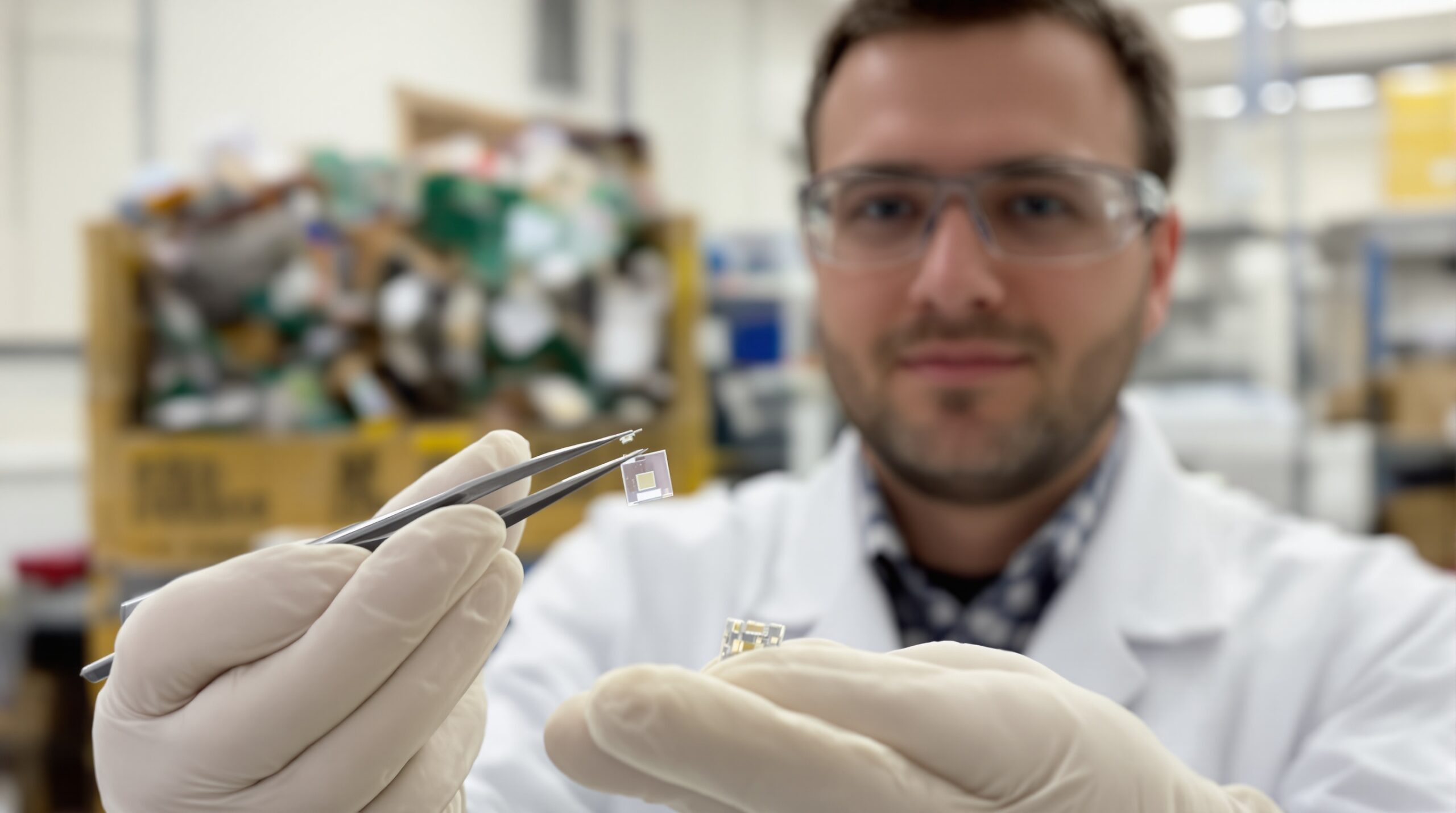
Scientists have introduced a biodegradable semiconductor that operates reliably, then safely disappears. The breakthrough suggests a new path for electronics that do not persist for centuries. It also supports temporary medical implants that avoid risky retrieval surgeries. Together, these possibilities point toward cleaner technology and gentler care.
Electronics today often outlast their usefulness by decades. That mismatch fuels mounting e‑waste and burdens recycling systems worldwide. A degradable semiconductor narrows that gap by matching function with designed lifetime. Consequently, it offers a practical lever for sustainability and patient safety.
What Makes a Semiconductor Biodegradable
A biodegradable semiconductor carries charge like conventional materials, yet it breaks down into benign byproducts. Researchers engineer the molecular structure to cleave under water, heat, light, or enzymatic action. They also select companion materials that resorb without harm. Therefore, the entire device can vanish on schedule.
Several material families support this strategy. Thin silicon nanomembranes slowly hydrolyze to harmless silicic acid. Metals like magnesium, zinc, and molybdenum dissolve into biocompatible ions. Meanwhile, organic semiconducting polymers can incorporate breakable linkers that depolymerize after service.
Designers tune the breakdown rate through chemistry, thickness, and encapsulation. Thicker films and barrier layers extend operational life. Thinner structures and permeable coatings shorten it. This tunability lets engineers align performance with mission needs.
How the Material Works in Devices
These semiconductors form transistors, diodes, sensors, and simple integrated circuits. They can switch, amplify, and process signals during their active window. They also interface with biodegradable conductors and dielectrics. As a result, complete systems can emerge from compatible parts.
Carrier mobility and on‑off ratio set the performance envelope. Current biodegradable materials achieve modest mobilities suitable for sensing and low‑power logic. They also support analog functions like rectification and signal conditioning. Therefore, many medical and environmental tasks fit within reach.
Engineers add temporary encapsulation to hold off moisture. Silk fibroin, cellulose, and bio‑based polymers often serve this role. These layers delay water ingress until the mission ends. Then, they surrender to hydrolysis and diffusion.
Cutting E‑Waste Through Transience
Global e‑waste exceeds fifty million metric tons each year. Many devices become waste within a few years. Short‑lived sensors and disposable gadgets contribute disproportionately. Biodegradable semiconductors target this segment directly.
Devices that work for months need not persist for decades. Temporary wearables, packaging trackers, and single‑use diagnostics can vanish afterward. Municipal systems would face less sorting and smelting. Consequently, landfill loads and informal processing could decline.
Manufacturers can also design for disassembly and composting. Paperboard, cellulose, and bio‑resins can host the circuitry. Water‑soluble adhesives simplify separation. In many cases, industrial composting can handle the remnants.
Lifecycle and End‑of‑Life Pathways
Lifecycle thinking begins at synthesis. Green solvents and lower temperatures reduce upstream burdens. Packaging relies on biodegradable barriers rather than fossil plastics. Then, disposal follows controlled dissolution or composting.
Engineers must verify complete and safe degradation. Residual metals and dopants must remain below ecological thresholds. Encapsulation must not impede breakdown indefinitely. Robust testing prevents problem shifting from user to environment.
Transient Medical Implants as a Flagship Application
Temporary implants can monitor, stimulate, or deliver therapy for days to months. Traditional devices often require surgical removal after use. That additional procedure carries pain, infection risk, and cost. A dissolvable system avoids that second intervention entirely.
Researchers have demonstrated transient pacemakers, neural sensors, and pressure monitors. These devices operate reliably during recovery periods. They then resorb into fluids the body naturally clears. Patients benefit from fewer incisions and faster discharge.
Biodegradable semiconductors enable sensing and control on soft, resorbable platforms. Magnesium conductors route signals to electrodes. Silk or PLGA substrates support delicate tissues. Therefore, the full implant can match organ mechanics and then disappear.
Powering Short‑Lived Implants Safely
Energy sources must also vanish without harm. Teams use bioresorbable thin‑film batteries with transient electrolytes. They also harvest energy wirelessly through inductive coupling. As an alternative, biofuel cells draw from local biochemistry.
Power budgets remain tight by design. Circuits operate at micro‑ to milliwatt levels. Duty cycling and event‑driven operation conserve energy. Consequently, devices meet clinical needs within safe thermal limits.
Performance, Stability, and Trade‑Offs
Biodegradability imposes constraints on performance and lifetime. Moisture and ions can degrade interfaces and mobility. Encapsulation delays these effects but cannot halt them forever. Engineers therefore optimize circuits for efficient, time‑bound service.
Target metrics include stable threshold voltage, low leakage, and adequate gain. Devices often meet sensor‑grade requirements. They rarely match advanced silicon for speed or endurance. However, the intended missions rarely demand that performance.
Calibration strategies compensate for slow drift. Designers use redundancy, self‑test, and algorithmic filtering. They also store reference states in transient memory. Thus, data quality holds over the planned window.
Manufacturing and Scalability
Production can leverage familiar tools and emerging techniques. Some devices use adapted semiconductor lines for thin silicon membranes. Others rely on solution printing for organic layers. Roll‑to‑roll processing supports low‑cost, high‑volume output.
Materials sourcing matters for scale. Abundant elements like magnesium and zinc reduce supply risks. Bio‑derived polymers support renewable content. Furthermore, solvent recovery minimizes emissions and cost.
Quality control verifies both function and programmed dissolution. Inline testing measures electrical parameters and barrier integrity. Accelerated aging predicts field lifetimes under humidity and heat. Manufacturers then label devices with reliable expiry windows.
Biocompatibility and Safety
Medical uses require careful biocompatibility evaluation. Degradation products must meet toxicology limits and local tissue tolerances. Standards like ISO 10993 guide testing. Regulators also require clinical evidence for safety and efficacy.
Key byproducts include silicic acid, magnesium ions, and zinc ions. These species occur naturally in the body. Proper dosing and geometry keep concentrations safe. Encapsulation controls exposure during active operation.
Environmental safety also matters for consumer devices. Composting conditions affect breakdown rates and pathways. Municipal systems vary widely by region. Clear disposal guidance helps users and waste managers.
Environmental Assessment and Policy Context
Life cycle assessment quantifies actual benefits and trade‑offs. Analysts compare energy use, emissions, and toxicity across stages. They also model leachate behavior in compost and soil. Transparent data builds trust in the technology.
Policy can accelerate responsible adoption. Extended producer responsibility can include biodegradable pathways. Eco‑labels may recognize time‑bound electronics. Meanwhile, procurement rules can favor recoverable materials.
Healthcare policies also shape deployment. Reimbursement models can reward reduced surgical burden. Hospitals can streamline workflows without extraction procedures. Consequently, patient outcomes and costs both improve.
Challenges That Remain
Several obstacles still require focused work. Devices must store reliably before use, despite humidity sensitivity. Packaging must remain biodegradable while robust in transit. Shelf life needs predictable, validated limits.
Electronic performance also needs modest improvements. Higher mobility and lower variability would widen applications. Better printable dielectrics would enhance stability. Standardized test protocols would aid comparisons across labs.
Supply chains must ensure consistent bio‑based materials. Certification can verify compostability and biocompatibility. Recycling streams must handle hybrid devices gracefully. Education will help users dispose of them correctly.
Outlook and Timelines
Near‑term products will target sensing, identification, and temporary medical functions. These applications match current capabilities well. They also deliver clear environmental and clinical value. Early pilots can validate economics and reliability.
Mid‑term advances will improve speed, stability, and integration. Hybrid systems may combine transient and conventional chips. Designers can isolate critical logic on dissolvable modules. This approach balances performance with sustainability.
Wider adoption will follow standards and supply maturity. Regulatory clarity will guide medical deployments. Municipal composting capacity will expand with demand. Collaborative efforts can clear these hurdles efficiently.
Why This Breakthrough Matters
Electronics need not be permanent to be powerful. A biodegradable semiconductor turns that idea into practical engineering. It aligns performance with purpose and time. Therefore, it promises less waste and gentler care.
Hospitals could reduce surgical risks and recovery time. Cities could face lower e‑waste volumes and cleaner streams. Manufacturers could design with end‑of‑life in mind. These gains compound across systems and years.
Continued research will refine materials, devices, and processes. Thoughtful policy will guide responsible scaling. Clinicians and patients will shape real‑world use cases. Together, they can help technology quietly appear, serve, and vanish.
Conclusion
The unveiling of a biodegradable semiconductor marks an important step. It brings transient electronics from concept toward routine practice. It also reframes success as performance plus graceful disappearance. With careful development, that balance can transform both gadgets and care.
