

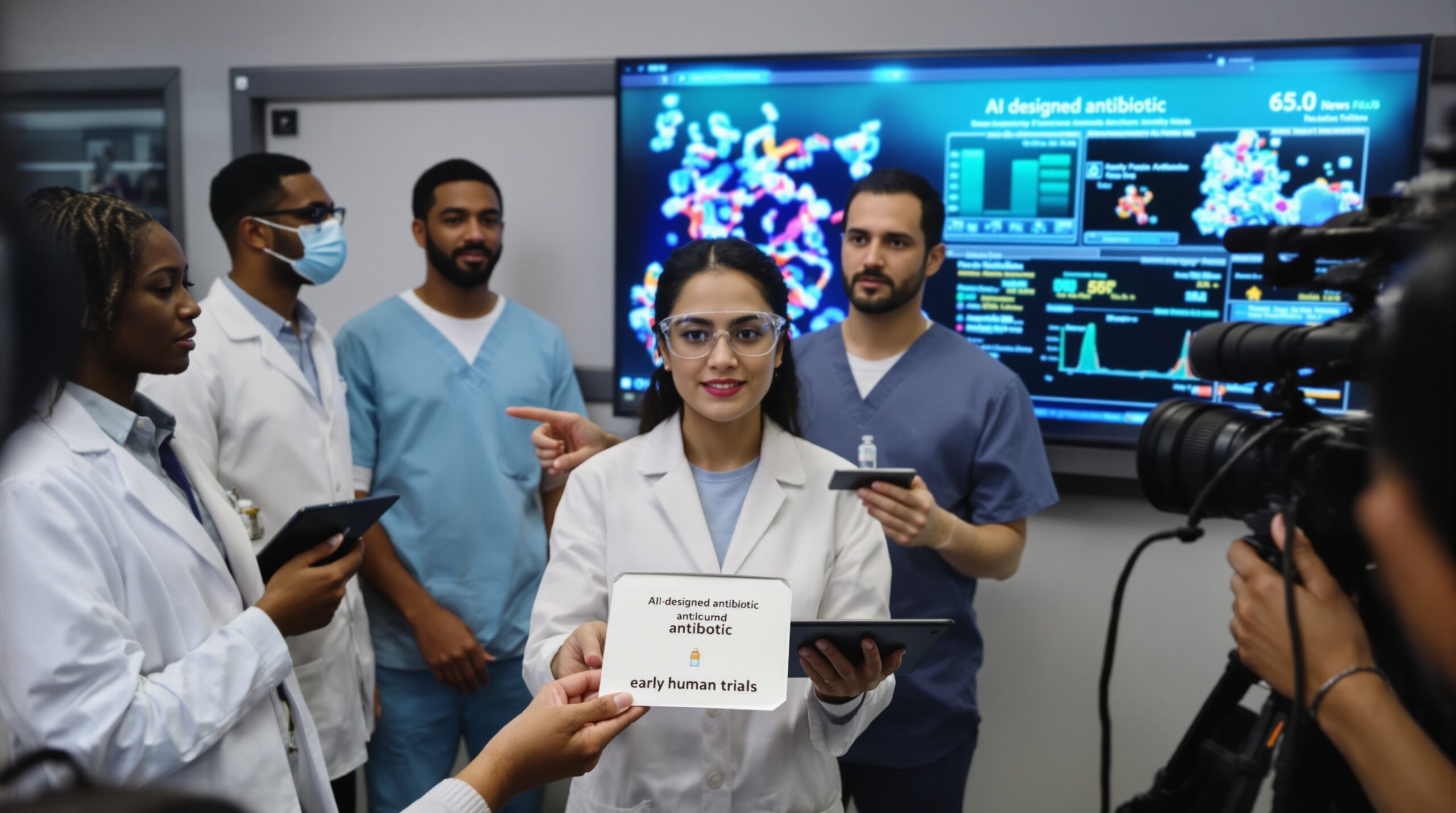
Scientists report a milestone in antimicrobial research with an AI-designed antibiotic that performed strongly in early human trials. Researchers used machine learning to identify a novel molecule targeting stubborn, drug-resistant bacterial infections. The candidate demonstrated clinically meaningful effects and a favorable safety profile in initial testing. These findings offer cautious optimism amid a worsening global resistance crisis.
The achievement reflects accelerated discovery timelines that would have seemed unrealistic a decade ago. AI tools streamlined target selection, molecule design, and preclinical prioritization in months instead of years. This efficiency helped researchers move quickly into human assessments. The approach now challenges entrenched assumptions about antibiotic discovery trajectories.
Why This Breakthrough Matters Now
Antibiotic resistance threatens modern medicine by undermining surgery, chemotherapy, and routine care. Resistant pathogens cause prolonged illness, higher costs, and increased mortality worldwide. Public health agencies warn that the pipeline for new antibiotics remains fragile. This context gives the AI-designed candidate strategic importance beyond a single product.
Hospitals increasingly battle organisms resistant to multiple drug classes. Clinicians often exhaust options while patients deteriorate. A novel mechanism could restore treatment confidence for certain high-risk infections. The trial results therefore carry weight even at an early stage.
How AI Guided the Antibiotic’s Design
Researchers trained models on chemical libraries, bacterial genomes, and known structure–activity relationships. Algorithms learned patterns linking molecular features to antibacterial potency and selectivity. The system proposed candidates predicted to overcome common resistance pathways. Scientists then synthesized top hits and validated them in laboratory assays.
AI triaged thousands of possibilities using multi-objective optimization. The models balanced potency, toxicity, solubility, and metabolic stability in one framework. Human experts reviewed AI recommendations to address model blind spots. This human-in-the-loop process reduced risk and improved real-world relevance.
Data, Models, and Iteration
The team combined graph neural networks with transformer architectures for molecular prediction. Training data included diverse bacterial species and resistance mechanisms. Iterative cycles refined predictions as fresh biological results arrived. This feedback loop steadily enhanced model accuracy and design precision.
Researchers also deployed generative models to propose new chemistries. These models explored chemical space beyond existing antibiotic classes. Medicinal chemists constrained designs to improve synthesis feasibility and safety margins. The collaboration maximized creativity without sacrificing practicality.
Early Human Trial Results
The first-in-human study evaluated safety, pharmacokinetics, and preliminary efficacy. Participants with confirmed drug-resistant infections received the investigational therapy under strict monitoring. Investigators observed reductions in bacterial load and faster symptom resolution in several cases. Pharmacokinetic profiles supported dosing schedules aligned with preclinical predictions.
Importantly, clinical response correlated with the drug’s proposed mechanism. Biomarker changes suggested successful target engagement at therapeutic concentrations. Investigators reported consistent exposure across participants and infection sites. These results justify expansion into larger, controlled trials.
Safety and Tolerability Signals
The candidate showed a favorable tolerability profile in early assessments. Reported adverse events were mostly mild and manageable with standard care. No dose-limiting toxicities emerged across tested ranges. Continued monitoring will assess rare risks not captured initially.
These safety signals support dose escalation and longer treatment duration evaluation. Investigators will scrutinize organ-specific effects with additional biomarkers. Safety confidence will shape trial designs for broader patient populations. The team plans careful risk management alongside scaled efficacy testing.
How It Compares to Existing Antibiotics
The AI-designed molecule targets bacteria that resist many current agents. Its activity profile complements rather than replaces existing therapies. Physicians could use it alongside standard options when resistance limits success. Early data indicate potential synergy with selected combinations.
Unlike some last-line drugs, the candidate aims for broader safety margins. Researchers emphasized minimizing collateral damage to beneficial microbiota. That strategy could reduce complications and support faster recovery. Comparative trials will clarify its clinical positioning within guidelines.
Proposed Mechanism of Action
Laboratory studies suggest the antibiotic disrupts an essential bacterial process with limited human homologs. This selectivity underpins its safety promise. The molecule evades common resistance mutations seen with older classes. That evasion appears central to its early efficacy signals.
Researchers mapped binding interactions using structural biology and mutational analysis. The results align with phenotypic changes observed during treatment. Adaptive resistance emerged slowly in in vitro evolution experiments. However, ongoing surveillance will track resistance dynamics in clinical settings.
From Lab Bench to Manufacturing Scale
Translating a novel molecule requires robust, scalable synthesis routes. Process chemists optimized steps to preserve yield and purity at scale. Quality controls address stereochemistry, impurities, and stability under storage. Manufacturers will validate reproducibility before late-stage clinical expansion.
Formulation scientists also refined delivery characteristics for consistent bioavailability. They evaluated oral and intravenous options during development. Route selection will match infection site and severity. Cost-effective manufacturing remains a priority for global access.
Regulatory and Ethical Considerations
Regulators will examine both the drug and its AI design process. Agencies increasingly request transparency on training data and model validation. Sponsors must document how AI influenced candidate choices and risk assessments. That documentation supports informed benefit–risk evaluations.
Stewardship commitments will accompany development to preserve effectiveness. Companies typically propose restricted use policies for novel antibiotics. Post-approval surveillance will monitor resistance patterns and off-label pressures. Ethical frameworks will guide equitable access while protecting future utility.
Limitations and Unanswered Questions
Early trial size limits conclusions about rare safety events. Efficacy estimates also carry uncertainty without randomized comparators. Heterogeneous infections can complicate outcome interpretations. Larger, diverse studies will test durability across clinical settings.
AI models can reflect biases in training data. Those biases might affect predictions for underrepresented pathogens or populations. Continuous model updating will mitigate these risks over time. Independent replication will strengthen confidence in the findings.
What Comes Next for Clinical Development
Researchers plan phase 2 trials with randomized, controlled designs. These studies will compare the candidate against current standards or combinations. Endpoints may include clinical cure, microbiological eradication, and time to symptom resolution. Health economic outcomes will also inform value assessments.
Trial designers will include high-risk groups to assess generalizability. Sites will span multiple regions with varying resistance landscapes. Regulators encourage adaptive designs that incorporate interim analyses. Such flexibility can accelerate progress while safeguarding participants.
Broader Implications for Antimicrobial Discovery
This success highlights AI’s potential across the antibiotic pipeline. Models can screen chemical space more efficiently than traditional methods. Researchers can prioritize candidates with favorable safety and resistance profiles. That prioritization reduces attrition and conserves limited development funds.
Academic and industry teams increasingly share datasets and benchmarking tools. Shared resources improve model reproducibility and external validation. Policy initiatives can further support data access and interoperability. These efforts will strengthen the field’s collective capabilities.
Stewardship, Access, and Sustainable Incentives
New antibiotics require careful stewardship to prevent rapid resistance. Hospitals will craft guidelines emphasizing appropriate, evidence-based use. Payers and policymakers can support subscription-style reimbursement models. Such frameworks reward availability rather than volume-linked sales.
Global access strategies must address supply chains and affordability. Partnerships can enable tiered pricing and local manufacturing where feasible. Donor support may bridge gaps in low-resource settings. These measures align innovation with public health goals.
Expert Perspectives and Cautious Optimism
Infectious disease specialists welcome fresh options for resistant infections. They also caution that single studies rarely settle efficacy debates. Methodologically rigorous trials will solidify the clinical narrative. Transparent data sharing will help clinicians interpret results responsibly.
AI researchers view the trial as validation of model-guided discovery. They emphasize continued investment in data quality and interpretability. Collaboration between computational scientists and clinicians remains essential. Together, they can translate algorithms into patient benefit.
Conclusion: A Promising Step Toward a Stronger Antibiotic Arsenal
The AI-designed antibiotic’s early human success represents a meaningful advance. It demonstrates practical benefits from combining machine learning with disciplined pharmacology. Confirmatory trials will determine its ultimate clinical and public health impact. For now, the results justify optimism and renewed momentum.
As development proceeds, responsible stewardship will guide deployment and preserve utility. Investment in data, models, and infrastructure will enhance future discovery. With careful execution, AI can help rebuild a resilient antibiotic pipeline. Patients stand to gain from faster, smarter innovation.
