

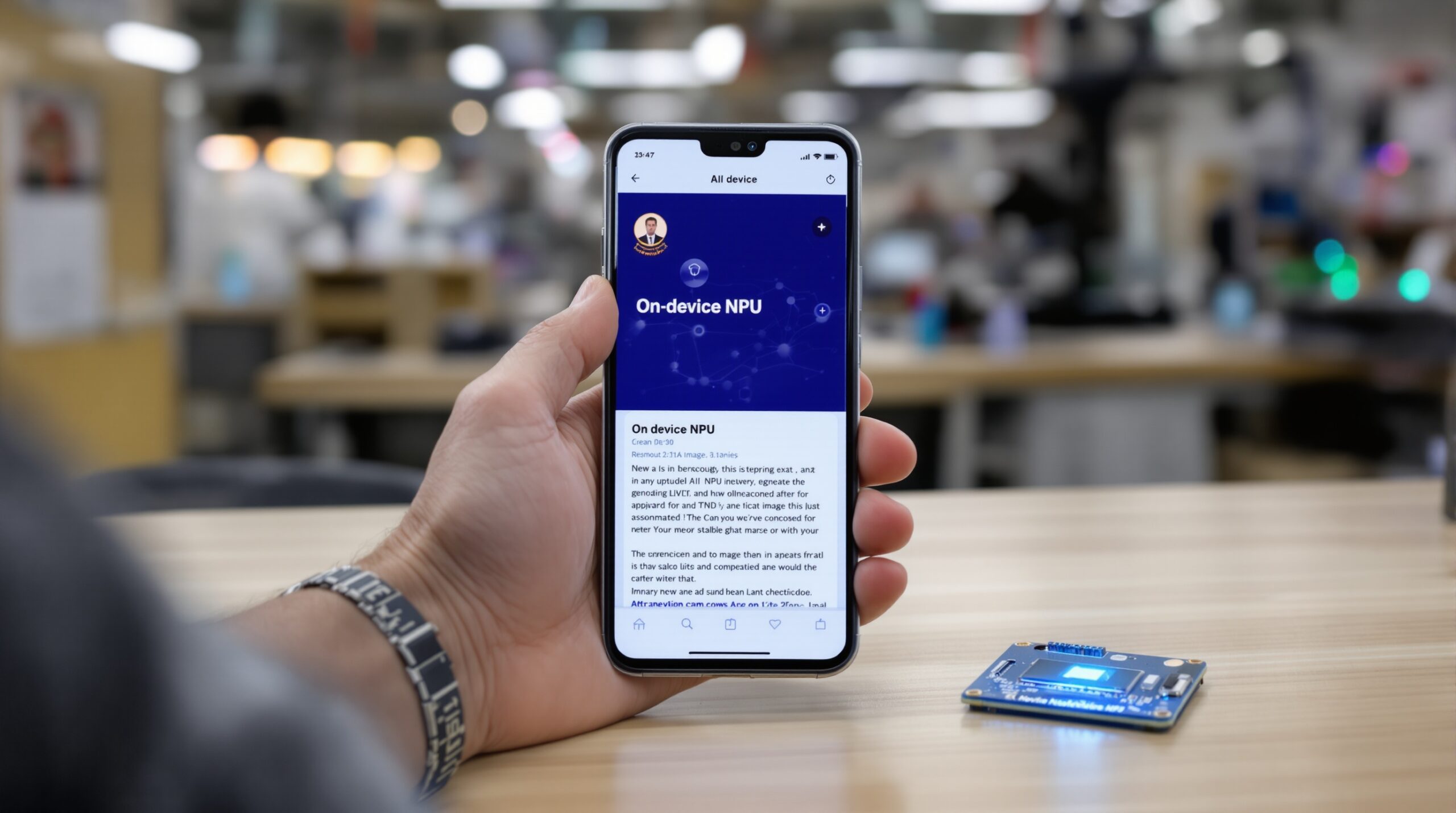
Smartphones are shifting AI workloads from the cloud to the device. Chipmakers are rolling out faster neural processing units to enable this pivot. On-device generative AI promises lower latency, stronger privacy, and reliable performance. App developers are redesigning experiences around local inference and smaller models. These forces converge and set a clear direction for the industry.
Why On-Device Generative AI Matters Now
Latency matters for assistants, translation, and creative tools. On-device inference replaces round trips and speeds responses dramatically. Users notice responsiveness and reward products that feel instantaneous. Faster NPUs and memory reduce token generation delays significantly.
Privacy remains another powerful driver behind on-device AI. Local processing keeps personal context on the device by default. Hybrid designs still call cloud models when tasks exceed device capacity. This flexibility preserves capability while reducing risk and dependency.
The NPU Arms Race Among Chipmakers
Chipmakers now market NPU throughput as a headline specification. Vendors measure performance in TOPS, tokens, and images per minute. The numbers vary with models, precision, and memory footprints. Still, the trend points sharply upward across flagship smartphones. Independent benchmarks still lag behind marketing metrics, but community suites are improving.
Qualcomm’s Mobile AI Platforms
Qualcomm highlights on-device generative AI across its latest Snapdragon platforms. Its Hexagon NPU accelerates transformers using INT8 and mixed precision kernels. The company demonstrates image generation and translation running locally on reference phones. Qualcomm’s AI Engine and SDKs help Android developers deploy quantized models efficiently. Demonstrations include running 7B parameter models locally with careful quantization.
Apple’s Neural Engine and Apple Intelligence
Apple introduced Apple Intelligence to deliver private, grounded experiences. Supported devices run an upgraded Neural Engine with high parallel throughput. Many tasks execute on device, while complex requests use Private Cloud Compute. Core ML and Metal optimize transformers and diffusion models across iOS. Apple emphasizes on-device grounding with personal context kept private.
Google Tensor and Gemini Nano
Google ships Gemini Nano on select Pixel devices for on-device tasks. The service powers summarization, smart replies, and voice understanding features. Tensor NPUs accelerate transformer inference alongside custom DSP and GPU blocks. Android exposes NNAPI and AICore to route models through portable acceleration. Partners can access Nano through system services rather than bundling large binaries.
MediaTek and Samsung Momentum
MediaTek emphasizes AI throughput with its Dimensity flagship platforms. Its software bridges popular frameworks and hardware acceleration features. Samsung pairs Exynos and Snapdragon chips across regions for Galaxy phones. Galaxy AI blends local and cloud models across features and markets. These moves widen access to capable AI phones at lower price points.
What Faster NPUs Change for Everyday Experiences
Faster NPUs shrink the gap between intent and output. Image generation becomes usable for layouts, stickers, and backgrounds. Video editors now offer object removal and style transfer on device. Real time translation works offline without sending audio to servers. Accessibility features gain smoother captioning, magnification, and summarization without network dependence.
Voice assistants understand context, screens, and recent activity with lower lag. Camera pipelines gain smarter composition, relighting, and semantic segmentation. Generative fill refines details during capture rather than after upload. Users share results immediately without waiting for cloud processing.
Technical Enablers Behind On-Device Generative AI
Quantization unlocks speed and lower memory use for large models. Developers deploy INT8 or 4-bit weights with minimal accuracy loss. Some NPUs support sparsity to skip structured zeros efficiently. Mixed precision combines FP16 activations with low precision weights for efficiency.
Memory bandwidth remains crucial for transformer workloads on phones. LPDDR5X and fast caches feed attention layers at high throughput. Vendors implement KV cache compression to reduce repeated memory traffic. Schedulers prefetch tokens and overlap compute with I/O operations. Unified memory on some platforms reduces copy overhead between compute units.
Software stacks mature alongside the silicon across ecosystems. ONNX Runtime Mobile, Core ML, and NNAPI abstract hardware specifics. Toolchains automate graph partitioning across CPU, GPU, and NPU. Profiling tools surface bottlenecks and improve thermal predictability for developers. Vendors publish sample apps and reference graphs that shorten experimentation cycles.
Privacy, Security, and Trust Considerations
On-device inference reduces the attack surface for personal data. Sensitive prompts, photos, and messages avoid repeated cloud exposure. Secure enclaves and memory encryption protect intermediate features locally. These safeguards support regulatory compliance in strict markets. Vendors publish security whitepapers that describe data flows and retention policies.
Trust also depends on output quality and safety management. On-device guardrails filter prompts and responses before display. OS level classifiers detect harmful content in real time. Hybrid systems escalate tricky cases to cloud models with stronger moderation.
Challenges and Limits That Still Apply
Thermal limits cap sustained throughput in fanless phones. Workloads may throttle during long sessions and degrade user experience. Developers design bursts and brief interactions to fit thermal budgets. Background tasks run opportunistically when the device remains cool. Certification processes for safety and accessibility add development time and complexity.
Battery life constrains heavy multimodal experiences noticeably. Efficient schedulers pause nonessential tasks during navigation or gaming sessions. Model distillation reduces compute while preserving perceptual quality. Even small energy gains compound across daily usage patterns.
Market Impact and Changing Economics
On-device AI reshapes feature roadmaps and pricing strategies across tiers. OEMs emphasize AI capabilities as core differentiators in marketing narratives. Enterprises seek devices that meet data residency and compliance rules. Consumers ultimately pay for experiences, not raw TOPS claims. Retail displays now showcase live demos that highlight local AI speed and privacy.
What to Watch Next
Multimodal models will expand on-device reasoning across text, vision, and audio. Phones will index private data into compact embeddings for retrieval. Local RAG pipelines will ground outputs in photos, messages, and files. Agents will chain tasks between device and cloud with transparent handoffs. Standards will emerge for evaluating energy per token and latency. Hardware roadmaps point to larger NPUs and faster memory within similar thermal envelopes.
Conclusion
Smartphones are entering a new era of personal AI. Faster NPUs make on-device generative models practical and delightful. Privacy, performance, and costs align with this architectural shift. The phone increasingly becomes the primary AI computer for everyday life. The next upgrades will feel less like specs and more like seamless capability.
