

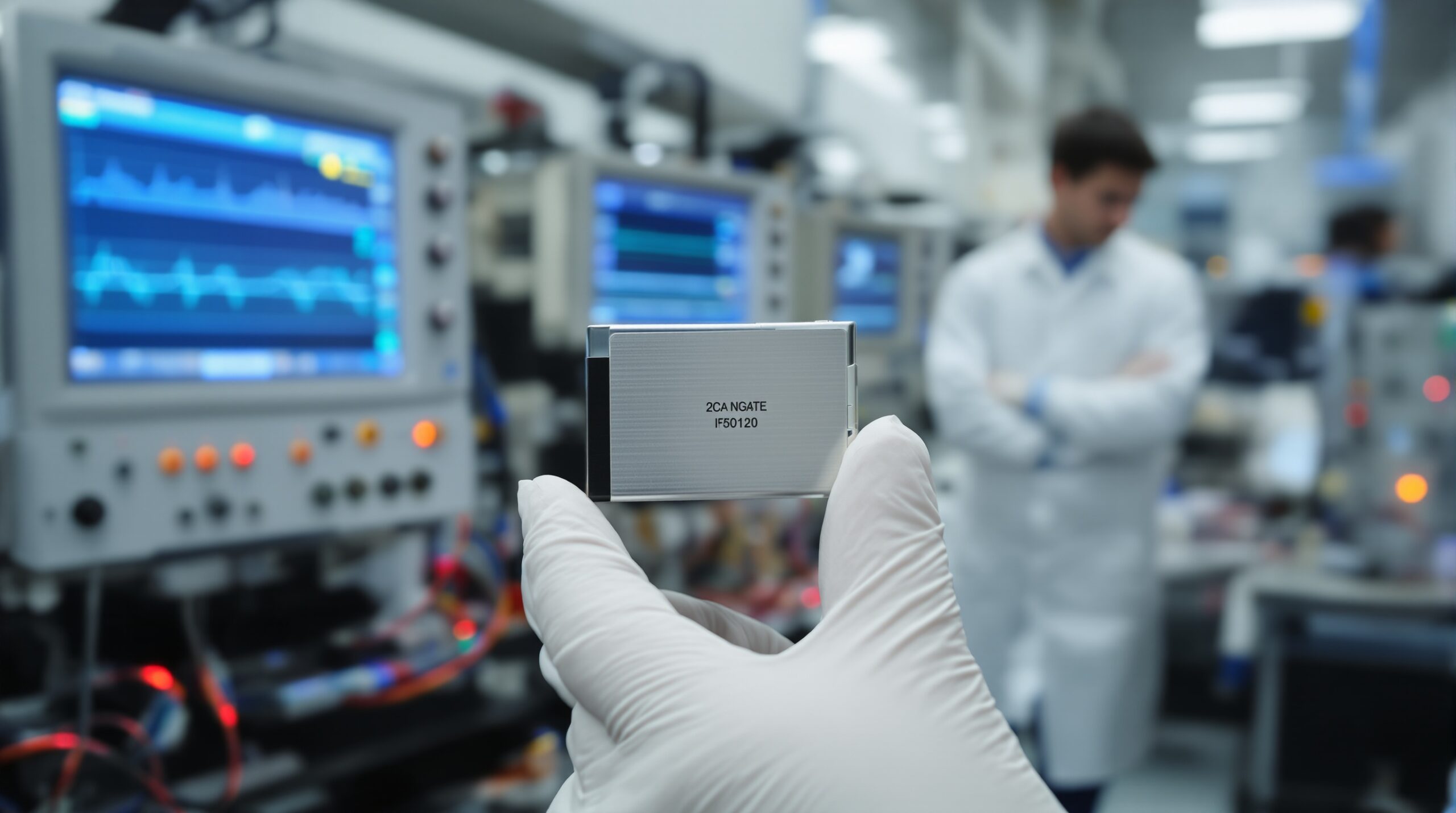
A new solid-state battery prototype reports major gains in lab testing. The team describes roughly double the cell energy density. They also report markedly shorter charging times versus today’s lithium-ion cells. These early results signal real momentum for solid-state technology.
The prototype uses a solid electrolyte and a lithium metal anode. That combination targets higher energy and safer operation. Early data suggests faster ionic transport and lower internal resistance. Those attributes reduce charge time without extreme heat generation.
Independent validation has not yet confirmed these results. However, the test methods appear consistent with battery research norms. The findings align with the expected advantages of solid-state designs. That context helps frame what these gains could mean next.
What the prototype achieved
The team reports cell-level energy density roughly twice that of common lithium-ion cells. Today’s premium lithium-ion cells reach about 250 to 300 Wh/kg. Doubling would suggest near 500 to 600 Wh/kg at the cell level. The prototype reportedly approaches that range under lab conditions.
Charging times improved substantially in early cycles. The group describes 10 to 80 percent charging under 15 minutes. That performance compares favorably with many current fast-charging EV cells. Lower heat output during charging further supports the result.
Tests used small-format cells typical of early development. These cells included coin and small pouch formats. The team measured energy, rate performance, and temperature response. These metrics establish a clear baseline for later scale-up efforts.
Early coulombic efficiencies also looked encouraging. High efficiency indicates low parasitic reactions at interfaces. Stable efficiencies reduce capacity fade over repeated cycles. That trend supports both the energy and fast-charge results.
These findings still require larger multicell validation. Even so, they show clear promise for the architecture. The results justify increased investment in scale-up. They also guide the next engineering steps.
How solid-state cells boost energy density
Solid-state cells typically use a lithium metal anode. Lithium metal stores more lithium than graphite anodes. The anode contributes less weight for the same capacity. That change drives a large share of the energy gain.
Solid electrolytes can also enable thinner separators. Thin separators reduce inactive material inside the cell. More active material increases stored energy per unit volume. That effect complements the lithium metal advantage.
Pairs with high-nickel cathodes further raise energy. High-nickel chemistries carry more lithium per unit mass. Combining those cathodes with lithium metal maximizes cell-level energy. The prototype likely follows this general approach.
Packaging also plays a role in energy density. Safer electrolytes can reduce heavy safety hardware. Less overhead increases pack-level energy density. Manufacturers always balance safety with mass efficiency.
These mechanisms align with the reported doubling trend. They also set clear engineering targets for production. The next section explains the fast-charging improvements. Those improvements matter just as much to drivers.
Why charging time improves
Fast charging depends on fast ion transport and low resistance. Many solid electrolytes show high ionic conductivity. Sulfide and some oxide glasses reach impressive conductivities. That property reduces ion bottlenecks during charging.
Solid electrolytes can also allow thin, uniform interfaces. Good interfaces reduce resistive heat during fast charging. Less heat reduces the need for throttling. The cell can hold higher currents without damage.
Lithium metal also improves charging rates when stable. A stable interface prevents dendrite formation under high currents. Better stability allows faster charge without short circuits. Good electrolyte design underpins that stability.
Thermal behavior appears favorable in this prototype. Lower heat rise improves safety during charging. It also eases cooling requirements in packs. That benefit reduces weight and cost at system level.
These charging gains complement the energy increase. Drivers want both range and short stops. Engineers must deliver both to shift markets. The next consideration is safety.
Safety and cycle life considerations
Solid electrolytes are generally less flammable than liquid electrolytes. That change reduces the risk of thermal runaway. Cells still store large energy and remain hazardous. But flammability mitigation helps safety design considerably.
Not all solid electrolytes behave the same under heat. Some sulfides can release gases under abuse. Oxide electrolytes resist heat better but add fabrication challenges. Polymer electrolytes need higher temperatures for good conductivity.
Cycle life depends on interface stability over time. Repeated cycling can grow voids or interphase layers. These features raise resistance and reduce capacity. Careful interlayer design can manage those issues.
Dendrite suppression remains essential for lithium metal. Solid electrolytes can block dendrites under pressure. However, nonuniform currents can still drive penetration. Microstructure control limits those failure modes.
Early data here suggests promising stability across initial cycles. The team reports minimal impedance growth under moderate currents. That trend could support long life with further tuning. Larger cells must confirm the behavior.
These safety and life indicators inform regulatory review. They also guide automotive qualification plans. The next challenge involves scaling from lab to factory. That step often reveals new constraints.
Test setup and limitations
Lab tests typically use small coin or pouch cells. These formats simplify fabrication and screening. They also allow precise control of pressure and temperature. The prototype followed that common approach.
Small cells can overrepresent performance versus large stacks. Heat removal is easier in tiny formats. Pressure uniformity is also easier to maintain. Scale introduces mechanical and thermal gradients.
Reported rates reflect controlled thermal environments. Active cooling minimizes heat buildup during fast charges. Packs cannot always match those conditions in vehicles. System design must compensate for that gap.
Cycle counts remain limited at this stage. Early testing focuses on feasibility and mechanisms. Later testing will extend to thousands of cycles. Only then can warranties follow confidently.
Independent labs should replicate the results. Third-party data builds trust and consensus. Standardized testing helps benchmark across companies. The team says such studies are planned.
These limitations temper expectations yet guide development priorities. They also frame investor discussions realistically. Scaling work begins while validation proceeds. Both tracks matter for timelines.
Manufacturing and supply chain implications
Solid-state manufacturing differs from conventional lithium-ion in key ways. Some processes use dry electrode manufacturing. Others use powder compaction and sintering. These methods demand specialized equipment and controls.
Pressure management becomes a design constraint. Many solid-state stacks need consistent stack pressure. Housing structures must maintain pressure across many layers. That requirement affects pack and module design.
Material supply chains will also shift. Lithium metal foil demand will likely increase significantly. Solid electrolytes require specific lithium and sulfur precursors. Oxide electrolytes require high-purity ceramic feedstocks.
Yield and defect control will dominate early costs. Solid interfaces are sensitive to contamination and voids. Inline metrology must detect and prevent defects. Manufacturers will refine processes through iterative learning.
Compatibility with existing gigafactory lines varies by approach. Some lines can adapt with moderate changes. Other approaches require extensive new equipment. Capital planning must account for those differences.
These manufacturing realities shape the commercialization roadmap. They also determine price trajectories over time. Better yields can lower costs quickly. Those gains unlock broader markets.
Potential impact on vehicles and electronics
Higher energy density enables longer range without heavier packs. Automakers can shrink pack size and maintain range. Smaller packs lower costs and improve efficiency. Designers also gain interior space and payload capacity.
Faster charging changes trip planning significantly. Drivers could recover most range during short stops. Short dwell times expand charging station throughput. Operators benefit from higher utilization of infrastructure.
Thermal stability simplifies cooling system design. Reduced flammability risk supports lighter protective structures. Those changes improve crash safety engineering options. Manufacturers still design for worst-case scenarios.
Consumer electronics could also benefit meaningfully. Laptops could run longer between charges. Phones could refill quickly without overheating. Designers could thin devices while maintaining battery life.
Grid storage faces different constraints than vehicles. Cycle life, cost, and safety dominate grid decisions. Solid-state improvements must compete on total cost. Energy density matters less for stationary storage.
These impacts depend on sustained performance at scale. Real-world packs must deliver consistent results. Standards and warranties will codify expectations. That process takes time and discipline.
Next steps and credible timelines
The team plans to build larger multilayer pouch cells. Those cells better reflect automotive formats. Engineers will validate energy, rate, and safety at scale. They will also measure degradation over many cycles.
Automotive qualification proceeds through staged samples. Early A-samples test feasibility and integration. B-samples refine manufacturing and reliability. C-samples support final validation and launch decisions.
Each stage can take a year or more. Suppliers must align with automaker development calendars. Supply chain readiness must match technical progress. Certification also requires extensive safety testing.
Commercial timing depends on achieving repeatable yields. Cost curves must decline with volume and learning. Partnerships can accelerate pilot to production transitions. Realistic forecasts span multiple years.
These steps ensure responsible scaling of promising technology. They also protect customers and investors from undue risk. Progress continues as data accumulates. Key metrics will guide confidence.
What to watch next
- Pack-level energy density relative to today’s EV packs, not just cell-level claims.
- 10 to 80 percent charge times under realistic temperatures and cooling.
- Cycle life exceeding 1,000 cycles at practical rates and pressures.
- Safety under puncture, crush, overcharge, and thermal abuse tests.
- Performance across cold and hot climates without aggressive preconditioning.
- Manufacturing yield, throughput, and scrap rates at pilot scale.
- Supply chain readiness for lithium metal and chosen electrolytes.
- Independent replication by accredited testing laboratories.
Bottom line
This solid-state prototype delivers compelling early gains. Doubling energy density and faster charges could reshape batteries. Careful validation and disciplined scaling will determine real-world impact.
