
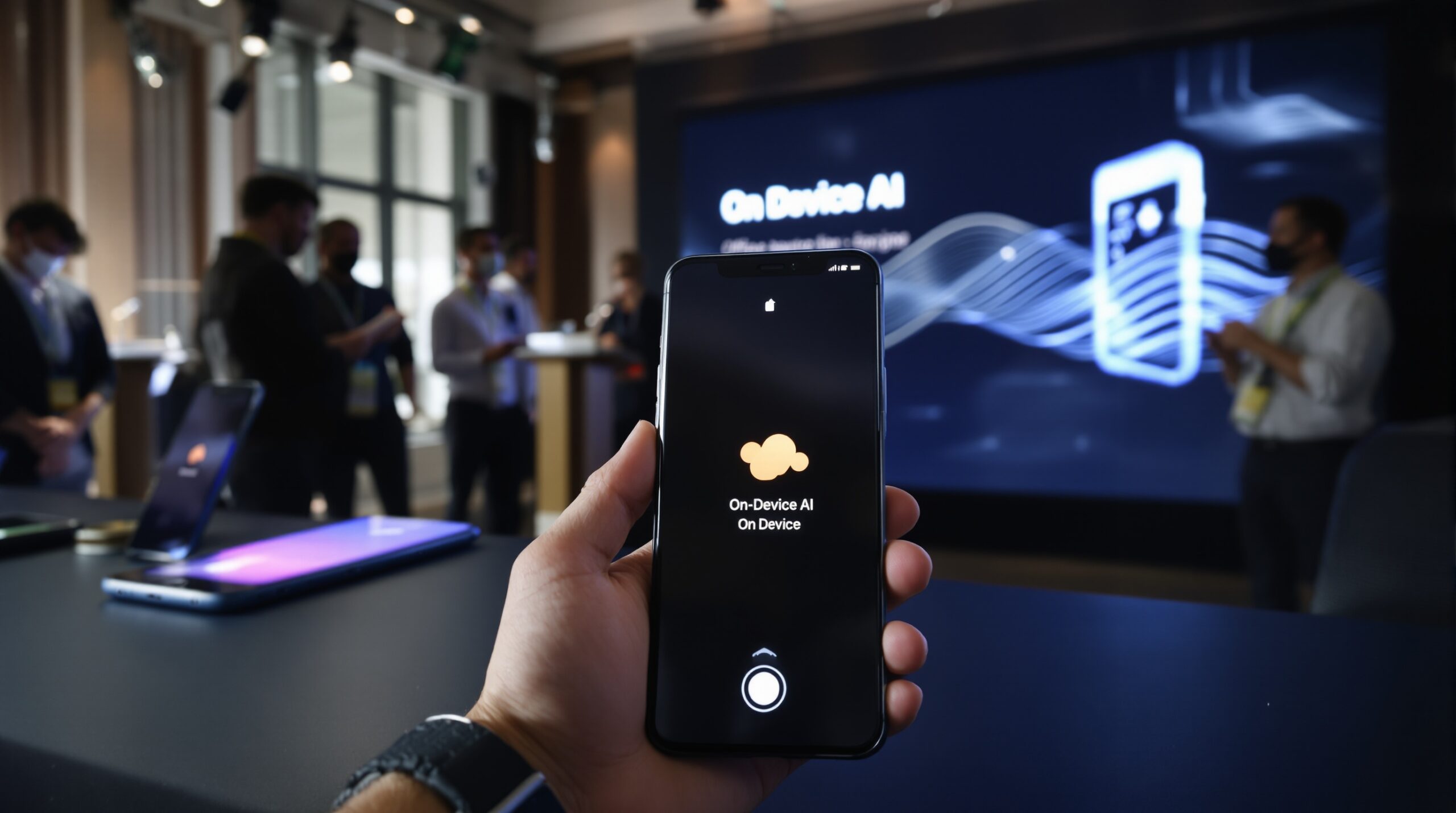
Smartphone makers see a turning point for artificial intelligence. They want assistants that run fully on the device, without clouds. This goal promises instant responses, improved privacy, and lower operating costs. The path remains challenging, yet momentum has clearly shifted. Companies now market on-device capabilities as core product features. That framing increases competition and sets ambitious expectations.
Why Offline, On-Device Assistants Matter
Latency drives the offline push first. Local inference removes network round trips, delivering results in milliseconds. Consistency follows closely behind latency. Offline systems work during flights, subways, and congested networks. Privacy strengthens with on-device processing, since sensitive content never leaves the phone. That posture helps with compliance and user trust. Costs also matter significantly. Local inference can reduce expensive cloud bills at scale. Those savings let companies bundle more AI features without subscription fatigue.
Reliability creates another advantage. Offline assistants avoid outages, throttling, and regional service gaps. Enterprises appreciate predictable performance and compliance. Developers benefit from fewer network dependencies and clearer experience design. These gains, however, demand serious hardware and software advances. Companies now invest across silicon, models, runtimes, and security. The race spans entire technology stacks.
Hardware Arms Race Powering Edge Intelligence
Smartphones now ship with neural processing units alongside CPUs and GPUs. These NPUs accelerate matrix math, transformers, and diffusion workloads. Vendors tout dramatic efficiency gains at mobile power budgets. Memory bandwidth and capacity remain critical constraints. Larger models and longer contexts stress mobile memory systems. Improved caches, compression, and fast RAM mitigate bottlenecks. Thermal design also shapes sustained performance. Vendors optimize for bursts and longer sessions without overheating.
Silicon Strategies: Qualcomm, MediaTek, Apple, and Google
Qualcomm emphasizes heterogeneous compute and dedicated AI accelerators. Its platforms combine CPU, GPU, NPU, and DSP pipelines for flexibility. The company demonstrates on-device image generation and speech models at events. MediaTek focuses on efficient transformer execution and latency reduction. Its chipsets highlight mixed-precision computation and optimized schedulers. Apple integrates the Neural Engine tightly with Core ML and Metal. That vertical control enables tuned models and privacy guarantees. Google pushes Android AI runtimes and device integrations. Gemini Nano runs on Pixel phones for selective on-device tasks.
Software Breakthroughs Enabling Offline Assistants
Model compression techniques make offline possible. Quantization reduces precision to 8-bit and 4-bit levels. Distillation trains smaller models from larger systems while preserving behavior. Sparsity prunes weights and activations for speed. Efficient attention reduces memory use for longer contexts. Token pruning and early exit logic skip unnecessary computation. Together, these methods shrink models dramatically without crippling quality.
Runtimes matter as much as models. Apple’s Core ML compiles graphs for the Neural Engine. Android’s NNAPI and vendor drivers execute operators efficiently. Google’s AICore supplies system-level access to Gemini Nano capabilities. Frameworks keep improving operator coverage and memory reuse. Low-level kernels for attention and convolution see constant tuning. Developers gain more stable APIs and predictable performance. That stability encourages real product deployment, not just demos.
Product Approaches from Major Players
Google’s On-Device Gemini Strategy
Google integrates Gemini Nano into eligible Pixel devices. The assistant handles tasks like smart replies and voice features locally. Recorder summarizes conversations on-device for supported models. These capabilities reduce latency and protect user content. Google balances offline processing with server models for heavier tasks. The company continues transitioning from Assistant to Gemini experiences. Android features increasingly rely on private on-device services. That architecture reduces dependency on constant connectivity.
Apple’s Hybrid Model with Strong On-Device Emphasis
Apple announced Apple Intelligence with a clear privacy focus. Many features run on-device using integrated models and the Neural Engine. When workloads exceed local capacity, Apple uses Private Cloud Compute. The system routes requests to attested Apple servers by design. That approach preserves privacy while extending capabilities safely. Siri gains context awareness and writing tools improve across apps. Apple conditions availability on newer hardware for performance reasons. This strategy nudges upgrades and standardizes user experience quality.
Samsung’s Galaxy AI Balances Local and Cloud Features
Samsung introduced Galaxy AI with a mix of on-device and cloud processing. Live Translate for calls can operate on-device for privacy. Photo editing, summarization, and transcription leverage local accelerators where possible. The company partners with Google and chip vendors closely. Its approach emphasizes multilingual features and seamless device integration. Samsung’s marketing highlights offline benefits for travelers and professionals. That message resonates with privacy-conscious audiences globally.
Others Enter the On-Device Arena
Meta optimizes open models for mobile devices and partners across ecosystems. Xiaomi and Oppo showcase localized, offline features for regional markets. Smaller vendors package on-device transcription and translation into utility apps. Startups offer specialized inference engines for mobile hardware. Carriers experiment with value-added AI bundles on premium plans. These moves widen the field and accelerate momentum.
Privacy, Security, and Regulation Shape Design Choices
Offline assistants help meet data minimization expectations. Sensitive content stays on the device by default. That principle aligns with GDPR and similar frameworks. Companies still need transparent consent and safe defaults. Auditability becomes vital as assistants affect critical tasks. Platforms implement secure enclaves and permission gating. Apple uses device-level protections for model access. Android employs Private Compute Core for sensitive signals. Model updates require signed packages and careful provenance controls.
Trust also depends on safety filters that run locally. Companies deploy lightweight guardrails for harmful content and hallucinations. On-device safety models screen prompts and responses before display. This approach reduces risk during offline operation. Vendors test combinational behaviors across languages and domains. Consumers expect consistent protections regardless of connectivity.
Business Models and Carrier Roles Evolve
On-device inference reduces ongoing cloud costs per user. That change enables broader feature availability without high subscriptions. Hardware differentiation becomes a revenue driver for AI performance. Vendors position NPUs as must-have features for premium tiers. Carriers may subsidize AI-rich devices for network upgrades. They also explore bundling storage and backup services. Partnerships around app stores and distribution remain strategically important. Developers gain marketplace leverage with efficient offline features. Their apps offer value in low-connectivity environments.
Technical Hurdles Still Ahead
Model size remains the toughest constraint today. Truly conversational quality often needs billions of parameters. Phones struggle with memory bandwidth and thermal limits. Quantized 7B models can run, but at tradeoffs. Multimodal fusion adds further complexity and compute demands. Long context windows require careful attention optimizations. Background processing competes with battery life and thermals. Scheduling across CPU, GPU, and NPU remains nontrivial. Debugging performance across diverse devices challenges developers. Consistent behavior across languages and dialects needs ongoing tuning.
Personalization adds another difficulty. Users want assistants that learn offline without leaking data. Techniques like federated learning and differential privacy help. However, they complicate update pipelines and storage. Local vector databases enable private memory and recall. These systems must encrypt data and respect permissions. Clear reset controls and transparency improve user confidence.
Benchmarks, Standards, and Developer Tooling Mature
Industry benchmarks for on-device AI are gaining visibility. Vendors publish speed and efficiency comparisons for real tasks. Benchmarks now include speech, translation, and summarization workloads. Standardized tests reduce marketing noise and guide engineering. Tooling also improves across platforms and vendors. Profilers help identify memory hotspots and kernel bottlenecks. Quantization toolchains simplify deployment from research to production. Documentation for guardrails and safety expands meaningfully. These improvements shorten development cycles and raise quality.
What to Expect Over the Next 12 Months
Expect broader availability of offline voice, translation, and summarization. Midrange devices will gain basic on-device assistants. Premium devices will feature richer multimodal interactions offline. More apps will offer local transcription and meeting notes. Image generation will run faster and consume less power. Platform updates will expose unified on-device AI APIs. Carriers will promote offline AI as coverage insurance. Enterprises will pilot offline assistants for field teams. Regulators will scrutinize safety disclosures and model sourcing. The market will reward transparent, reliable execution.
Implications for Consumers and Developers
Consumers will notice faster, more private interactions. Features will feel stable regardless of connectivity and travel. Battery impact will improve as optimizations land. Device choice will matter more for AI features and longevity. Developers get new canvases for creative, privacy-respecting apps. They can design experiences that never touch external servers. Local-first architectures reduce backend complexity and costs. Analytics must evolve to respect offline operation. Teams will rely more on on-device telemetry and synthetic tests.
The Bottom Line
Tech giants are racing toward fully offline, on-device AI assistants. The journey blends hardware advances with model innovation. Today’s products often use hybrid approaches for practicality. However, the trajectory points clearly toward more offline capability. Competitive pressure and user expectations will sustain that direction. Companies that deliver reliable, private, and fast experiences will win. The smartphone is becoming a capable personal computer for AI. That shift changes software design and business models alike. The result will feel faster, safer, and more personal.