

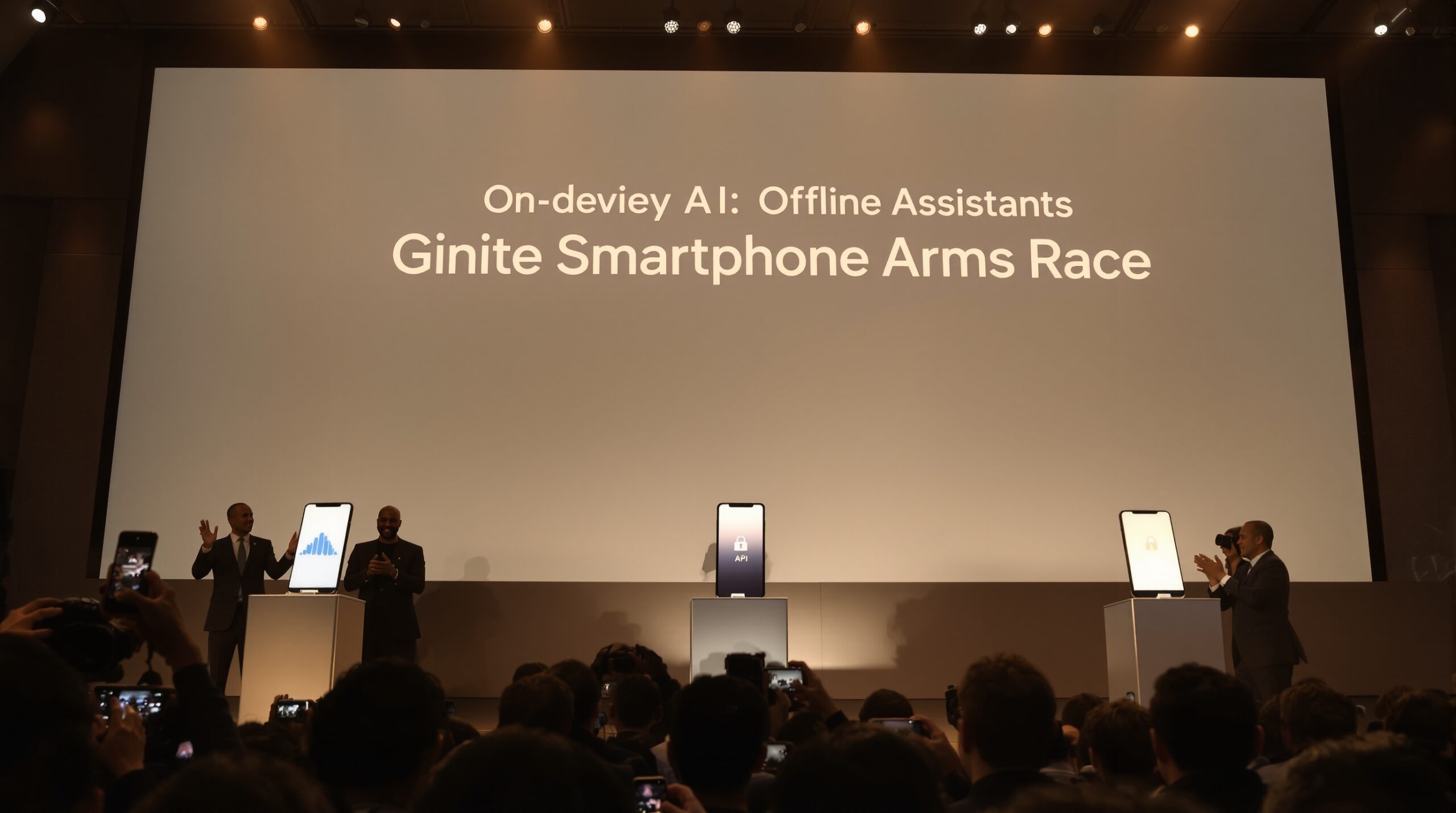
Major smartphone makers are racing to deliver AI assistants that run entirely on the device, without cloud help. The push promises faster responses, stronger privacy, and dependable features even without a signal. Companies see offline capabilities as a core differentiator for next-generation phones. That shift is already reshaping chip design, software tooling, and mobile operating systems.
On-device assistants no longer feel like far-off research projects. They now handle summaries, translation, transcription, and image generation locally. Manufacturers are showcasing offline demos that would have required servers just a year ago. This momentum sets the stage for intense competition across the mobile industry.
What Makes Offline AI Possible Today
Three forces enable credible offline AI assistants on phones. First, mobile NPUs deliver huge gains in parallel processing and energy efficiency. Second, compact models use quantization, pruning, and distillation to shrink memory and compute needs. Third, OS-level frameworks streamline hardware acceleration and memory management for AI tasks.
These advances compound across the stack. AI workloads now execute on heterogeneous engines spanning CPU, GPU, and dedicated NPUs. Mixed precision math delivers speed without wrecking output quality. Meanwhile, model architectures optimize token throughput and reduce context memory. Those choices turn once impractical models into pocketable assistants.
The Key Players and Their Offline Strategies
Google Pushes Gemini Nano On-Device
Google ships Gemini Nano as an on-device model for compatible Android devices. It powers features like Recorder summaries and smart replies without sending audio to the cloud. Developers access AICore, which schedules and accelerates local inference efficiently. This approach reduces latency and keeps sensitive content on the phone.
Google’s strategy pairs compact on-device models with larger cloud models when needed. The assistant can respond offline for supported tasks and elevate complex requests online. That hybrid design balances responsiveness with breadth of capability. It also helps conserve battery during heavy workloads.
Apple Leans on On-Device Models and Private Cloud Compute
Apple emphasizes privacy and speed with on-device models for many Apple Intelligence features. The system handles writing tools, notifications triage, and contextual actions locally when possible. For heavier requests, Apple routes data to Private Cloud Compute with strong privacy protections. Users gain offline reliability and measured cloud escalation.
Apple’s silicon roadmap prioritizes high-performance NPUs and fast memory bandwidth. That hardware focus underpins low-latency experiences and robust device-side inference. The company integrates these capabilities deeply into iOS and macOS frameworks. Tight integration helps avoid fragmented developer experiences.
Samsung Banks on Galaxy AI Across Devices
Samsung positions Galaxy AI as a blend of on-device and cloud features. Interpreter mode and select translation features can operate locally, enabling travel-friendly experiences. Other capabilities may use cloud backends for broader language coverage and improved accuracy. The company aims to scale features across phones, tablets, and laptops.
Samsung’s approach leverages partnerships with model providers and chipset vendors. It tailors features to regional requirements and carrier constraints. The strategy favors practical, day-to-day use rather than research demonstrations. That orientation could accelerate mainstream adoption.
Chipmakers Drive the Hardware Foundation
Qualcomm, MediaTek, and Apple fuel the offline shift with powerful NPUs. They demonstrate on-device large language models and diffusion models generating images in seconds. These vendors promote developer toolchains for quantization and optimization. Their roadmaps target higher tokens per second with lower power draw.
Qualcomm highlights end-to-end pipelines for speech, vision, and language running locally. MediaTek showcases all-big-core CPU designs and strong NPUs for sustained workloads. Apple integrates neural acceleration tightly with secure enclaves and memory subsystems. This competition accelerates progress and expands device eligibility for offline features.
What Offline Assistants Can Do Today
Offline assistants excel at tasks with focused context and limited complexity. Summarizing recordings, drafting messages, and translating short phrases work reliably. On-device transcription means interviews and notes stay private and accessible without connectivity. Visual tasks like object recognition and image edits also run effectively on-device.
Developers integrate offline inference for latency-sensitive moments. Keyboard suggestions and autofill predictions feel more responsive without network delays. Accessibility features, like live captions, benefit from local processing and consistent performance. These use cases improve daily convenience meaningfully.
Limits That Still Matter
Offline assistants face constraints, despite rapid progress. Compact models may hallucinate more often than large cloud models. Long-context reasoning can challenge memory and throughput limits on phones. Battery and thermal budgets restrict sustained heavy generation.
Vendors mitigate these limits with careful orchestration. Systems route demanding queries to cloud models under clear privacy rules. Devices cache recent information to accelerate follow-up interactions. Feature design often breaks tasks into smaller, locally solvable chunks.
Privacy, Security, and Compliance Implications
Running AI offline reduces exposure to network interception and third-party data processing. Sensitive audio, messages, and photos can stay on the device. Enterprises value local processing for compliance with data residency requirements. Health, finance, and legal workflows particularly benefit.
However, local inference does not eliminate all risks. Models can memorize examples and leak information through outputs. Devices require secure enclaves, encrypted storage, and strict permission controls. Clear audit trails and policy controls remain crucial for regulated industries.
Performance, Battery Life, and Thermal Realities
On-device AI must deliver speed without draining batteries. Modern NPUs provide impressive throughput per watt compared with CPUs. Scheduling frameworks batch operations and adjust frequencies to manage thermals. Mixed precision arithmetic cuts energy use while preserving output quality.
Vendors also use sparsity and compiler optimizations to reduce computations. Memory bandwidth remains a crucial bottleneck for large context windows. Devices with faster RAM and larger caches handle longer prompts more comfortably. Users experience smoother interactions as these bottlenecks ease.
Developer Ecosystems Are Maturing Quickly
Tooling now simplifies deploying optimized models on phones. Frameworks expose unified APIs for text, audio, and vision pipelines. Quantization toolkits convert models to eight-bit or four-bit formats with minimal quality loss. Profilers help identify hot spots and memory pressure in real workloads.
Platforms encourage thoughtful fallback strategies. Developers can prefer local inference and escalate selectively to the cloud. That pattern preserves privacy and controls costs for popular apps. It also yields graceful degradation in low-connectivity environments.
The New Smartphone Arms Race
Offline AI raises the stakes for hardware differentiation. Manufacturers market TOPS metrics, memory bandwidth, and sustained performance numbers aggressively. Camera features and communications tools now hinge on AI throughput. Marketing focuses on instant responses and private processing as headline benefits.
Carriers will likely spotlight offline features in retail experiences. Retail demos can show translation, summarization, and editing without network reliance. That pitch resonates in travel, rural areas, and privacy-conscious markets. As a result, upgrade cycles may accelerate among power users.
Consumer Benefits and Everyday Impact
Users gain assistants that work anywhere and protect their data by default. Airplane mode no longer disables core AI features. Voice control, captioning, and image editing stay responsive and available. Everyday tasks feel faster and more personal.
Parents appreciate local processing for children’s devices and school environments. Travelers rely on offline translation and navigation support. Professionals benefit from confidential summaries of meetings and documents. These scenarios illustrate why offline capabilities matter broadly.
Challenges Ahead for the Industry
Fragmentation remains a risk as features vary by chipset, memory, and OS version. Developers must test across many configurations to ensure reliability. Vendors need clear disclosures about when data leaves the device. Trust depends on transparent policies and understandable controls.
Another hurdle involves updating on-device models safely. Over-the-air updates require secure signing and careful resource management. Users should control when downloads occur to protect data plans. Effective model lifecycle management will become a competitive criterion.
Outlook: Hybrid by Design, Offline When It Matters
Offline assistants will expand steadily as hardware and models improve. Hybrid designs will persist to handle complex or long-context tasks. Competition will push vendors to move more capabilities on-device each year. Users will notice faster interactions and greater control over data.
The arms race benefits developers and consumers with richer, more reliable features. Companies that balance privacy, performance, and practicality will lead. Offline capability will become a baseline, not a premium feature. That shift marks a meaningful evolution in everyday mobile computing.
