

A targeted response
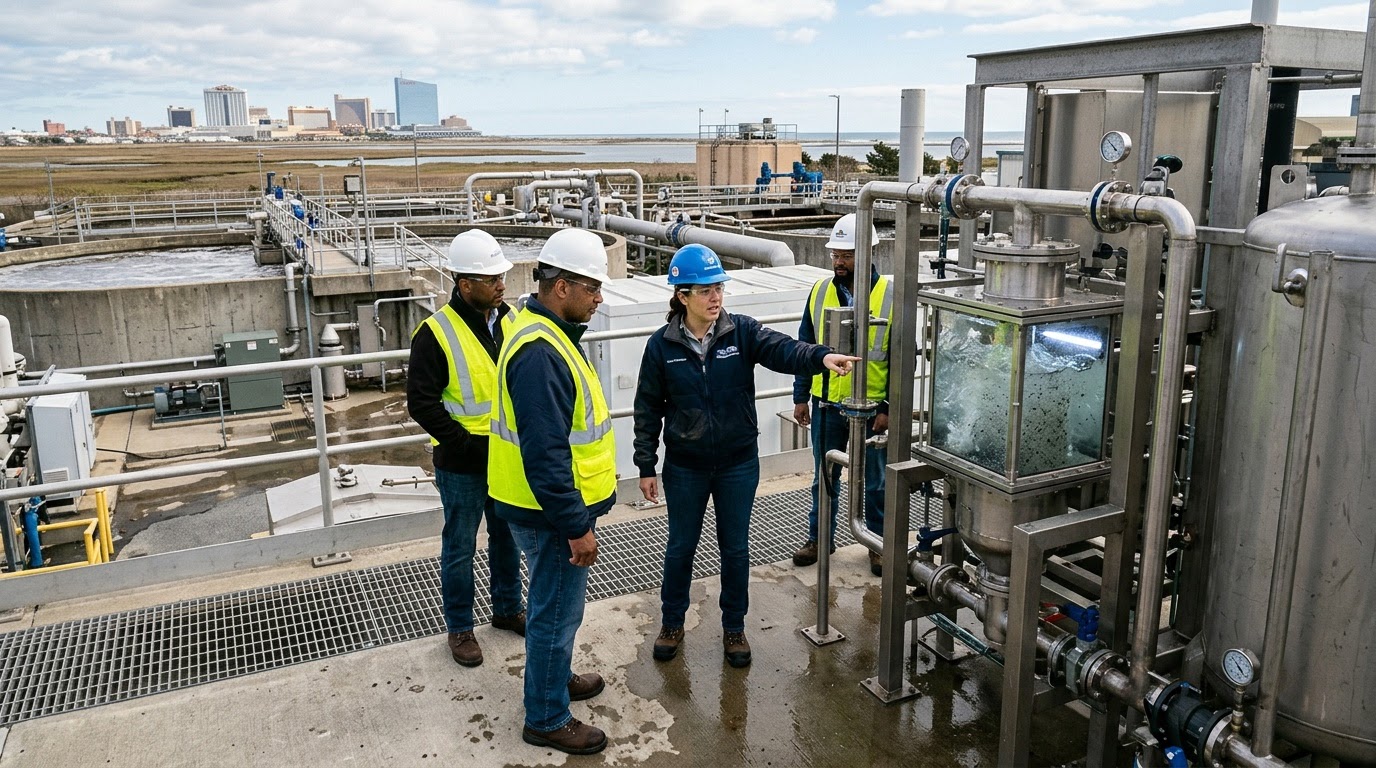
The Atlantic County Utilities Authority has unveiled a pilot system designed to capture microplastics from treated wastewater in Atlantic City. The installation adds a focused research tool to a plant that already removes conventional pollutants. Officials and technology partners presented the project as a practical test under real operating conditions.
The plant receives sewage from Atlantic City and surrounding communities, then treats it before ocean discharge. That location gives researchers access to large, changing flows containing fibers, fragments, and other tiny particles. The project therefore connects laboratory research with the difficult conditions found inside public wastewater infrastructure.
How the capture system works
The demonstration uses PolyGone’s Artificial Root technology, which mimics structures that aquatic plants use to collect particles. Specialized surfaces attract microplastics as water moves through the system. Operators can remove the captured material, clean the collection media, and return that media for additional use. The process also concentrates particles for measurement, helping researchers identify what enters and leaves the treatment stream.
The unit operates as an added treatment step rather than replacing the plant’s biological and mechanical processes. Engineers can adjust flow, exposure time, and cleaning schedules while monitoring performance. Those trials will show whether the equipment remains effective amid changing temperatures, particle loads, and wastewater chemistry.
Why microplastics reach wastewater
Scientists generally define microplastics as plastic particles smaller than five millimeters, although measurement categories vary. Households release synthetic fibers while washing clothing, blankets, and other textiles. Personal care products, deteriorating household materials, industrial sources, and street runoff contribute additional particles. Tire wear can also reach sewers where communities use combined drainage systems.
Plastic does not disappear when larger items break apart. Sunlight, friction, heat, and chemical weathering divide discarded material into progressively smaller pieces. Some particles measure below a micrometer, entering the less standardized category often called nanoplastics. Their small size complicates sampling, identification, and removal.
Conventional treatment already captures much
Wastewater plants remove many microplastics through screening, settling, biological treatment, and filtration. Published studies often report high removal percentages, but results depend on sampling methods and particle sizes. Even a small remaining share matters when a facility processes millions of gallons daily. The Atlantic City trial targets particles in that remaining stream before treated water reaches the ocean.
Removal also creates another question because many trapped particles settle into sewage sludge. Plants may landfill, burn, or beneficially use treated sludge, depending on local permits and practices. Each route carries different costs and potential exposure pathways. A dedicated capture system could isolate a concentrated waste stream for controlled handling and future study.
A coastal setting raises the stakes
The ACUA facility sits beside a region defined by beaches, fishing, tourism, and sensitive coastal habitats. Its treated effluent travels through a permitted ocean outfall after disinfection and required testing. Microplastics can persist in marine environments and move through sediments, surface waters, and food webs. Researchers have found them in shellfish, fish, seabirds, and many other organisms.
Presence alone does not establish a specific health effect, however. Scientists continue studying how particle size, shape, polymer type, and attached chemicals influence toxicity. Researchers also lack standardized methods for comparing many environmental samples. The Atlantic City work can provide useful operational data, although one project cannot settle broader health questions.
Testing performance beyond a laboratory
Laboratory tests provide controlled comparisons, but municipal wastewater changes hourly and seasonally. Rain, tourism, household activity, industrial discharges, and maintenance work can alter both volume and composition. Biofilms and ordinary debris may coat collection surfaces or reduce water movement.
Operators must measure capture rates without disrupting legally required treatment duties. They must also track energy use, cleaning frequency, labor needs, and material durability. A promising filter could remain impractical if it clogs quickly or produces excessive residual waste. Longer trials reveal those operational tradeoffs more clearly than short demonstrations.
Measurement remains a central challenge
Microplastic analysis requires careful sampling because airborne fibers can contaminate bottles, filters, and laboratory equipment. Researchers often use microscopy to count suspected particles and spectroscopy to identify their polymers. Different mesh sizes and analytical thresholds can produce very different totals. Any performance claim therefore needs a clear description of methods, particle ranges, and quality controls.
The project can compare water before and after the capture unit under matching conditions. Repeated samples can show whether removal remains consistent during changing flows. Researchers can then examine captured material to determine common sizes, shapes, and polymer types. Transparent reporting would help utilities compare this approach with membranes, sand filters, and other advanced treatments.
Regulation has not caught up
Federal wastewater permits regulate many pollutants, including solids, nutrients, pathogens, and certain toxic chemicals. However, the United States lacks a nationwide wastewater discharge limit specifically for microplastics. Regulators still need reliable definitions, test methods, exposure data, and enforceable monitoring procedures. That gap makes voluntary research partnerships especially important for developing evidence.
States and federal agencies continue evaluating plastic pollution through research, grants, product rules, and waste reduction programs. Source reduction matters because no downstream system can economically capture every particle. Better textile design, washing controls, stormwater management, and plastic waste prevention can reduce incoming loads.
Costs will shape wider adoption
Public utilities must justify new equipment through measurable benefits, dependable operation, and affordable life-cycle costs. Electricity, replacement media, sampling, staff time, maintenance, and disposal can outweigh an attractive purchase price. Retrofits must also fit crowded facilities without restricting existing treatment capacity.
The trial should help estimate expenses for different flow rates and target removal levels. Scaling a modular unit may prove easier than rebuilding an entire treatment train. However, performance at one plant may not transfer directly to facilities with different wastewater characteristics. Utilities will need site-specific testing before making major investments.
Partnerships move research into practice
The Atlantic City project brings together utility operators, technology developers, and researchers with different responsibilities. Operators understand safety, permits, maintenance, and the plant’s daily constraints. Developers can refine collection materials and system design after observing field performance. Researchers can build sampling plans, verify results, and communicate uncertainty.
That collaboration can shorten the distance between a promising material and usable public infrastructure. It can also expose weaknesses before another utility spends money on deployment. Successful innovation requires both capture efficiency and dependable integration with routine plant operations. The unveiling marks a starting point for that evaluation, not its conclusion.
What comes next
Project teams will need sustained monitoring to understand seasonal performance and maintenance demands. They should report how much plastic the unit captures and which particle sizes escape. Disposal records will matter because collected material must remain outside waterways after removal. Independent review could strengthen confidence in future claims and guide comparable testing elsewhere.
For Atlantic City, the system offers a visible response to a pollutant that standard permits rarely address. It also gives the wastewater sector a controlled setting for testing a developing technology. If results remain strong, other coastal utilities may consider similar systems alongside upstream prevention. Regardless of the outcome, the project will add evidence to an urgent discussion about plastic pollution.


