

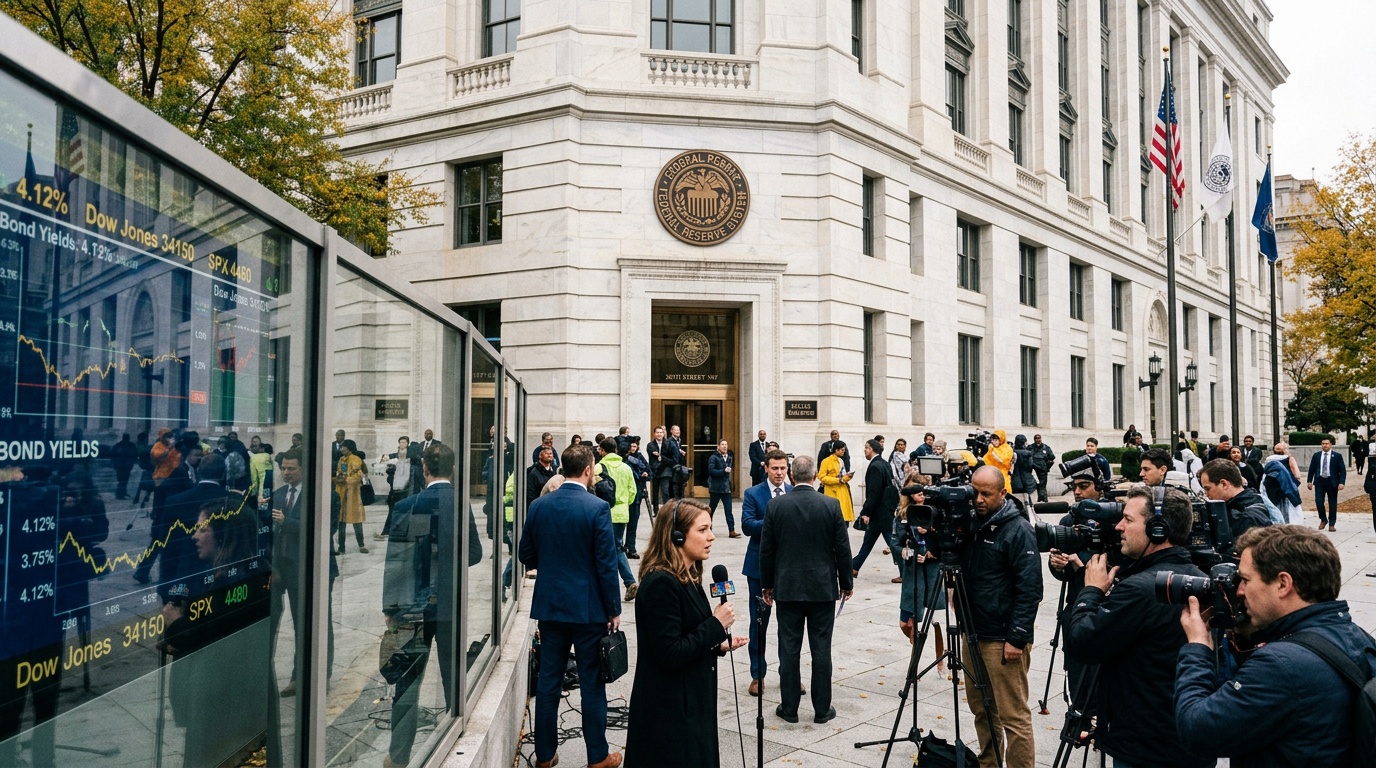
Policy decision draws scrutiny
The Federal Reserve’s latest policy meeting places the future path of interest rates at the center of market attention. The Federal Open Market Committee sets a target range for the federal funds rate, its principal policy tool. That overnight rate influences borrowing costs across the economy, although markets also respond to growth, inflation, and risk. Investors will examine the decision, policy statement, and Chair’s press conference for evidence about future choices. They will also compare the language with previous communications, searching for changes in confidence or concern. A steady rate would not end the debate, because guidance can shift expectations before officials take action. Likewise, a rate change could matter less than signals about the likely pace of subsequent moves. The meeting therefore offers both a current decision and a broader assessment of economic conditions.
How the committee reaches its decision
The FOMC includes seven Board governors and five voting Reserve Bank presidents. The New York Fed president votes permanently, while four other presidents rotate. All twelve Reserve Bank presidents attend meetings and contribute views, even when they do not vote. Officials review staff forecasts, regional information, financial conditions, and risks surrounding the outlook. They pursue a congressional mandate of maximum employment and stable prices. The Fed interprets price stability as two percent inflation over the longer run, measured by the PCE index. Officials assess maximum employment through many labor-market indicators, because no single statistic fully captures that broad goal. Decisions reflect committee judgment, not a mechanical formula tied to one report. Consensus often shapes the outcome, although members can dissent when their preferred policy differs.
What policymakers are watching
Inflation remains central because persistent price pressures can erode purchasing power and destabilize expectations. Officials monitor headline and core measures, with core readings excluding volatile food and energy categories. They examine monthly changes, annual rates, and the breadth of price increases across goods and services. Shelter costs, wages, productivity, and supply conditions can each influence inflation’s direction. Labor data provide another pillar, including payroll growth, unemployment, vacancies, participation, and weekly jobless claims. A cooling labor market may reduce inflation pressure, but abrupt weakness could threaten maximum employment. Policymakers also track consumer spending, business investment, housing activity, credit availability, and gross domestic product. No single indicator determines policy, and individual releases often contain noise or revisions. The committee therefore assesses patterns across several months while weighing risks that may emerge faster.
Why the statement matters
The post-meeting statement is short, but carefully chosen wording can move global markets. It describes current economic conditions, identifies risks, and announces the target range. Changes in adjectives or clauses can reveal how officials view inflation, employment, or uncertainty. Market participants often distinguish between a hawkish message, favoring tighter policy, and a dovish one, favoring easier policy. Those labels simplify a complex debate, yet they help describe the expected direction of rates. The vote count also matters because dissents can expose disagreement about timing or risk management. However, a unanimous decision does not prove that every participant supports the same future path. Officials may agree on today’s setting while holding different forecasts for growth, inflation, and employment. That distinction makes the press conference essential for interpreting the statement’s compressed language.
Projections and the dot plot
At four meetings each year, the Fed publishes its Summary of Economic Projections. Participants provide forecasts for inflation, unemployment, economic growth, and the appropriate federal funds rate. The rate estimates appear as dots, with each dot representing one participant’s view. The chart does not identify individuals, and it does not constitute a committee promise. Its median can show how the center of officials’ expectations has shifted. However, the composition of the committee changes, and forecasts depend on uncertain assumptions. The projections also include ranges and central tendencies, which reveal disagreement beyond the median. Markets sometimes overemphasize one year’s median rate while ignoring uncertainty around the entire path. New data can quickly alter those views, especially when inflation or employment surprises. The dot plot works best as a conditional outlook, not a fixed schedule.
The Chair’s press conference
After the statement, the Fed Chair answers reporters’ questions and explains the committee’s reasoning. The discussion can clarify whether officials need greater confidence before cutting rates or stronger evidence before raising them. Questions often address financial conditions, balance-sheet policy, labor demand, inflation persistence, and the costs of waiting. The Chair usually stresses data dependence, which means officials will respond to the evolving outlook. Data dependence does not mean reacting mechanically to every new statistic. Instead, policymakers consider incoming information, forecast implications, and the balance between inflation and employment risks. Tone can influence markets, particularly when prepared remarks and spontaneous answers seem to point differently. Still, listeners should separate explanations of possible scenarios from firm signals about the next meeting.
How markets translate the message
Bond traders rapidly adjust Treasury yields after the announcement and press conference. Shorter maturities usually respond strongly to expected policy changes, while longer yields incorporate additional forces. Those forces include expected inflation, economic growth, term premiums, and demand for safe assets. Futures contracts can imply probabilities for future rate settings, but those probabilities change continuously. They represent market pricing rather than an official Fed forecast. Stock prices may rise when expected borrowing costs fall, although growth concerns can reverse that response. The dollar often reacts to changes in relative interest-rate expectations between the United States and other economies. Market moves can become volatile when the decision differs from expectations or guidance appears ambiguous. Initial reactions sometimes reverse after investors study the full message.
What rate decisions mean for borrowers
The federal funds rate does not directly set most consumer borrowing rates. However, it affects banks’ funding costs and broader benchmarks used throughout credit markets. Credit card rates and home-equity lines often adjust relatively quickly because many carry variable rates. Auto loans, business loans, and mortgage rates also reflect credit risk, maturity, and market conditions. Fixed mortgage rates commonly track longer-term Treasury yields more closely than the current federal funds rate. Savers can benefit from higher policy rates when banks and money-market funds offer better returns. Transmission takes time, so past rate changes may continue affecting demand after the meeting. That lag complicates policy because officials must act before the full economic impact becomes visible.
Uncertainty keeps the outlook open
The meeting cannot eliminate uncertainty because inflation, hiring, growth, and financial conditions can change unexpectedly. Officials keep options open when risks from acting too early or too late appear balanced. Clear communication guides expectations and explains how policymakers will evaluate fresh evidence before deciding again. Investors should focus on the Fed’s reaction function, rather than one possible rate-change date alone. Future policy will reflect inflation’s progress, labor-market resilience, financial stability, and the broader economic outlook.


