

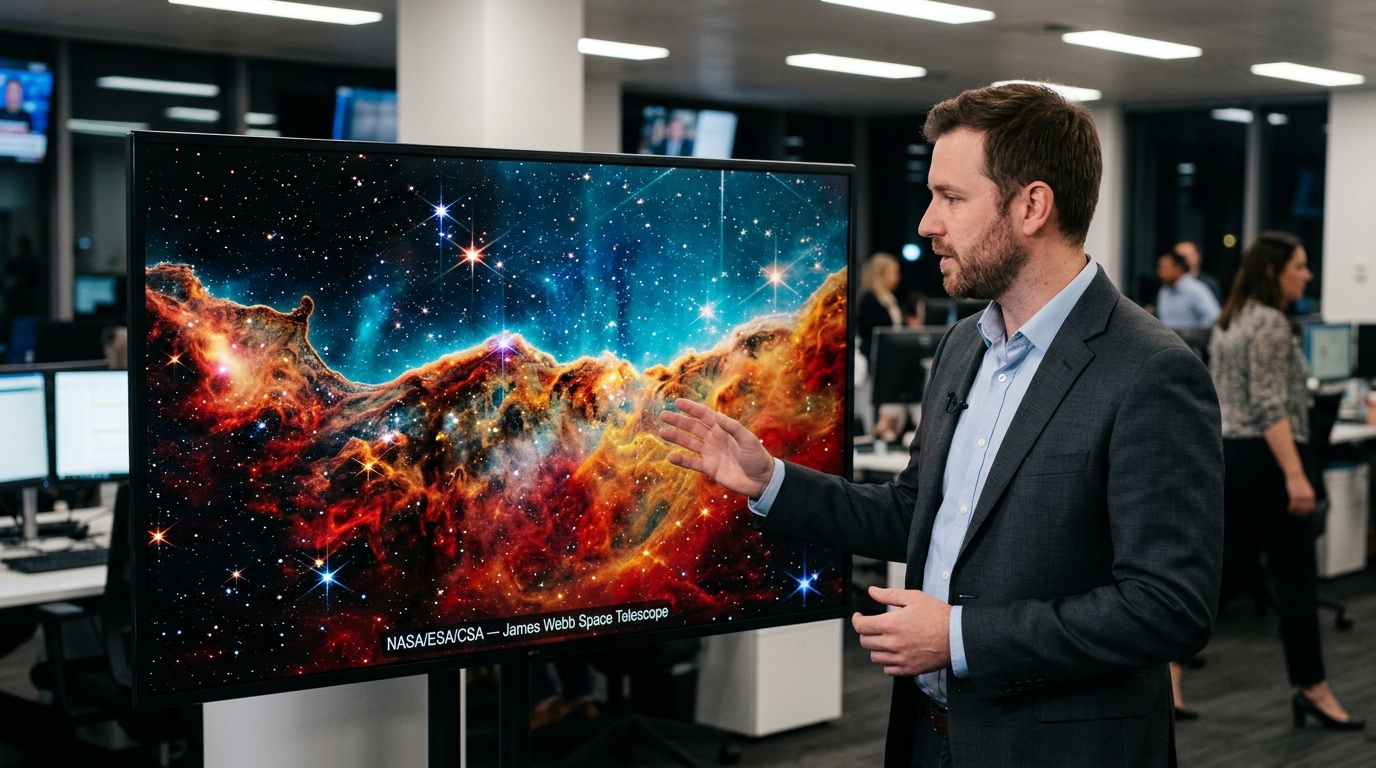
Webb Reveals Fresh Details Inside a Nearby Stellar Nursery
NASA has released new James Webb Space Telescope images that reveal remarkable details inside a nearby star-forming nebula. The observations highlight regions where young stars emerge from thick clouds of gas and dust. Webb’s infrared instruments penetrate material that blocks visible light. Scientists can now examine hidden structures with exceptional clarity. These observations improve understanding of how stars and planetary systems begin their lives.
The newly released images combine scientific value with striking visual detail. Bright newborn stars illuminate surrounding material through powerful radiation and stellar winds. Dark filaments weave through glowing clouds across the nebula. Each feature helps researchers investigate physical processes shaping stellar birth. The observations also provide valuable comparisons with earlier missions and ground-based telescopes.
Why Nearby Nebulae Matter to Astronomers
Nearby nebulae offer excellent laboratories for studying star formation because they remain close enough for detailed observation. Their relative proximity allows astronomers to resolve smaller structures than distant stellar nurseries. Webb’s sharp resolution exposes dense knots where gravity gathers gas into future stars. These observations strengthen models describing the earliest stages of stellar evolution.
Many nearby nebulae contain stars representing different ages and masses. Researchers can compare newborn objects with older neighboring stars inside the same environment. This broad view reveals how local conditions influence stellar growth. It also shows how energetic young stars reshape surrounding clouds over time.
Looking Beyond Visible Light
Webb observes primarily in infrared wavelengths rather than visible light. Infrared light passes through dust more effectively than shorter wavelengths. Hidden stars become visible despite thick surrounding material. Scientists can identify previously unseen objects embedded deep within molecular clouds. This capability represents one of Webb’s greatest scientific strengths.
Infrared observations also reveal warm dust and complex molecules across star-forming regions. Researchers measure temperatures, chemical compositions, and movement inside these clouds. Such information supports detailed investigations of stellar birth. It also improves understanding of environments where planets eventually develop.
How Stars Form Inside Giant Clouds
Star formation begins inside enormous clouds containing hydrogen, helium, and microscopic dust particles. Gravity gradually pulls denser regions together until collapse becomes unavoidable. Material falls toward the center, increasing pressure and temperature. Eventually nuclear fusion ignites within the growing protostar. A new star begins producing its own energy.
The surrounding cloud does not remain unchanged during this process. Powerful radiation pushes against nearby gas and dust. Stellar winds carve cavities and sculpt dramatic pillars throughout the nebula. These changing conditions can trigger additional star formation nearby. They may also halt collapse in neighboring regions.
Webb’s new images capture several stages of this complex sequence simultaneously. Some stars remain deeply embedded within dense cocoons. Others have already cleared away surrounding material. This diversity allows scientists to compare developmental stages across one interconnected environment.
What the New Webb Images Show
The newly released observations display intricate filaments, glowing cavities, and compact clusters of young stars. Bright points scattered throughout the nebula represent recently formed stellar objects. Dust lanes appear darker because they absorb or block shorter wavelengths. Webb’s infrared sensitivity reveals many hidden sources beyond those dark features.
Some regions display shock waves where fast-moving material collides with surrounding gas. These energetic interactions produce distinctive shapes and glowing edges. Scientists analyze such structures to estimate speeds, temperatures, and physical conditions. Each measurement contributes to more accurate theories describing stellar development.
The images also reveal subtle textures that earlier telescopes could not easily distinguish. Fine strands of dust connect larger cloud structures across the nebula. Researchers examine these patterns to understand how gravity, turbulence, and magnetic fields interact. Those forces influence where future stars eventually appear.
Powerful Instruments Behind the Discovery
Webb carries advanced scientific instruments designed for complementary observations. The Near-Infrared Camera captures detailed images across important wavelengths. The Near-Infrared Spectrograph studies light from many objects simultaneously. The Mid-Infrared Instrument examines cooler dust and molecules. Together they provide an unusually complete picture of star-forming environments.
Spectroscopy remains especially valuable because it separates light into individual wavelengths. Scientists identify chemical signatures within gas and dust through those measurements. They detect molecules, estimate temperatures, and calculate motion using subtle shifts in light. These techniques transform beautiful images into rigorous scientific evidence.
Building on Earlier Space Telescope Discoveries
Webb complements rather than replaces previous astronomical observatories. The Hubble Space Telescope continues producing valuable visible and ultraviolet observations. Webb extends those investigations into the infrared spectrum. Combined datasets create a broader understanding of cosmic environments than either mission could achieve alone.
Earlier missions identified many important features inside nearby nebulae. Webb now reveals additional detail within those same regions. Scientists compare observations across different wavelengths to uncover hidden processes. This collaborative approach strengthens confidence in scientific conclusions.
Why These Observations Matter for Planet Formation
Stars often form alongside disks containing gas and dust. Those disks eventually produce planets, moons, asteroids, and comets under suitable conditions. Webb detects important features inside many young stellar systems. Researchers investigate how these disks evolve during their earliest stages.
The telescope also identifies water, carbon-containing molecules, and other ingredients linked to planetary development. Detecting these materials helps scientists understand chemical conditions surrounding newborn stars. Such research supports broader investigations into planetary diversity throughout the galaxy. Every observation adds another piece to that scientific puzzle.
Collaboration Across the Scientific Community
NASA operates Webb through an international partnership with the European Space Agency and the Canadian Space Agency. Scientists from many countries analyze the telescope’s observations. Research teams share data, compare interpretations, and publish peer-reviewed results. This collaborative process improves scientific accuracy and encourages new discoveries.
Public image releases also support education and outreach. Students, educators, and amateur astronomers gain access to remarkable views of the universe. These observations encourage curiosity while demonstrating modern scientific methods. They also highlight the value of long-term space exploration.
The Continuing Webb Mission
Webb continues observing galaxies, exoplanets, stellar nurseries, and objects throughout the solar system. Mission planners schedule investigations addressing many scientific questions across astronomy. Each observing cycle introduces fresh opportunities for unexpected discoveries. The telescope’s capabilities continue exceeding many early expectations.
Future observations of nearby nebulae will expand current findings through repeated measurements and additional targets. Researchers will compare different star-forming regions to identify common patterns and important differences. Those comparisons refine theoretical models describing stellar birth across varied environments. Every new dataset strengthens understanding of cosmic evolution.
NASA’s latest Webb images demonstrate how advanced infrared astronomy transforms knowledge about the universe. Hidden stellar nurseries now appear with extraordinary detail and scientific value. These observations deepen understanding of how stars emerge from dusty clouds. They also illuminate the origins of planetary systems that may resemble our own.
