

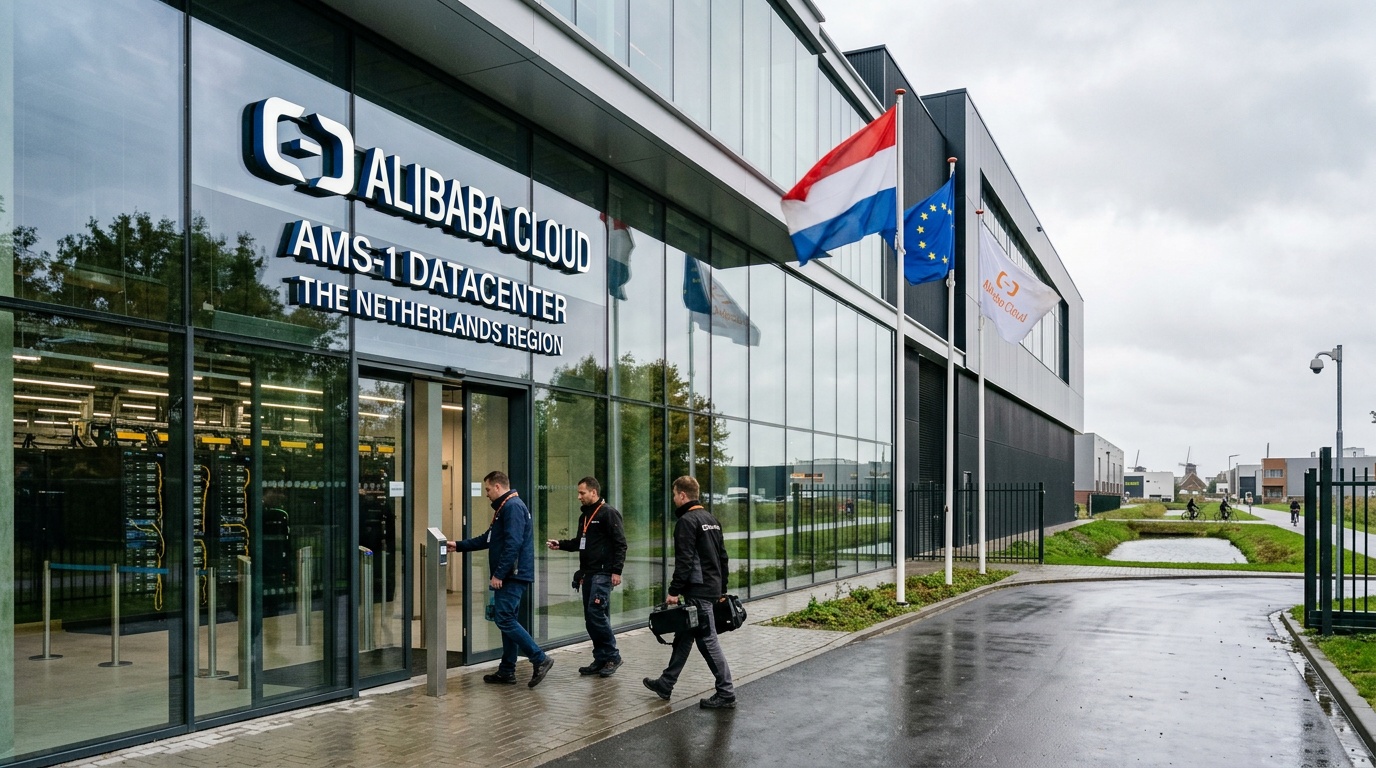
Alibaba Cloud has opened its first public cloud region in the Netherlands, expanding its European infrastructure footprint. The launch gives organizations a local option for running applications, storing information, and using managed cloud services. It also reduces the physical distance between workloads and users across the Netherlands and nearby markets. Alibaba Cloud describes itself as Alibaba Group’s digital technology and intelligence backbone. The new region therefore supports both local customers and international companies operating within Europe.
A public cloud region offers shared infrastructure through standardized online services, while customers control their own resources. They can also scale workloads as demand changes, subject to available services and account limits.
Understanding the new public cloud region
Alibaba Cloud said the region provides core computing, storage, networking, database, and security capabilities. Customers can select the Netherlands when deploying supported products through Alibaba Cloud’s management tools. A regional endpoint can simplify architecture for applications serving Dutch users. It can also lower network delay compared with a location farther from those users. Actual performance still depends on connectivity, application design, service choice, and traffic patterns.
Cloud providers often divide regions into availability zones, which use distinct facilities and supporting systems. Customers must verify the Dutch region’s zone layout and product availability before designing resilient workloads. Service catalogs frequently expand after a region launches. That phased approach lets providers add specialized databases, analytics tools, or accelerator capacity over time.
Why the Netherlands matters
The Netherlands offers dense telecommunications links, a skilled technology workforce, and strong access to continental Europe. Amsterdam hosts AMS-IX, a major internet exchange that connects networks from many countries. National fiber routes and international connections help cloud operators move traffic efficiently. Those strengths have attracted global platforms, colocation providers, and enterprise technology operations. Alibaba’s arrival adds another public cloud choice within that established market.
Location also matters for latency-sensitive services, including commerce, media delivery, industrial systems, and interactive business software. Shorter routes may improve response times, although network peering and application architecture remain important. This proximity may help development teams test and tune services around local usage patterns.
A broader European infrastructure footprint
The Dutch region complements Alibaba Cloud’s established European regions in Germany and the United Kingdom. It gives customers another geographic option rather than replacing those locations. Organizations can choose regions according to user location, legal requirements, service availability, and recovery objectives. Multinational customers may also connect European systems with deployments across Alibaba Cloud’s wider Asian and global network. That reach can appeal to companies trading between Europe and Asia.
Alibaba Cloud competes with large American platforms and established European providers. Amazon Web Services, Microsoft Azure, Google Cloud, Oracle, and local operators already serve Dutch demand. Instead, the region broadens procurement choices and gives existing Alibaba customers a nearby deployment option. Buyers will compare pricing, contracts, certifications, support, product depth, and ecosystem compatibility.
Services and artificial intelligence opportunities
Core cloud capabilities
Core infrastructure services provide the foundation for websites, enterprise software, data platforms, and mobile applications. Managed databases can reduce routine administration, while object storage supports backups and large data collections. Virtual networks help customers isolate systems and control traffic flows. Security products can assist with monitoring, filtering, identity controls, and threat management. However, customers remain responsible for configuration and appropriate access policies.
Potential uses for artificial intelligence
The region may also support artificial intelligence projects that need nearby compute and governed data. Teams could prepare datasets, operate business applications, or connect to available AI services. Specialized model platforms and graphics processors may have separate regional availability. Customers should check Alibaba Cloud’s current catalog before planning production deployments. That verification prevents teams from assuming every global product launched simultaneously in the Netherlands.
Data protection and regulatory responsibilities
Data location remains a central issue for European cloud buyers. The General Data Protection Regulation governs personal data processing across the European Economic Area. Hosting information in the Netherlands can support residency strategies and internal governance requirements. However, local storage alone does not establish GDPR compliance. Organizations must define lawful processing grounds, retention rules, security controls, and individual rights procedures.
Customers also need to examine support access, telemetry, backups, subprocessors, and any international transfers. Contracts and technical settings should reflect those decisions. A cloud provider secures the underlying platform, while customers secure their identities, data, and applications. This shared responsibility continues regardless of the region’s country. Independent audits and certifications can inform procurement, but each buyer must evaluate its own obligations.
Security, availability, and recovery planning
A nearby region creates options, but resilient systems still require deliberate design. Teams should spread critical components across available fault boundaries and remove single points of failure. They should test recovery procedures instead of assuming platform redundancy protects every application. Monitoring must cover performance, capacity, security events, and dependency failures. Clear operational ownership helps teams respond quickly when incidents occur.
Backups need separate protection from production credentials and destructive actions. Some organizations may copy data to another region for disaster recovery. That choice increases resilience but can create additional transfer, cost, and compliance considerations. Encryption should protect sensitive information during transmission and storage. Key management policies must also match the organization’s risk model.
Migration and purchasing considerations
Existing Alibaba Cloud customers can assess whether moving workloads improves latency, governance, or operational consistency. A migration usually begins with application inventories, dependency maps, and data classification. Teams can then compare regional services, quotas, prices, and network routes. Pilot deployments reveal performance issues before a wider transition. A phased plan also limits disruption and gives operators time to update procedures.
Organizations should test management tools, billing, technical support, documentation, and integration options. Contract terms deserve the same attention as technical features. Exit planning matters because applications can become closely tied to proprietary services. Portable architectures can reduce switching difficulty, although they may sacrifice some managed-service advantages. A balanced evaluation connects business needs with measurable technical requirements.
Sustainability and long-term impact
Cloud expansion also raises questions about energy, water, hardware use, and local grid capacity. The Netherlands has scrutinized large data center development because infrastructure affects land and electricity demand. Customers increasingly request emissions information when comparing hosting choices. They should examine provider reporting methods, renewable electricity claims, and workload efficiency. Efficient software and right-sized resources can lower both costs and environmental impact.
Outlook for Alibaba Cloud in Europe
The opening marks a strategic step for Alibaba Cloud in European markets. Its practical impact will depend on customer adoption, service expansion, reliability, and sustained regulatory trust. For Dutch organizations, the region adds another venue for cloud modernization and international growth. For Alibaba Cloud, it strengthens a bridge between its Asian roots and European demand. The next test involves turning local infrastructure into durable customer value.
