

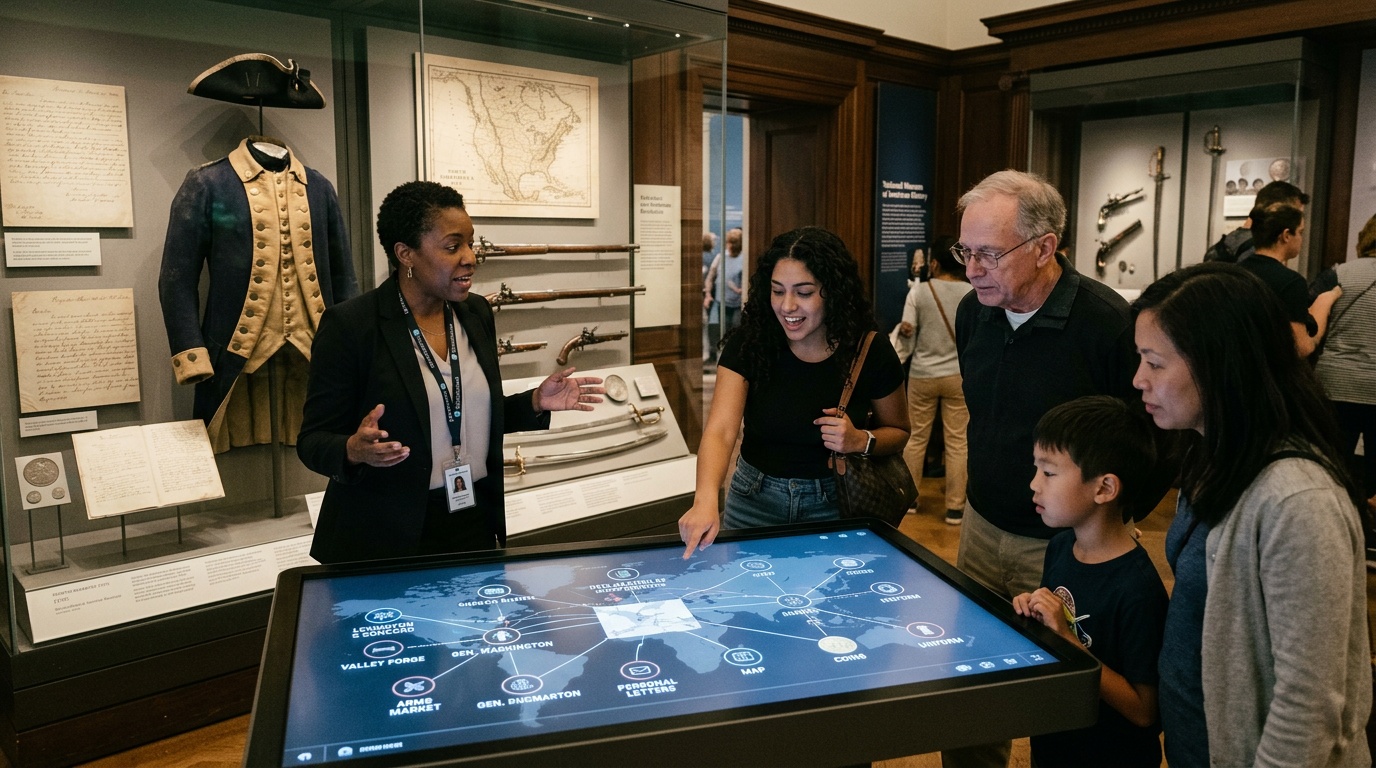
The Smithsonian preserves weapons, portraits, manuscripts, clothing, coins, and everyday objects connected with the American Revolution. These materials sit across several museums, archives, libraries, and research units. That distribution can make related objects difficult to identify.
Smithsonian teams use artificial intelligence to reveal connections within extensive digital collections. AI can compare catalog descriptions, names, dates, locations, and images more quickly than manual research. The technology helps researchers discover relationships that traditional keyword searches may overlook.
Connecting a Dispersed National Collection
No single Smithsonian museum holds every artifact associated with the Revolution. The National Museum of American History preserves military, political, and domestic materials. The National Portrait Gallery holds images of prominent leaders and lesser-known participants. The Smithsonian American Art Museum provides additional visual records of revolutionary memory.
Libraries and archives also preserve letters, books, maps, and institutional records. Other Smithsonian units document Indigenous, African American, scientific, and international perspectives. AI-assisted discovery can bring those separate resources into a more connected research environment.
Why Traditional Searches Miss Relationships
Collection records developed under different standards during different periods. One catalog may use a person’s full name. Another may include a title, nickname, or outdated spelling. Place names also changed as colonies became states and settlements expanded.
A basic search usually depends on exact words entered by the user. AI systems can recognize related concepts and alternative forms of a name. They can also identify dates, organizations, battles, occupations, and geographic references within descriptive text.
How Artificial Intelligence Finds Connections
Natural language processing allows computers to analyze written collection descriptions. The software can extract names, places, events, and dates from structured fields and longer notes. It may then compare those details across thousands of records.
Machine-learning tools can group records with similar language or subject matter. Computer vision can examine visual features within digitized paintings, prints, photographs, and three-dimensional objects. Together, these methods can suggest connections for curators and historians to investigate.
Building Networks Around People and Events
A connected system can organize information around historical people rather than individual objects. A soldier might appear in a portrait, military record, family letter, and commemorative medal. AI can help place those records within one searchable network.
The same method can connect materials with battles, political debates, trade routes, or diplomatic missions. Researchers can follow a location across maps, objects, and documents. This networked approach presents history as a series of relationships rather than isolated catalog entries.
Digitization Provides the Essential Foundation
Artificial intelligence cannot analyze an artifact without usable digital information. Museums must photograph objects, scan documents, create metadata, and maintain reliable databases. Those processes require specialized staff, equipment, funding, and long-term planning.
The Smithsonian launched its Open Access initiative in 2020. It released millions of digital images and collection records for unrestricted public reuse. The institution applies a Creative Commons Zero designation when rights and restrictions allow that release.
Human Transcription Improves Machine-Readable Records
Handwritten documents create another challenge because older scripts can confuse automated recognition software. The Smithsonian Transcription Center invites volunteers to transcribe and review digitized materials. Their work transforms difficult handwriting into searchable text.
Accurate transcriptions give AI systems better information to analyze. They also help readers with visual impairments and researchers who cannot visit Washington. Human participation therefore remains central to the Smithsonian’s broader digital strategy.
Revealing Broader Revolutionary Stories
Revolutionary history extends beyond famous generals, political leaders, and battlefield victories. Women managed farms, businesses, households, and supply networks during the conflict. Enslaved and free African Americans made difficult choices about military service, freedom, family, and survival.
Indigenous nations pursued their own diplomatic and military strategies. France, Spain, Britain, the Netherlands, and Caribbean colonies shaped the war’s direction. Connected collections can help audiences examine those intersecting experiences.
Objects Can Challenge Familiar Narratives
A uniform may reveal military rank, manufacturing practices, and international supply chains. A household object can document labor, consumption, or wartime shortages. A portrait may communicate political status while hiding unequal access to power.
AI does not interpret those meanings independently. Instead, it directs specialists toward patterns that deserve closer examination. Curators can then compare physical evidence, documentary sources, provenance records, and established scholarship.
Supporting Exhibitions and Public Research
Connected records can help curators identify potential loans, supporting documents, and related images. They can also reveal objects that rarely appear in galleries. That capability matters because museums display only a limited portion of their holdings.
For visitors, connected collections can support digital timelines, maps, educational resources, and thematic online exhibitions. Teachers can compare evidence from several Smithsonian units. Students can trace how one person or event appears through different historical sources.
Preparing for the Nation’s 250th Anniversary
The United States marks the Declaration of Independence’s 250th anniversary on July 4, 2026. That milestone has increased public interest in revolutionary history and the nation’s founding promises. Smithsonian collections provide evidence for examining both achievements and contradictions.
AI-assisted connections can support that examination without imposing one fixed story. Audiences can explore independence alongside slavery, displacement, civil rights, political representation, and international conflict. The technology expands access to evidence behind those discussions.
Accuracy, Bias, and Historical Context
AI-generated connections require careful review because collection records contain gaps and historical biases. Earlier catalogers sometimes used outdated terminology or incomplete descriptions. Some communities appear extensively in official documents, while others remain underrepresented.
Algorithms can repeat those imbalances when they rely entirely on existing data. They can also connect people incorrectly when several individuals share a name. Smithsonian specialists must evaluate suggestions before presenting them as reliable historical relationships.
Provenance Still Requires Expert Investigation
Provenance records document an object’s ownership, movement, and custody. AI can locate repeated names or matching dates within those records. However, it cannot automatically resolve every uncertainty or confirm every attribution.
Curators must examine original documents, physical characteristics, and acquisition histories. Conservators may analyze materials and manufacturing techniques. Historians then compare the findings with primary sources and credible scholarship.
Human Expertise Remains Essential
The Smithsonian uses technology to assist research rather than replace professional judgment. Machines can process large amounts of information and propose useful patterns. People determine whether those patterns carry historical significance.
Community knowledge also strengthens collection records. Descendant communities may identify people, places, cultural practices, or meanings absent from older catalogs. Responsible digital work should preserve those contributions and explain how institutions use them.
A More Accessible Path Through History
AI-supported discovery can make Smithsonian collections easier to navigate from classrooms, homes, and research centers. It can connect a familiar artifact with documents and perspectives that deepen its meaning. Those links encourage visitors to ask new questions.
The strongest results combine digitization, accurate metadata, human review, and transparent methods. AI provides speed and scale, while historians provide context and accountability. Together, those resources can present the American Revolution as a complex, connected, and continuing national story.
