

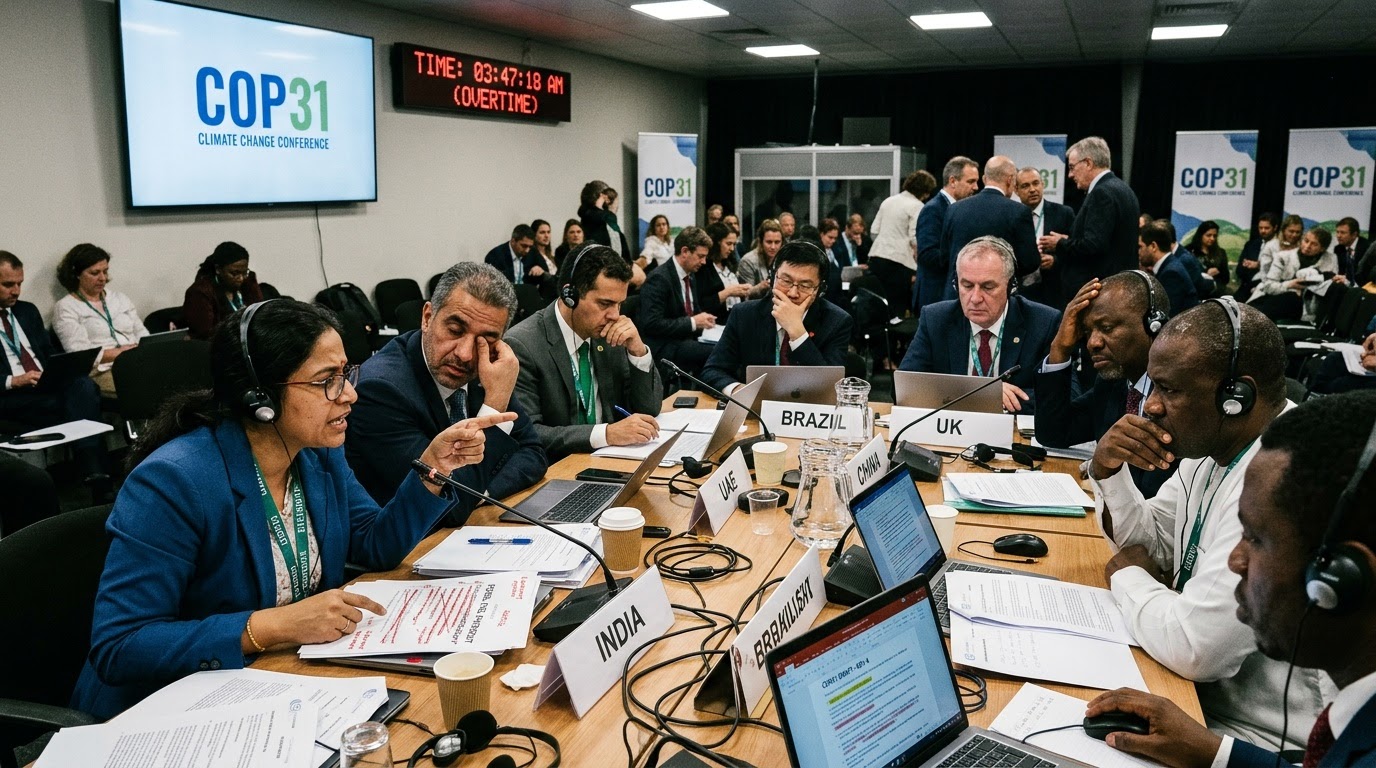
Negotiators at COP31 pushed talks into overtime after ministers failed to bridge divisions over fossil fuels and climate finance. The delay kept delegations working through revised texts, informal meetings, and consultations among political leaders. Countries agreed that climate action must accelerate, but they disputed who should move first and who should pay.
The final hours matter because United Nations climate decisions normally require consensus among nearly 200 parties. Any delegation can block agreement, although presidents seek wording every government can accept. That process often produces compromises, yet small phrases can carry major economic consequences. Türkiye hosted the summit in Antalya, while Australia led negotiations under a compromise between the two governments.
Fossil fuel language drives division
The sharpest dispute concerned how COP31 should address coal, oil, and gas after earlier climate commitments. At COP28, countries agreed to transition away from fossil fuels in energy systems in a just, orderly, and equitable manner. They also backed faster renewable energy deployment and stronger energy efficiency improvements during this decade. Many governments now want language that turns those broad commitments into measurable national action.
Supporters of stronger wording sought clearer timelines, regular progress reviews, and limits on new fossil fuel dependence. Small island states and climate-vulnerable countries linked that demand directly to survival under accelerating sea-level rise. Several developed and Latin American countries also argued that markets need stronger signals for clean investment. They said another general declaration would not close the growing gap between promises and implementation.
Fossil fuel-producing nations resisted language they viewed as prescriptive, discriminatory, or detached from national circumstances. Some emphasized emissions reductions rather than the sources producing those emissions. They promoted carbon capture, methane controls, and other technologies as alternatives to explicit production restrictions. Emerging economies also warned that abrupt limits could threaten energy access, industrial growth, and public revenues.
Finance exposes a deeper divide
Climate finance created the second major obstacle, with countries contesting both the scale and structure of future support. Developing nations argued that grants and highly concessional funding remain essential for adaptation and unavoidable climate losses. They warned that additional loans can deepen debt burdens in countries already facing disasters and high borrowing costs. Donor governments highlighted budget constraints and called for wider contributions from wealthier emerging economies.
The argument builds on the finance agreement reached at COP29 in Baku. That deal set a goal of at least $300 billion annually for developing countries by 2035. It also called for scaling finance from public and private sources toward $1.3 trillion annually by 2035. Developing countries said the smaller figure remained far below their needs, especially when inflation and debt costs matter.
At COP31, negotiators debated how to track delivery and distinguish genuine support from ordinary investment flows. Recipient countries sought transparent accounting for grants, loans, guarantees, and mobilized private capital. They also pressed developed countries to publish predictable funding plans rather than announce irregular pledges. Without those details, vulnerable nations argued, headline totals could obscure weak public support and expensive financing.
Finance also shaped the fossil fuel debate, since poorer countries cannot replace infrastructure without affordable capital. A coal-dependent economy needs grids, storage, worker protections, and new industries alongside renewable generation. An oil-exporting state may need revenue diversification before global demand falls more sharply. These realities strengthened calls for a just transition package rather than an isolated energy target.
Adaptation remains in the bargain
Adaptation funding added another layer to negotiations as extreme weather continued straining national budgets. Developing countries requested stronger commitments for resilience, early-warning systems, agriculture, water, and public health. Many donors accepted the urgency but resisted formulas that automatically assigned new financial liabilities. Negotiators also examined indicators for measuring progress under the global goal on adaptation.
Loss and damage need delivery
Loss and damage discussions raised similar concerns about access, speed, and funding adequacy. Vulnerable states want the dedicated fund to deliver money quickly after devastating climate impacts. They also want simpler applications because limited administrative capacity can delay assistance. Contributors, meanwhile, face pressure to replenish the fund while supporting adaptation and mitigation programs.
Overtime moves talks behind doors
As the deadline passed, the presidency circulated new drafts designed to narrow options and remove disputed brackets. Ministers then met in smaller groups, where facilitators tested compromise language away from formal plenary speeches. Such meetings can unlock agreement, but excluded delegations may challenge texts they did not help shape. The presidency therefore had to balance speed, transparency, regional representation, and political trust.
Possible compromises centered on implementation rather than imposing identical fossil fuel policies on every country. Negotiators considered language recognizing different national pathways while reaffirming previously agreed global energy goals. Another approach could pair stronger transition language with finance, technology transfer, and capacity-building commitments. However, each addition creates new questions about responsibility, timelines, and verification.
The outcome will shape national plans
The talks also carried consequences for countries’ nationally determined contributions under the Paris Agreement. Those plans describe national emissions targets and policies, while reflecting different capabilities and circumstances. A weak outcome could reduce pressure for stronger implementation during the critical period before 2030. A credible package could instead guide legislation, investment decisions, and international cooperation.
Scientific assessments frame the urgency behind the diplomatic bargaining. The Intergovernmental Panel on Climate Change says every increment of warming increases risks and damages. Global emissions must fall rapidly to preserve a viable chance of limiting warming near 1.5 degrees Celsius. Yet energy security, development needs, and geopolitical tensions continue shaping government choices.
The final balance carries wider stakes
Observers watched whether the final text would preserve earlier commitments or weaken them through qualifications. They also tracked whether finance provisions included deadlines, reporting rules, and identifiable sources. Civil society groups demanded language protecting human rights, Indigenous peoples, workers, and affected communities. Business groups sought predictable rules that could support long-term investment and reduce policy uncertainty.
Overtime does not guarantee ambition, and prolonged sessions can exhaust smaller delegations with limited staff. Still, extra hours can create political space when leaders face the costs of failure. A collapse would leave major disputes unresolved and could weaken confidence in multilateral climate cooperation. An agreement would still depend on national implementation, domestic budgets, and sustained international pressure.
COP31’s final balance will rest on whether countries connect energy transition demands with credible financial support. Stronger fossil fuel language without resources may appear unfair to poorer economies. More finance without clear mitigation progress may remain unacceptable to contributors and climate-vulnerable states. Negotiators must reconcile both concerns before the conference can close with a defensible package. Until then, overtime will continue exposing the central bargain that has shaped climate diplomacy for decades.


