

What the outage actually involved
The global technology disruption on July 19, 2024, stopped flights, delayed medical care, and interrupted payments across continents. Many reports called it a Microsoft outage because failed computers displayed Windows error screens. However, Microsoft did not release the defective update that caused the largest disruption. Cybersecurity company CrowdStrike distributed that update to its Falcon security software. The distinction matters because the incident exposed dependence across connected technology layers.
At 04:09 UTC, CrowdStrike released a Falcon sensor configuration update for Windows hosts. The update contained defective data within a content file used by the security platform. Affected machines crashed and entered repeated restart cycles, often called boot loops. Mac and Linux systems running CrowdStrike software did not experience the same failure. CrowdStrike identified the problem, reverted the change, and published recovery instructions.
The company said the event was neither a cyberattack nor a security breach. Microsoft later estimated the update affected 8.5 million Windows devices. That figure represented less than one percent of all Windows machines. Yet those devices supported many essential operations, amplifying their failure far beyond their numbers. Recovery also required hands-on work for many encrypted or remotely managed computers.
Concentration turned one defect into systemic disruption
The incident revealed concentration at both the platform and security layers. Organizations worldwide use Windows for employee devices, servers, kiosks, scheduling systems, and operational tools. Many also select CrowdStrike to monitor threats across those same computers. A single faulty update therefore reached unrelated businesses through a shared, trusted channel. The resulting failures appeared simultaneously, despite differences among industries and countries.
Automatic updates usually improve security because they distribute protections against new threats quickly. Security vendors also need privileged access to detect malicious behavior inside operating systems. Those strengths become hazards when defective code or content bypasses effective safeguards. Fast deployment then increases the blast radius before customers can intervene. The consequences showed how this tradeoff could disrupt ordinary life.
Consequences moved quickly into daily life
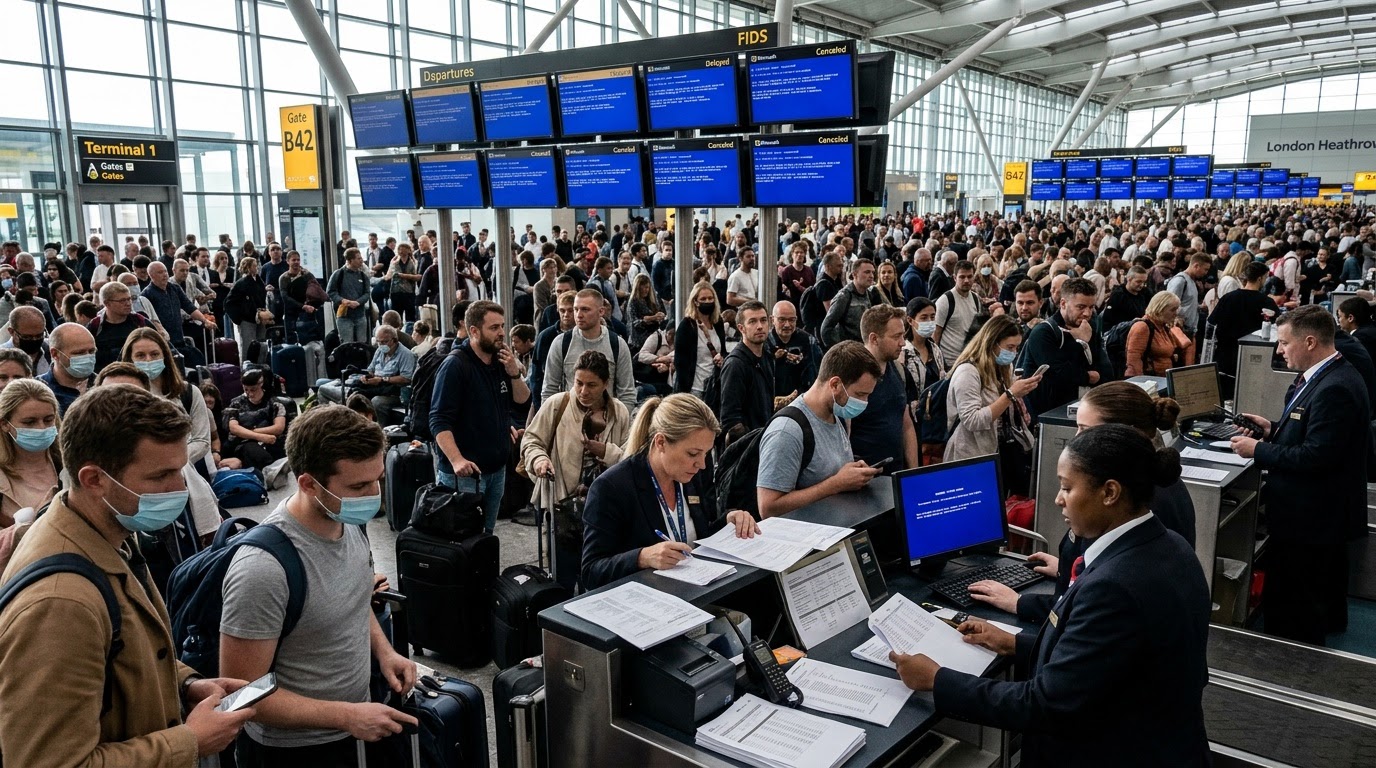
Airlines grounded or delayed thousands of flights because check-in, dispatch, and crew systems became unavailable. Passengers encountered queues, missed connections, and limited information at airports. Some carriers recovered faster than others, reflecting architectures and contingency plans. Delta Air Lines reported canceling about 7,000 flights over several days. The disruption continued after many affected computers returned to service.
Healthcare providers postponed appointments, lost access to records, and switched to manual procedures. Britain’s National Health Service reported disruption to primary care services, including general practices. Some hospitals in the United States delayed procedures or redirected patients. Emergency services in several locations reported temporary communications problems. These effects turned a software defect into a public safety concern.
Banks, retailers, broadcasters, government offices, and logistics companies also reported interruptions. Payment failures prevented some customers from completing ordinary purchases. Media organizations lost production tools, while workers faced inaccessible corporate systems. Parametrix estimated direct United States Fortune 500 losses, excluding Microsoft, at about $5.4 billion. Such estimates vary, but they illustrate how shared infrastructure can create correlated economic losses.
Why familiar continuity plans proved insufficient
Many continuity plans assume a local outage, regional disaster, or isolated supplier failure. This event affected customers, vendors, and support channels at the same time. Companies could not always borrow equipment or redirect work to unaffected partners. Technical staff also faced the same broken laptops as other employees. Traditional redundancy offered limited protection when backup systems shared identical software.
Some recovery steps required technicians to start machines in safe mode and remove the defective file. BitLocker encryption complicated access when organizations could not retrieve recovery keys. Remote management tools often failed because the target computer could not boot normally. Large companies sometimes had to repair thousands of endpoints individually. That labor-intensive process extended disruption long after CrowdStrike corrected the update.
Supplier diversity also proved more complicated than simply buying services from two vendors. Both suppliers may depend on the same cloud, identity provider, network, or operating system. A company can therefore purchase apparent redundancy without gaining genuine independence. Procurement teams need architectural maps that reveal hidden fourth-party dependencies. This visibility creates the foundation for stronger resilience measures.
Building resilience without abandoning shared platforms
Organizations cannot realistically replace every major platform, and concentration sometimes delivers security and efficiency benefits. Instead, leaders should identify services whose failure would halt safety-critical or revenue-critical work. They should then define recovery priorities, acceptable downtime, and manual alternatives. Critical teams need printed procedures and offline contact information. Regular exercises should test those resources under realistic conditions.
Companies can limit update risk through staged deployment rings and carefully selected test systems. Vendors should release changes to small groups before expanding distribution. Customers need controls that pause nonessential updates when early warning signals appear. However, delays must remain short enough to preserve protection against active threats. Good governance balances update speed against the potential blast radius.
Resilient architecture also separates critical functions across different failure domains. An emergency communications service should not depend entirely on ordinary employee devices. Recovery keys, system images, and essential documentation should remain securely available offline. Organizations should test restoring representative machines, not merely confirm that backups exist. Testing exposes missing permissions, outdated instructions, and unrealistic recovery timelines.
Boards and executives must treat technology concentration as an enterprise risk, not only an information technology issue. Contracts should specify incident communications, testing expectations, audit rights, and recovery support. Metrics should measure dependency depth, restoration time, and the number of systems sharing common components. Cyber insurance can absorb some losses, but it cannot restore flights or medical appointments. Financial transfer never replaces operational preparedness.
Regulators and providers face wider responsibilities
Regulators increasingly expect firms to understand and manage technology suppliers beyond direct contracts. The European Union’s Digital Operational Resilience Act became applicable in January 2025. It requires covered financial entities to manage information technology risks and oversee critical providers. Other authorities have also strengthened rules for incident reporting, operational testing, and third-party oversight. These measures reflect concern that private failures can create systemic consequences.
Technology providers carry important responsibilities because customers cannot inspect every internal control. Providers should test updates across diverse environments and improve automated rollback mechanisms. They should also give customers timely, precise, and usable recovery guidance. Transparent post-incident reviews can help customers adjust architecture and procedures. Market power should bring stronger engineering discipline, not weaker accountability.
The July outage did not prove that large technology providers are unsafe. It showed that efficiency and standardization can concentrate failures across society. Resilience therefore requires more than purchasing backup capacity or signing another supplier. Organizations must understand shared dependencies, rehearse recovery, and preserve workable alternatives. Governments and providers must support those efforts with oversight, transparency, and safer deployment practices. The next faulty update may differ, but the concentration risk will remain.
