

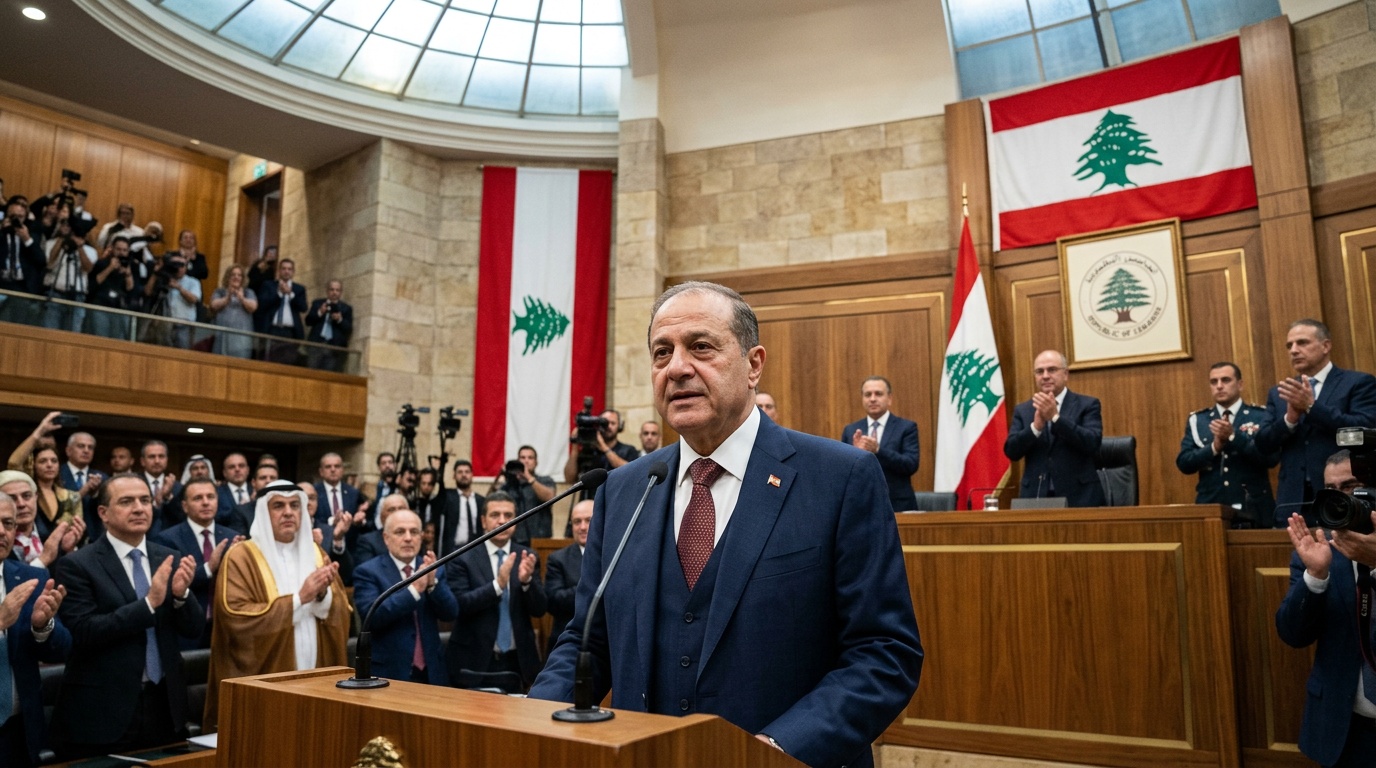
Lebanon’s parliament elected army commander Joseph Aoun president on January 9, 2025, ending a vacancy that lasted over two years. Lawmakers gave Aoun 99 votes during a second ballot in the 128-seat legislature. His victory restored a head of state after repeated parliamentary failures and deep political division. The breakthrough also followed major regional changes and a devastating conflict between Israel and Hezbollah.
Aoun took the oath immediately and addressed lawmakers from Beirut’s parliament building. He promised to strengthen state institutions, enforce laws, and rebuild public trust. He also pledged that only the state should carry weapons, a sensitive message for Hezbollah.
A decisive parliamentary vote
The first ballot exposed remaining resistance. Aoun secured 71 votes, falling short of the two-thirds threshold of 86. Thirty-seven lawmakers cast blank ballots, while others used protest votes or supported alternative names. Speaker Nabih Berri then suspended the session for consultations among parliamentary blocs. During that break, Hezbollah and its Shiite ally, the Amal Movement, agreed to support Aoun.
The second ballot produced a decisive result. Aoun received 99 votes, comfortably exceeding the required majority and demonstrating broad cross-party backing. His election became Parliament’s thirteenth attempt to choose Michel Aoun’s successor.
A constitutional question
Aoun’s candidacy also raised a constitutional question. Article 49 restricts senior public employees from seeking the presidency while serving, or within two years after leaving office. Parliament did not approve a separate constitutional amendment before voting. Supporters argued that Aoun’s broad result provided sufficient legitimacy, especially because lawmakers had accepted military precedents. Other experts maintained that Parliament should have amended Article 49 explicitly.
How the presidential vacuum persisted
Michel Aoun, who is unrelated to Joseph Aoun, completed his six-year term on October 31, 2022. Parliament then failed twelve times to elect a successor. No alliance controlled enough seats to impose a candidate. Rival blocs also left sessions after opening ballots, breaking the quorum needed for further voting. The repeated failures left Lebanon without a president for about 26 months.
Najib Mikati’s caretaker government managed daily affairs during the vacancy, but its restricted status complicated major decisions. Lebanon’s confessional system also made presidential bargaining inseparable from wider negotiations over power. Political convention assigns the presidency to a Maronite Christian and the premiership to a Sunni Muslim. It assigns the parliamentary speakership to a Shiite Muslim. Parliament elects the president, so parties must build legislative agreement rather than win a direct national vote.
Why compromise became possible
Former minister Suleiman Frangieh had remained Hezbollah’s preferred candidate for much of the vacancy. Frangieh withdrew on January 8 and endorsed Aoun, clearing a major obstacle before Parliament met. Hezbollah and Amal initially withheld support during the first ballot, then backed Aoun after consultations. Their switch gave the army commander support across Lebanon’s principal sectarian and political camps.
Beyond domestic bargaining, international diplomacy reinforced the negotiations. Envoys from France, the United States, Saudi Arabia, Qatar, and Egypt repeatedly urged leaders to elect a president. This five-country group linked institutional stability with reconstruction, financial assistance, and long-delayed economic reforms. US envoy Amos Hochstein visited Beirut before the vote. Saudi envoy Yazid bin Farhan also met rival factions before the session.
Hezbollah entered the election after war with Israel killed senior leaders, displaced civilians, and devastated many communities. Israel killed Hassan Nasrallah in September 2024, sharply weakening Hezbollah’s established command. Syrian rebels then toppled Bashar al-Assad in December, removing another crucial Hezbollah ally. These events changed calculations among factions that had previously blocked compromise.
A military career during repeated crises
Joseph Aoun was born in Sin el-Fil in 1964 and joined the Lebanese Army in 1983. The Cabinet appointed him army commander in March 2017. He is not related to former president Michel Aoun, despite their shared surname. His military career gave him limited partisan baggage compared with many established politicians.
Months after his appointment, Aoun led the Dawn of the Outskirts offensive against Islamic State militants near Syria. The operation removed militants from positions near Lebanon’s northeastern border, although Hezbollah and Syrian forces fought nearby. During the 2019 protests, the army often stood between demonstrators and rival groups, though confrontations still occurred. Aoun later kept the military functioning as Lebanon’s currency collapse destroyed salaries and strained morale. Foreign donors, especially the United States, provided equipment, training, and emergency support.
Promises in the inaugural address
After taking the oath, Aoun declared a new phase for Lebanon and promised to respect the Constitution. He said the state must hold the exclusive right to bear arms. That pledge directly addressed the central dispute over Hezbollah’s independent arsenal. Aoun also promised a national defense strategy, stronger border control, and action against smuggling.
He called for judicial independence and pledged to fight corruption, organized crime, and political interference. He promised to protect depositors and pursue economic reforms after Lebanon’s financial collapse. Aoun also emphasized rebuilding areas damaged by Israeli attacks and returning displaced residents. He sought stronger relations with Arab countries, which had cooled amid Hezbollah’s growing influence. Together, these commitments established ambitious tests for a presidency with limited executive powers.
Presidential powers and a new government
Lebanon’s president appoints the prime minister after binding parliamentary consultations and signs government formation decrees. The president can return legislation for reconsideration and chair Cabinet meetings when attending them. However, the postwar Constitution shifted substantial executive authority to the Council of Ministers. Aoun therefore needs cooperation from the prime minister, Cabinet, and Parliament to carry out his agenda. That requirement quickly moved attention toward forming a functioning government.
On January 13, parliamentary consultations gave former judge and diplomat Nawaf Salam support to become prime minister. Aoun designated Salam, who then served as president of the International Court of Justice. Salam formed a 24-member government on February 8, replacing Mikati’s caretaker administration. The transition filled another institutional gap and opened a path for policy decisions.
Security and economic challenges
The most urgent security challenge lay in southern Lebanon, where a November 2024 ceasefire halted the Israel-Hezbollah war. The agreement called for Lebanese troops to deploy alongside UN peacekeepers as Hezbollah removed weapons south of the Litani River. It also required Israeli forces to withdraw, although implementation encountered delays and disputes.
Lebanon’s banking collapse had trapped deposits, devalued the currency, reduced incomes, and expanded poverty since 2019. Electricity shortages and weak public services further eroded confidence in the state. An initial 2022 agreement with the International Monetary Fund remained unfinished because leaders delayed required reforms. The conflict added billions of dollars in damage and losses to an already formidable economic burden.
A breakthrough, not a final resolution
Aoun’s election ended the presidential vacuum, but it did not erase Lebanon’s factional rivalries. Parliament remained fragmented, while Hezbollah’s weapons and Israel’s military actions continued generating tension. Success would depend on enforcement, coalition building, foreign support, and public confidence. Still, the 99-vote result showed that lawmakers could reach agreement after years of paralysis. Lebanon finally gained a president, allowing its institutions to confront challenges that the deadlock had left unresolved.
