
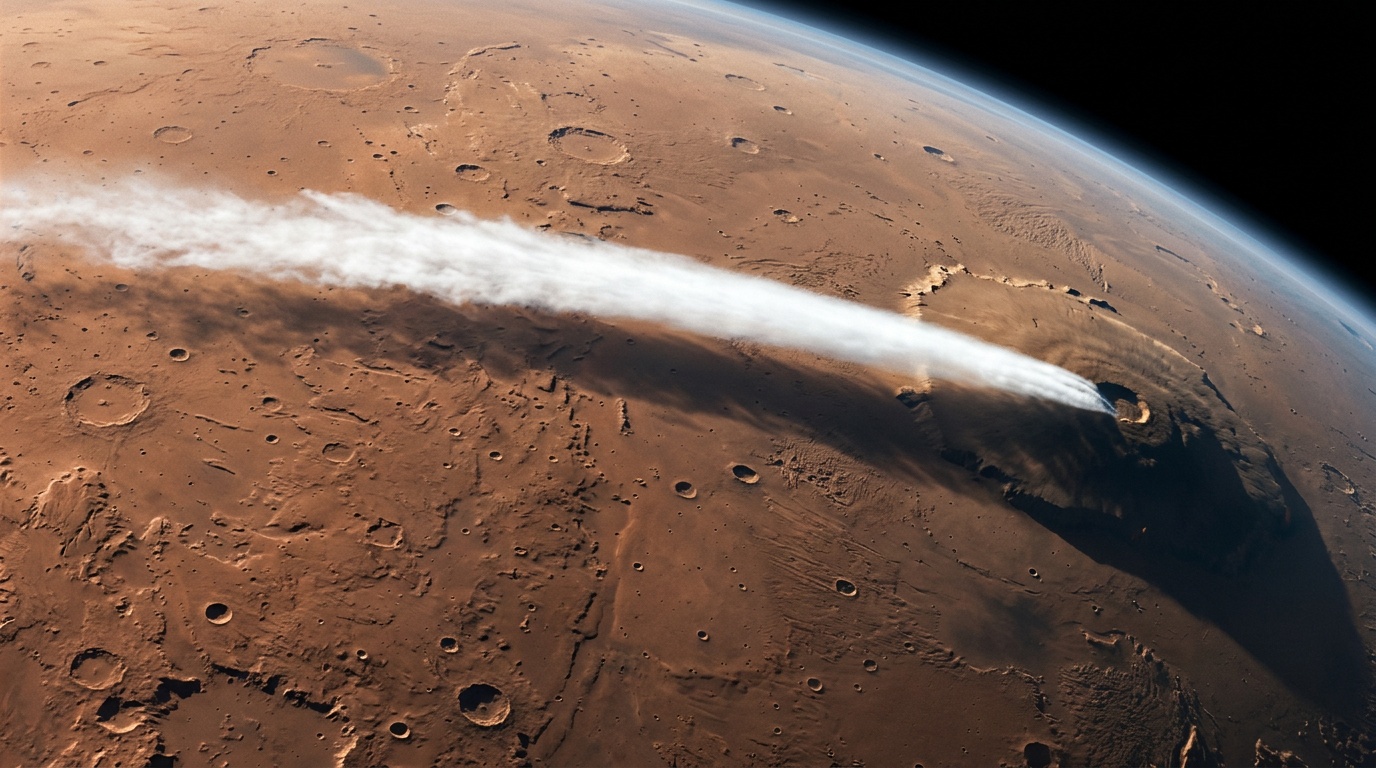
A cloud on a planetary scale
During certain Martian seasons, a brilliant cloud develops near Arsia Mons shortly before sunrise. It then streams westward for hundreds of miles, becoming visible even to modest orbital cameras. At maximum extent, the plume can reach about 1,800 kilometers, or roughly 1,100 miles. That extraordinary length inspired descriptions of Mars’ daily 1,000-mile cloud.
Despite its dramatic appearance, the feature does not signal an eruption. Scientists identify it as a water-ice cloud shaped by winds, temperature changes, and towering terrain. Its repeated schedule offers researchers a natural experiment in Martian weather. Yet models still struggle to reproduce every stage of its rapid growth and disappearance.
The volcano behind the spectacle
Arsia Mons rises along Mars’ Tharsis volcanic province, a vast elevated region near the equator. The shield volcano reaches about 18 kilometers above Mars’ reference datum, although estimates vary. Its broad flanks redirect air moving across the plateau, creating strong vertical disturbances. Those disturbances provide the cloud’s essential atmospheric trigger.
Mars hosts three other enormous volcanoes nearby, including Olympus Mons and Arsia’s Tharsis Montes neighbors. However, Arsia Mons produces the most conspicuous recurring elongated plume observed there. Researchers therefore examine its slope geometry, regional winds, and local temperatures for a special combination. That comparison leads directly to the cloud’s daily formation cycle.
How the morning plume forms
Before dawn, winds push relatively moist air upward along Arsia Mons’ western flank. Rising air expands as pressure falls, causing temperatures to drop rapidly. Water vapor then condenses around airborne dust particles, producing tiny ice crystals. Planetary scientists call this terrain-driven process orographic cloud formation within the thin Martian atmosphere.
The cloud’s bright head forms near the volcano, at altitudes around 45 kilometers in some analyses. Strong winds stretch ice particles westward, creating a narrow tail across the morning sky. This process resembles mountain clouds on Earth, but Mars magnifies the scale. Understanding that scale requires following the plume minute by minute.
Growth at remarkable speed
Observations indicate that the tail can lengthen at roughly 600 kilometers per hour during its fastest growth. Within several hours, it may span distances comparable with major portions of Europe. The plume remains relatively narrow, sometimes measuring around 150 kilometers across. These proportions create the striking impression of a white ribbon.
Sunrise eventually warms the atmosphere and changes the winds supporting condensation. The cloud separates from Arsia Mons, drifts onward, and dissipates before later daylight observations. Its complete cycle can unfold within about three morning hours. Consequently, spacecraft arriving at the wrong local time can miss everything.
A seasonal clock on Mars
The plume does not appear every day throughout the Martian year. It returns during a defined season around southern spring and summer. Researchers have tracked activity for weeks near southern summer solstice, when regional circulation favors formation. Mars takes about 687 Earth days to orbit the Sun, so opportunities arrive slowly.
Individual mornings follow a consistent timetable, although length, brightness, and timing vary. Seasonal temperature patterns alter available water vapor and the winds crossing Tharsis. Dust abundance also affects how sunlight heats the atmosphere and where ice can nucleate. This dependable rhythm helps observers plan scarce early-morning measurements.
A camera rescued from obscurity
ESA’s Mars Express orbiter supplied many crucial views through its Visual Monitoring Camera. Engineers originally installed the simple camera to confirm Beagle 2’s separation in 2003. Later, teams revived it for public imaging and scientific monitoring. Its wide field proved ideal for capturing a structure too large for narrower instruments.
Mars Express also carries higher-resolution instruments, which helped place the cloud within its geographic and atmospheric context. The orbiter’s changing viewing geometry sometimes revealed the plume near the limb before sunrise. Combining broad images with detailed data gave scientists both continuity and precision. That partnership transformed casual pictures into a valuable atmospheric record.
Old images reveal a long history
The cloud gained broad attention after clear observations during 2018. That year’s global dust storm altered the atmosphere, but the storm did not create the recurring phenomenon. However, investigators found similar elongated clouds in older spacecraft archives. Viking observations from the 1970s showed that the phenomenon was not new.
Archival work lets researchers compare several Martian years without waiting decades. Each recovered image constrains the season, local time, cloud length, and viewing angle. These comparisons show recurring behavior alongside meaningful year-to-year differences. The historical record therefore shifts the question from whether it repeats to why details change.
Why scientists remain puzzled
Scientists understand the broad orographic mechanism, so the entire cloud is not inexplicable. The puzzle lies in reproducing its exceptional length, altitude, timing, and rapid detachment. Models must represent steep terrain, thin air, ice microphysics, dust, and changing winds together. Small errors in any ingredient can produce a very different plume.
Researchers also ask why Arsia Mons displays this behavior more prominently than neighboring giants. Its location, flank shape, and seasonal airflow probably combine in an unusually favorable way. Yet observations remain sparse during the dark hours when development begins. Better coverage could reveal the trigger that current simulations overlook.
Mars makes clouds differently
Mars has a thin atmosphere dominated by carbon dioxide, with surface pressure below one percent of Earth’s. Liquid water cannot persist widely on today’s surface under ordinary conditions. However, water vapor still circulates among polar caps, soil, frost, and the atmosphere. Cold temperatures allow water-ice clouds to form at many locations.
Mars also produces carbon-dioxide ice clouds at higher altitudes under sufficiently cold conditions. The Arsia Mons plume, however, consists primarily of water ice. Its crystals trace air motions that instruments cannot directly sample everywhere. Therefore, the cloud acts like visible dye flowing through an otherwise transparent atmosphere.
What the cloud can teach
By tracking the plume, scientists can estimate wind speeds and test how air rises over major topography. They can also examine where ice nucleates, how crystals grow, and when warming dissipates the cloud. Those measurements improve weather models used to interpret other Martian regions. They also connect local mountain effects with planet-wide circulation.
Improved forecasts matter for robotic missions, since temperature, dust, and winds influence spacecraft operations. Future orbiters could observe pre-dawn development more often with thermal and visible instruments. Coordinated surface measurements might also constrain lower-atmosphere humidity near Tharsis. Together, those data would challenge models more rigorously than ever before.
For now, Mars’ immense morning ribbon remains both understood and mysterious. Basic physics explains its icy composition and mountain-driven origin. Its scale and precise daily choreography still expose gaps in atmospheric knowledge. That combination makes the cloud scientifically useful, visually spectacular, and worthy of continued attention from researchers.