

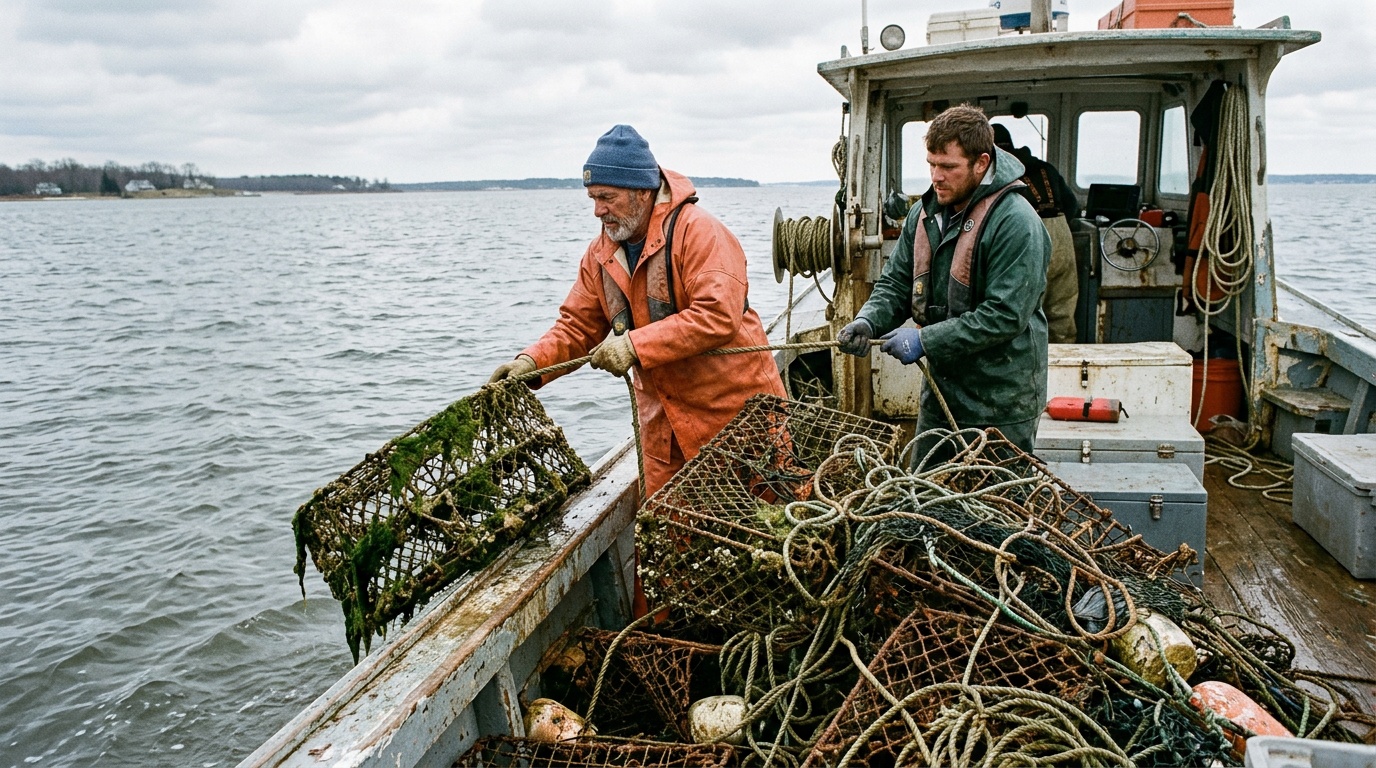
Cold weather brings a different kind of harvest to the Chesapeake Bay. Maryland and Virginia watermen leave their usual fishing grounds to recover lost and abandoned traps. Across organized projects, crews have removed thousands of derelict crab pots from Bay waters. The work protects wildlife, clears navigation hazards, and gives resource managers valuable information. It also places experienced local captains at the center of a practical restoration effort.
Most recovered gear consists of blue crab pots, the Bay’s dominant fishing trap. Watermen often call them ghost pots because they keep fishing without an operator. Storms, vessel propellers, moving ice, and cut buoy lines can separate pots from owners. Heavy currents can then drag gear beyond its original location. Some pots also remain after accidents, illness, or rushed seasonal closures.
Why Abandoned Pots Keep Fishing
Understanding the threat begins with the way a crab pot works. A standard commercial pot uses vinyl-coated wire, bait chambers, and funnel-shaped entrances. Crabs enter through those funnels but struggle to find the narrow route outward. When nobody tends the pot, captured animals may die and become fresh bait. That cycle can attract more crabs, fish, eels, and other bottom-dwelling animals. Corrosion eventually opens many pots, although sturdy materials can delay that escape.
Ghost gear does more than waste a potential commercial catch. It kills marketable blue crabs before watermen can harvest them legally. It can also trap undersized crabs that support future seasons. Oyster toadfish, Atlantic croaker, spot, American eels, and other species sometimes enter unattended pots. Diamondback terrapins face particular danger where pots sit in shallow brackish habitat. Lost lines and floats may also snag propellers or interfere with active fishing gear.
Finding Hidden Gear Underwater
Because surface searches miss most targets, crews combine careful planning with underwater technology. Many lost pots have no buoy, and muddy water hides them completely. Project teams identify likely fishing areas, historical hotspots, and reported loss locations. They may divide those waters into survey grids for consistent coverage. State agencies issue special permissions because ordinary rules restrict taking another fisher’s gear.
Crews often tow side-scan sonar behind small workboats to search the bottom. The instrument sends sound outward and displays hard objects with their acoustic shadows. Experienced operators distinguish likely pots from rocks, debris, pilings, and natural features. They record promising coordinates and return along a planned retrieval route. Sonar cannot classify every target perfectly, so crews still confirm each object directly.
Skill on the Water
After sonar marks a target, technology gives way to demanding deck work. Watermen maneuver carefully and drag grappling hooks across the suspected location. They feel for resistance, retrieve the line, and lift heavy gear over the rail. Pots may arrive packed with sediment, shell, vegetation, or living animals. Crews sort the contents, release viable wildlife, and document dead organisms. They also record pot condition, location, ownership markings, and other requested details.
Winter conditions make those tasks physically demanding. Cold spray freezes on decks, while short daylight limits survey time. Hooks and wire create injury risks aboard a rolling boat. Local captains understand tides, shoals, weather shifts, and safe approaches to working grounds. Their practical knowledge makes retrieval faster and helps researchers interpret sonar images.
Maryland Watermen Target Local Hotspots
Although crews use similar methods, Maryland shapes projects around local waters, fishing seasons, available grants, and management priorities. Cleanup work usually occurs during periods when normal crabbing activity has stopped. That timing reduces conflicts with legal gear and limits disruption for active watermen. The Maryland Department of Natural Resources works with watermen, nonprofits, researchers, and funding partners. Together, those efforts have removed thousands of abandoned traps from Maryland waters and tributaries.
Maryland’s shoreline creates a complicated search area. Tributaries, coves, river mouths, and main-stem fishing grounds each present different bottom conditions. Teams may target areas with heavy historical pot use or frequent gear conflicts. Retrieved metal commonly goes to recycling or approved disposal facilities rather than returning overboard. Usable identification tags can help managers determine where gear originated and how it moved.
Virginia Builds a Large Removal Program
Farther south, Virginia established one of the Bay’s best-documented large-scale removal efforts after severe blue crab declines. Federal fishery disaster funding supported the program, while state managers and scientists coordinated operations. The Virginia Marine Resources Commission worked with the Virginia Institute of Marine Science and commercial watermen. Between 2008 and 2014, the effort recovered more than 30,000 derelict pots from Virginia waters. Program reports also documented tens of thousands of animals inside recovered gear.
The Virginia initiative hired watermen during the winter closure, when ordinary pot fishing paused. That approach supplied seasonal income while using vessels and skills already suited for the job. Scientists paired retrieval records with spatial analysis to estimate where losses concentrated. Their findings linked many pots with navigational channels and areas of intense fishing activity. Those patterns helped managers consider targeted cleanup zones instead of searching randomly.
What Recovered Gear Teaches Managers
Beyond immediate removal, every lifted pot provides evidence about the Bay’s hidden debris. Location data reveal clusters near channel edges, busy grounds, and places with strong currents. Condition records show whether corrosion, broken lines, vessel strikes, or burial likely influenced loss. Catch observations identify species exposed to ghost fishing and the condition of trapped animals. Managers can compare those records across seasons, projects, and habitat types.
The results also show that removal offers benefits beyond counting recovered pots. Fewer ghost traps can reduce avoidable mortality and return usable space to active fisheries. Cleared gear can lower entanglement risks for boats, anchors, research equipment, and fishing lines. Recycling recovered steel keeps bulky debris from shorelines and landfills whenever facilities accept it. Most importantly, cleanup connects restoration spending with local experience and measurable field results.
Preventing the Next Generation of Ghost Pots
Those findings guide cleanup, while prevention can reduce future gear losses. Clear markings help agencies identify owners and return recently lost equipment. Strong buoy lines, proper line lengths, and routine inspections reduce avoidable separation. Watermen can also avoid setting pots where vessel traffic regularly crosses buoy lines. Accurate loss reporting gives cleanup teams better starting points for later surveys.
Modern escape features add another layer of protection. Cull rings allow smaller crabs and some fish to leave working pots. Biodegradable panels or fasteners can create larger openings after unattended gear spends time underwater. Regulations differ by jurisdiction, so harvesters must follow current Maryland or Virginia requirements. Designers still balance normal fishing durability against reliable escape after a pot becomes lost.
Cleanup programs cannot recover every missing trap across the Chesapeake Bay’s vast bottom. However, each retrieval prevents more uncontrolled fishing and removes another piece of hazardous debris. Continued cooperation can improve surveys, strengthen prevention, and direct limited funding toward high-risk locations. Together, prevention and watermen-led removal protect the Bay while supporting the people who know it best.
