

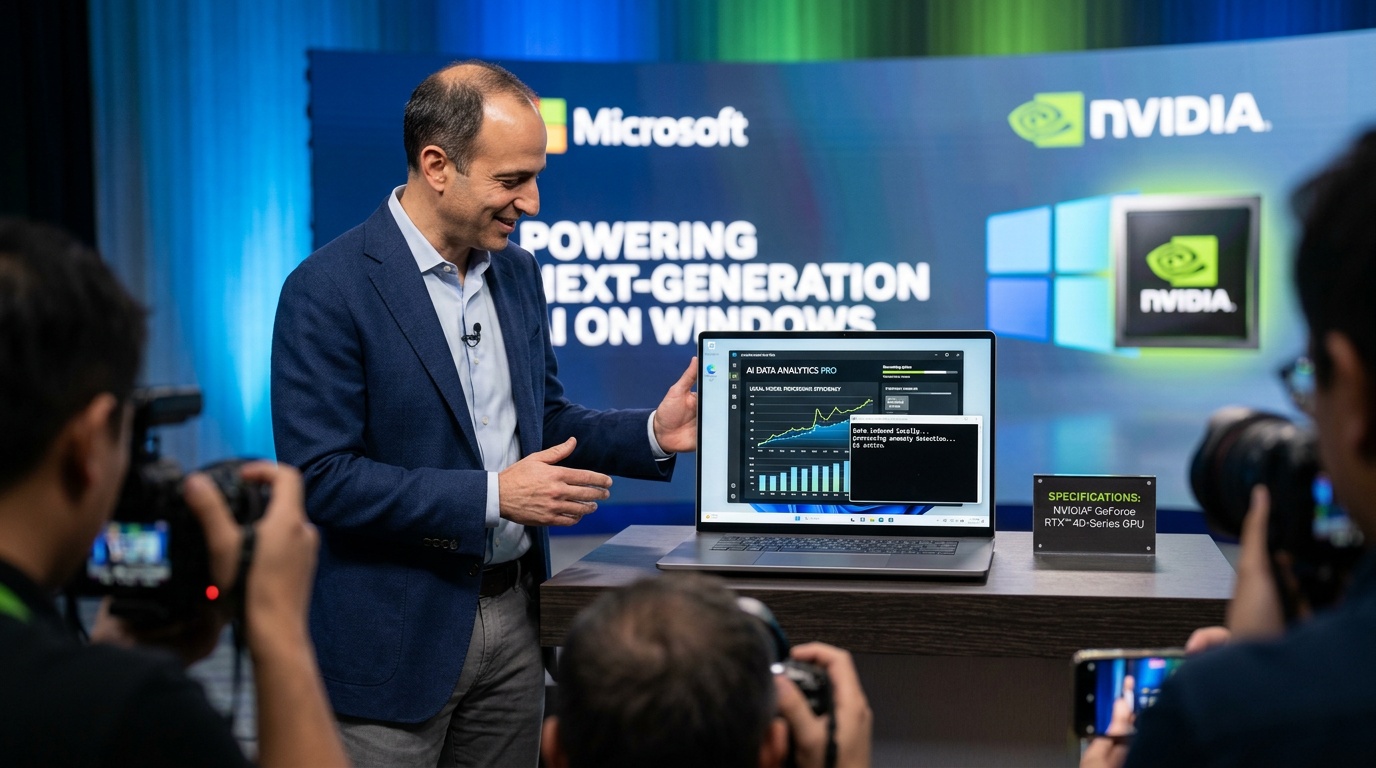
Microsoft has unveiled a new wave of Windows laptops using Nvidia hardware for demanding artificial intelligence workloads. The machines target developers, creators, researchers, and businesses that want to process AI tasks locally. This approach reduces dependence on cloud services while expanding the capabilities available on portable computers.
The announcement strengthens Microsoft’s strategy for turning Windows into a flexible platform for AI development and deployment. Nvidia provides established acceleration technologies, including powerful graphics processors and specialized Tensor Cores. Microsoft contributes Windows integration, development frameworks, management features, and connections to its wider software ecosystem.
These systems will not eliminate cloud computing or traditional processors. Instead, they provide another computing layer for workloads requiring fast parallel processing. That distinction explains why Microsoft and Nvidia view local AI as a complement to cloud infrastructure.
What Microsoft’s announcement covers
The announcement covers Windows laptops designed around stronger local AI performance. Manufacturers can combine Nvidia technology with processors, memory, storage, and cooling systems suited to their customers. Exact specifications, prices, and availability will therefore vary across brands and configurations.
Microsoft supplies the operating environment that connects applications with available computing hardware. Windows can direct different tasks toward a central processor, graphics processor, or neural processing unit. Developers can select the resource that offers suitable performance, efficiency, and compatibility.
Nvidia-powered does not always mean Nvidia supplies every important processor inside each laptop. Many systems pair an Nvidia GPU with a processor from another chipmaker. Other designs could integrate Nvidia technology more closely, depending on each manufacturer’s engineering choices.
Why Nvidia hardware matters
Modern AI models perform huge numbers of mathematical operations when generating text, images, video, audio, or software code. Graphics processors can execute many calculations simultaneously, making them useful for these workloads. Nvidia also equips its recent GPUs with Tensor Cores designed for AI operations.
Nvidia’s CUDA software platform gives developers another reason to use its hardware. Many research tools, creative applications, and machine-learning frameworks already support CUDA acceleration. That established software base can shorten development work and simplify the movement of existing projects onto Windows laptops.
Available video memory will strongly influence each laptop’s practical capabilities. Larger models need more memory for parameters, prompts, intermediate results, and generated output. Developers often use compression and quantization techniques when a model exceeds the available memory capacity.
Local AI changes the computing model
Local processing lets applications perform some operations without sending information to an external data center. This capability can reduce network delays and support work where internet access remains unreliable. It can also lower recurring cloud costs for frequent, predictable tasks.
Privacy represents another potential advantage, although local processing does not automatically guarantee secure handling. An application can keep sensitive documents on the laptop when its design prevents external transmission. Organizations must still apply encryption, access controls, updates, and appropriate data policies.
Useful local workloads include document summarization, image generation, audio transcription, coding assistance, and semantic search. Creative applications can also accelerate effects, noise removal, background replacement, and video enhancement. These uses show why Microsoft wants Windows to support several AI engines.
GPUs and NPUs serve different needs
Neural processing units usually prioritize power efficiency during sustained, relatively lightweight AI operations. They can support features such as background effects, live captions, and continuous system assistance. Their efficient design helps manufacturers preserve battery life during routine tasks.
Discrete Nvidia GPUs generally target heavier workloads that benefit from greater parallel computing capacity. They can process larger models, complex visual projects, and demanding development tasks. However, that performance can increase power consumption, heat production, and cooling requirements.
Windows can benefit when applications divide work between the CPU, NPU, and GPU. The operating system and supporting runtimes can match tasks with suitable hardware. This hybrid approach provides flexibility that a single processing engine cannot always deliver.
Microsoft’s software layer connects the hardware
Microsoft has developed Windows AI tools that help programmers discover, optimize, and run models on compatible devices. Windows ML and ONNX Runtime support hardware-accelerated inference across several processor families. DirectML also provides a common interface for machine-learning acceleration through Windows graphics technologies.
Windows AI Foundry extends that strategy with tools for selecting models and preparing applications for local deployment. Developers can test models against available hardware before distributing their software. Microsoft aims to reduce the specialized work required for each processor configuration.
Nvidia offers additional tools, including CUDA libraries and inference software optimized for its processors. Developers can also use Windows Subsystem for Linux for workflows built around Linux tools. Together, these options make Windows more accessible for established AI development practices.
Copilot branding requires careful distinction
Microsoft uses the Copilot name across assistants, applications, cloud services, and Windows features. A laptop with an Nvidia GPU does not automatically qualify for every Copilot experience. Each feature carries its own hardware, software, regional, and account requirements.
Microsoft defines Copilot+ PCs through minimum specifications that include a capable NPU, sufficient memory, and adequate storage. A powerful discrete GPU can supplement those components without replacing every requirement. Buyers should review complete specifications instead of relying on broad AI labels.
Some Copilot features still use Microsoft’s cloud infrastructure because large models require substantial computing resources. Other functions can operate partly or entirely on the device. Microsoft will likely continue combining both approaches as hardware and models improve.
Benefits come with practical limits
Local AI laptops can deliver faster responses because data travels shorter distances. They can also continue supporting compatible tools during network outages. Businesses may gain greater control over confidential material when properly designed applications keep processing on the device.
However, portable systems face stricter thermal and electrical limits than desktop workstations or data centers. Sustained AI workloads can drain batteries quickly and activate cooling fans. Manufacturers must balance performance with weight, noise, temperature, and usable battery life.
Model size creates another constraint because advanced systems can require enormous memory and storage resources. Smaller models may perform well on focused tasks but struggle with broader instructions. Cloud systems will remain important for training and operating the largest models.
A broader market for portable AI
Microsoft’s Nvidia-focused announcement broadens a Windows AI market that already includes hardware from AMD, Intel, and Qualcomm. Competition gives computer manufacturers more design choices and gives developers access to different acceleration technologies. It may also encourage software companies to support several hardware backends.
For buyers, the most important questions will involve real applications rather than advertised performance figures. Memory capacity, cooling quality, battery endurance, and software compatibility will shape daily results. Independent testing should reveal how effectively individual models handle sustained local workloads.
Microsoft and Nvidia ultimately want portable Windows machines to become credible AI development and production platforms. The laptops bring substantial computing power closer to users and their data. Their success will depend on useful software, dependable performance, clear pricing, and responsible data handling.
